
Case study Nº 16
A $1.2B mall went to auction. The only bidder was the bank it owed
Westfield and Brookfield stopped paying a $558M mortgage on San Francisco Centre in June 2023. The public record — four appraisals, a 28-note CMBS trust, and a resale that collapsed in July 2026 — shows how a billion-dollar valuation unwinds, with a source on every number.
Ben Fan, with Darryl WengFebruary 1, 202613 min readWatch the reel
Appraised, 2016
$1.2B
Winning bid, Nov 2025
$134M
An 89% markdown in nine years.7,18,20 But the second figure is not a sale price in the ordinary sense: at the foreclosure auction the only bidder was the lender, paying with the debt it was already owed. Jump to the appraisals ↓
On 12 June 2023, Unibail-Rodamco-Westfield and Brookfield Properties stopped paying the $558 million mortgage on San Francisco Centre and began handing the building to their lender.10,11 Two and a half years later, on 12 November 2025, the loan’s bondholders took the property at a foreclosure auction on the steps of City Hall with a bid the Chronicle and SFGATE report as $134 million, the San Francisco Standard as $133 million, and the rating agency KBRA as “between $133.0 and $134.0 million.”7,19,20,21 Nobody else bid.20
That is the headline, and it is the least interesting part. The record underneath it — a 1988 mall, a 2006 expansion, a single loan sliced across two dozen notes, four appraisals and one failed resale — shows something more specific than a city’s decline. It shows what happens to a leveraged building when the income under it stops, and how long it can take for anybody to be allowed to fix it.
| The property at a glance | Number |
|---|---|
| Address | 865 Market Street, San Francisco18 |
| Opened / expanded | 1988 · $460M expansion opened 28 Sep 20061,3 |
| Size (as variously reported) | 1.2M–1.5M sq ft; loan collateral 795,000 sq ft6,19,20 |
| Mortgage, July 2016 | $558.0 million whole loan5,6 |
| Appraisal behind that loan | $1.2 billion18 |
| In-line sales, year to March 2016 | $915 per sq ft (US mall average: $471)5 |
| Payments stopped | 12 June 202310,11 |
| Appraisal, July 2025 | $195.0 million ($245 per sq ft)7 |
| Foreclosure auction, 12 Nov 2025 | $133–134M credit bid · no competing bids7,20 |
| Occupancy at foreclosure | 9% leased2,20 |
| Status | Closed since Feb 2026; back on the market since Jul 202624,25 |
Start with the building
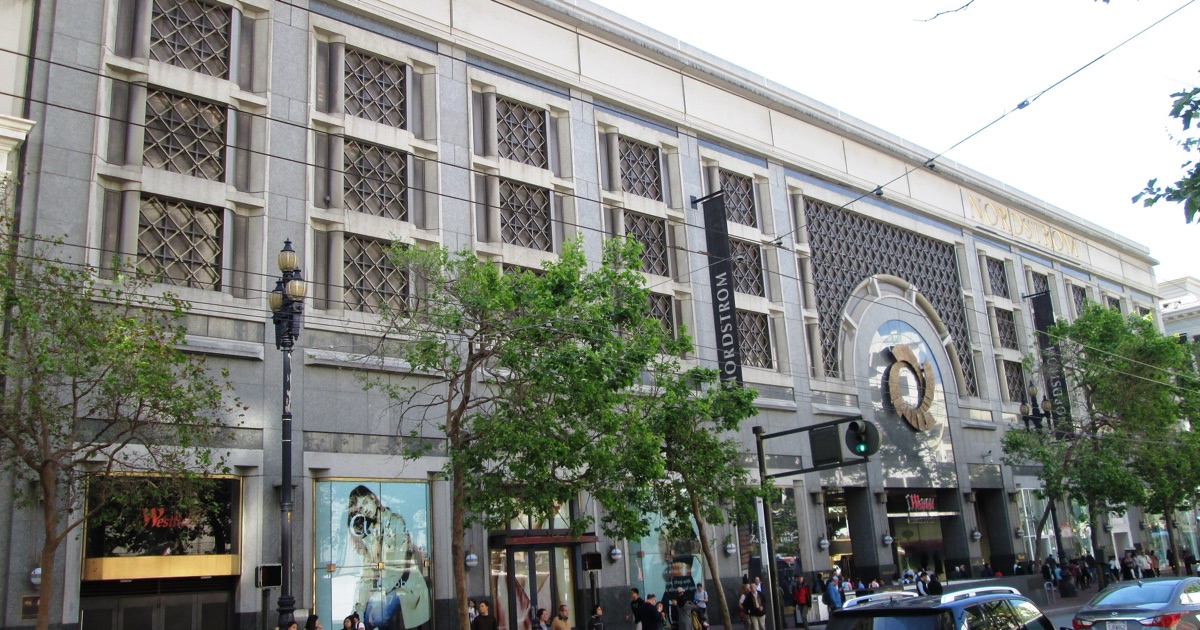
The San Francisco Shopping Centre opened in 1988 on the south side of Market Street, which at the time was considered the wrong side. “Even the week it opened,” a local planning figure told the New York Times years later, “people said it will never work on the south side of Market.”1 It worked. The developer, Sheldon Gordon,2 put Nordstrom on the top five floors rather than the bottom, so shoppers had to travel the whole building to reach it, and set the whole thing directly above BART’s Powell Street station, one of the busiest in the system.1 By 2002 the shops were selling $529 a square foot against a national mall average of $330.1
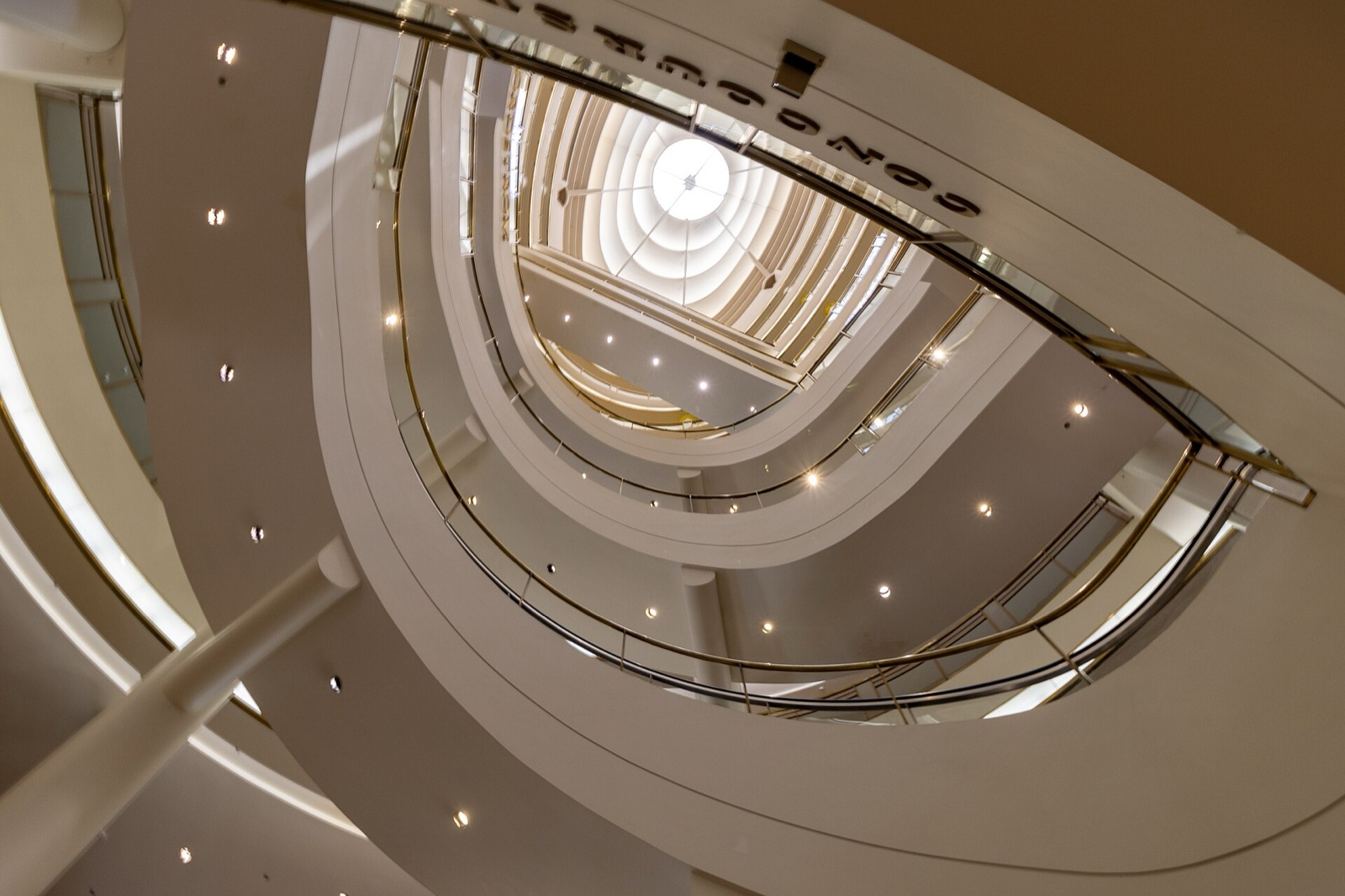
Next door stood a corpse. The Emporium, San Francisco’s first department store, designed by Albert Pissis and rebuilt after the 1906 earthquake behind its surviving colonnade, had closed in 1996; the building was shuttered in 1999.1 Westfield bought the mall in 2002 and quickly agreed a joint venture with Forest City Enterprises, which held the development rights to the Emporium. Their plan was to connect the two buildings across five floors, raise the 102-foot Emporium dome so it read on the skyline, and drop the largest Bloomingdale’s outside New York into the gutted shell.1 Under the agreement the two companies shared ownership and Westfield ran the property.1
It opened on 28 September 2006 as a $460 million expansion, a 1.5 million square foot centre employing 3,350 people, with no new parking on the theory that a mall over a subway station does not need any.3 Twelve years after that, on 31 July 2018, Brookfield agreed to buy Forest City outright for $11.4 billion.4 Brookfield had not chosen this mall; it arrived with the company.14
What the 2016 file described
A portrait of a very good mall.
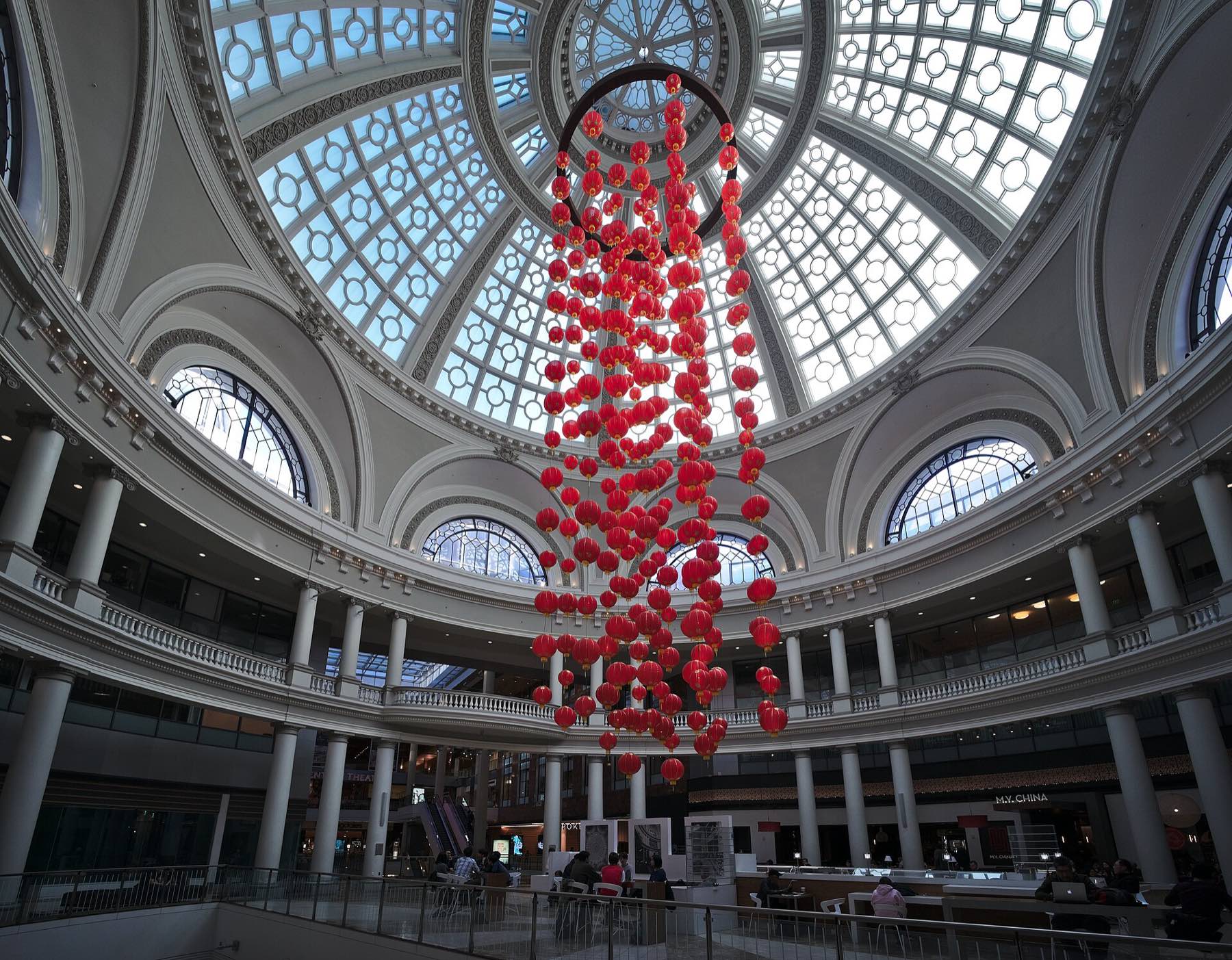
The 1908 Emporium dome, raised and restored in the 2006 expansion, photographed on 12 February 2017 with lanterns hung for the Lunar New Year — seven months after the $558 million mortgage was written against the property.Photo: Dllu, CC BY-SA 4.0, via Wikimedia Commons
The loan that priced the peak
In July 2016 Deutsche Bank and JPMorgan Chase wrote a $558.0 million first mortgage on the property and took it to the bond market.5 This is CMBS — a commercial mortgage-backed security, which means one loan is chopped into slices of different risk and sold to investors who are repaid in a strict order, safest first. The borrower gets a cheaper rate than a single bank would offer. What the borrower gives up is ever having one counterparty again.
The slicing here was unusually fine. Of the $558.0 million, a $306.9 million portion went into a single-asset trust called DBJPM 2016-SFC, made up of eight senior A notes totalling $182.0 million and four subordinate B notes totalling $124.9 million. The other sixteen senior A notes, $251.1 million between them, went into other deals entirely.6 One building, twenty-eight notes, and eventually — as the Standard put it while the sale was stalling nine years later — sellers who are “500 people who’ve never met.”27
The loan was not funding a purchase. It refinanced existing debt, some of it securitised in 2007, and to make the numbers work the borrower had to put in an extra $1.7 million of its own equity.5 That detail matters for what this brief can and cannot tell you: because the money went to retire old debt rather than to buy anything, the public record never contains a clean figure for what Westfield and Brookfield had invested in this property. There is no equity cheque to measure a loss against, which is why this study has no cash waterfall in it.
What the 2016 file does contain is a portrait of a very good mall. Sales in the smaller stores ran at $915 a square foot for the year to March 2016 — nearly double the $471 average for US malls reported by the International Council of Shopping Centers, and 26% above Westfield’s own portfolio average.5 Bloomingdale’s and Nordstrom together held 650,298 square feet.5 The property was about 96% occupied.6 The appraisal was $1.2 billion,18 against income the loan was underwritten on of roughly $57 million a year.18 That is a little over twenty times income — a 4.75% capitalisation rate, the yield a buyer accepts when it believes the rent will still be there in thirty years.
One footnote on the paperwork, because the sources disagree and both are cited here. The contemporaneous 2016 bond coverage and the Standard’s 2025 and 2026 reporting name Deutsche Bank and JPMorgan Chase as the originators;5,19,27 the lenders’ own 2023 foreclosure suit was reported as describing the loan as “first originated by Wells Fargo.”14 The trust’s name settles which pair actually wrote it.
The anchor that had been there since the doors opened
On 2 May 2023, Nordstrom confirmed it would not renew. Its chief stores officer wrote to staff that “the dynamics of the downtown San Francisco market have changed dramatically over the past several years, impacting customer foot traffic to our stores and our ability to operate successfully.”8 The mall store was 312,000 square feet and had been there since 1988; with the nearby Nordstrom Rack, the two closures took about 357,500 square feet of retail off downtown.8,10
The mall’s owner was blunter than its tenant. Unibail-Rodamco-Westfield said the closure “underscores the deteriorating situation in Downtown San Francisco,” that retailers were leaving “due to the unsafe conditions,” and that it had urged the city to address a “lack of enforcement against rampant criminal activity.”8 Those are the company’s claims, made in a statement, and the next chapter tests them against the numbers.
Nordstrom’s last day was Sunday 27 August 2023. A few dozen shoppers came; one bought a $20 bottle of hand lotion so she would have something to remember it by.12 Loan filings show the property was 47% occupied that March, and roughly 25% once Nordstrom had gone.15
The reels this brief grew from attribute that second collapse to co-tenancy clauses — lease terms letting other shops cut rent or leave when an anchor departs. Co-tenancy is real and common in mall leases. But no source reviewed for this brief reports co-tenancy clauses being invoked at San Francisco Centre, and the leases are not public, so the claim is not made here. What the record does show is plainer: an anchor gone, a landlord that had already announced it was leaving the country, and tenants free to run out their own terms.
The morning they stopped paying
On 12 June 2023, Westfield and Brookfield stopped paying.10,11 A spokesperson said: “Given the challenging operating conditions in downtown San Francisco, which have led to declines in sales, occupancy and foot traffic, we have made the difficult decision to begin the process to transfer management of the shopping center to our lender to allow them to appoint a receiver to operate the property going forward.”11 The company supplied its own numbers: mall sales of $455 million in 2019 down to $298 million in 2022, and visits down 43%, from 9.7 million to 5.6 million — against traffic across its other US malls that fell 2%.10,11 With Nordstrom gone the centre would be 55% leased, where the average Westfield mall in America was 93%.10
The mechanism that let them do it is the part worth understanding. The lenders’ remedy ran against the building. When they sued in September 2023 they named several limited liability companies associated with Westfield America, not Brookfield, and asked the court to appoint a receiver over the property and then sell it to pay down the debt.14 No reporting reviewed here shows a claim reaching either parent company’s balance sheet, and the loan documents themselves are not public. In practice the owners handed over an asset worth less than the mortgage and kept walking, which is the deal a non-recourse mortgage describes: the lender’s recovery is the building.
And the exit was not only about this building. Mayor London Breed said the move had been “coming for some time” and pointed at strategy: Unibail-Rodamco-Westfield had already told investors it planned a “radical reduction of our financial exposure to the U.S. over the course of 2022 and 2023.”11 It had sold Westfield Santa Anita for $537.5 million the year before.11 A company that has decided to leave a country does not spend to defend its weakest asset there.
The account, and the record
Three months after the handback, a tenant sued the people who had left. AE Retail West, the American Eagle subsidiary that ran a store at 865 Market Street, alleged more than 100 “significant security incidents” at that one shop in the year to May 2023, including staff threatened with a machete, and accused the owners of letting a “slow decline in performance” become “full neglect” that turned the mall into a “lightning rod” for crime. The complaint says the owners looked at increasing security and “ultimately decided not to make that investment.”13 Westfield said it had not yet seen the lawsuit and declined to comment.13 Those are allegations in a filing, not findings.
The lenders’ own suit says something in the same direction and is not an adversary with a lease to protect: the borrower had stopped paying to maintain or secure the property on 12 September 2023, which “severely and immediately” threatened its integrity and value.14
As for the crime the owner named, the Chronicle tested it against the data the week Nordstrom announced. Some of it holds: San Francisco recorded 304 shoplifting reports per 100,000 residents in 2021, up 14.7% on 2019 and roughly double 2020, against a California rate of 163.9 Some of it does not. Annual 911 calls at Fifth and Market — the corner the mall sits on — fell from 3,951 in 2019 to 897 in 2022.9 Larceny reports in the police district containing the mall rose sharply through the pandemic, to 1,800 in 2022 from 1,088 in 2020, and were still well below the 2,535 recorded in 2019.9 A criminologist at the Public Policy Institute of California told the paper San Francisco does stand out on shoplifting, and also that the data is incomplete because so much goes unreported.9 Both things are true, and the second set of numbers mostly measures the same thing the landlord was complaining about: fewer people.
Three appraisals down
A billion dollars did not evaporate in twenty-four months. It took nine years, and the last mark is 4% of the first.
What the building is worth
$53.0 million
Mar 2026 · KBRA's own valuation7
96% below $1.2 billion
$67 a square foot — 40% of what the trust itself bid four months earlier, and about 4% of the 2016 appraisal.
- Jul 2016$1.2 billion
- Reported Jan 2024$290 million
- Jul 2025$195.0 million
- 12 Nov 2025$133–134M
- Mar 2026$53.0 million
- against$558.0M
The 2016 whole loan, drawn as the line the value fell past. Everything after the second mark is the lenders arguing about how much of their own principal is left.
Every figure here is a mark, not a trade. No loss has been realised, because the lenders hold a building rather than cash — and KBRA expects significant principal losses whenever it is finally sold.
| When | Mark | Value |
|---|---|---|
| Jul 2016 | Appraisal supporting the $558M loan | $1.2 billion |
| Reported Jan 2024 | Special servicer commentary, via Morningstar | $290 million |
| Jul 2025 | The servicer's updated appraisal | $195.0 million |
| 12 Nov 2025 | Foreclosure credit bid, on the steps of City Hall — Not a valuation and not a sale in the ordinary sense: the lenders bid the debt they were already owed, and nobody bid against them. The Chronicle and SFGATE report $134 million, the Standard $133 million, and KBRA "between $133.0 and $134.0 million" — so the bar is drawn at the middle of a range the sources do not close. | $133–134M |
| Mar 2026 | KBRA's own valuation | $53.0 million |
| — | The 2016 whole loan, drawn as the line the value fell past. Everything after the second mark is the lenders arguing about how much of their own principal is left. | $558.0M |
Mar 2026, KBRA's own valuation, $53.0 million.
Three appraisals down
The reels say the bank lost more than $400 million of principal. Set $558.0 million of original principal against a $133–134 million credit bid and the gap is about $424 million before advances, unpaid interest and fees; The Real Deal put total exposure at $626 million by September 2025.7,18 But no loss of any size has been realised, because the lenders now own the building rather than cash, and the number is not final: KBRA values the asset at $53.0 million — 40% of what the trust bid for it — and expects “significant principal losses” when it is finally sold.7 The eventual loss may be larger than $400 million. It is not yet a number anyone can print as fact.
- Jul 2016$1.2 billion
- Reported Jan 2024$290 million
- Jul 2025$195.0 million
- 12 Nov 2025$133–134M
- Mar 2026$53.0 million
- against$558.0M
The 2016 whole loan, drawn as the line the value fell past. Everything after the second mark is the lenders arguing about how much of their own principal is left.
Every figure here is a mark, not a trade. No loss has been realised, because the lenders hold a building rather than cash — and KBRA expects significant principal losses whenever it is finally sold.
An auction with one bidder
A notice of trustee’s sale was recorded in October 2024.18 The auction was then postponed again and again for more than a year, not because no date could be found but because the bondholders could not agree.18,27
It finally ran on 12 November 2025 on the steps of City Hall, lasted more than an hour, involved twelve witnesses, and was conducted in two parts, because the San Francisco Unified School District owns a 75,675 square foot parcel under the section where Nordstrom used to be.19 The winning bid was a credit bid: the lenders did not pay cash, they bid the debt they were already owed.19 No one bid against them.20
Who exactly took title is reported two ways, and both belong here. The Chronicle and SFGATE name lenders Goldman Sachs and JPMorgan Chase as having foreclosed and bid $134 million, and The Real Deal follows them.20,21,26 The Standard reports that the group of investors controlling the loan took the property through an affiliate, and appended an editor’s note clarifying that Deutsche Bank and JPMorgan Chase, who originated the loan in 2016, “were not involved in the foreclosure.”19 Both descriptions point at the same fact: the building went to the people holding its debt.
Within days CBRE was hired to sell it again, in two parts to match the ownership split, and pitched not as a mall but as a site — “transform the existing structure or pursue a new mixed-use vision within the existing 400-foot height limit.”2,20 The property was 9% leased.2,20
Then the lights went out
Nine days after the auction, workers in the surviving shops began receiving notices to close. One was told 31 December; another, 26 January.22 Emptying the building was a deliberate act rather than a further decay: with almost no profitable tenants left, clearing it cut the daily cost of running it and handed the next buyer a clean slate with nobody to negotiate around.22
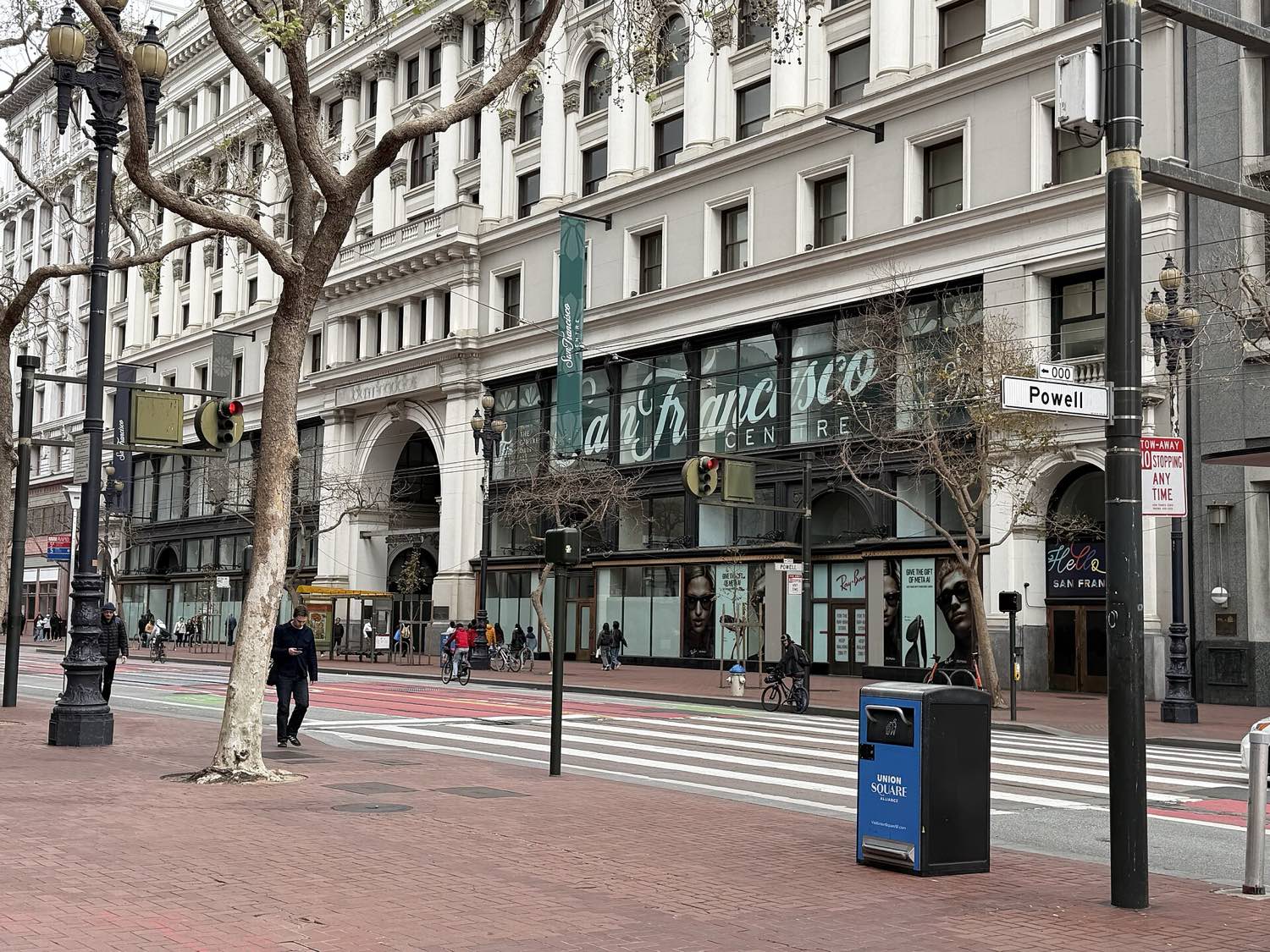
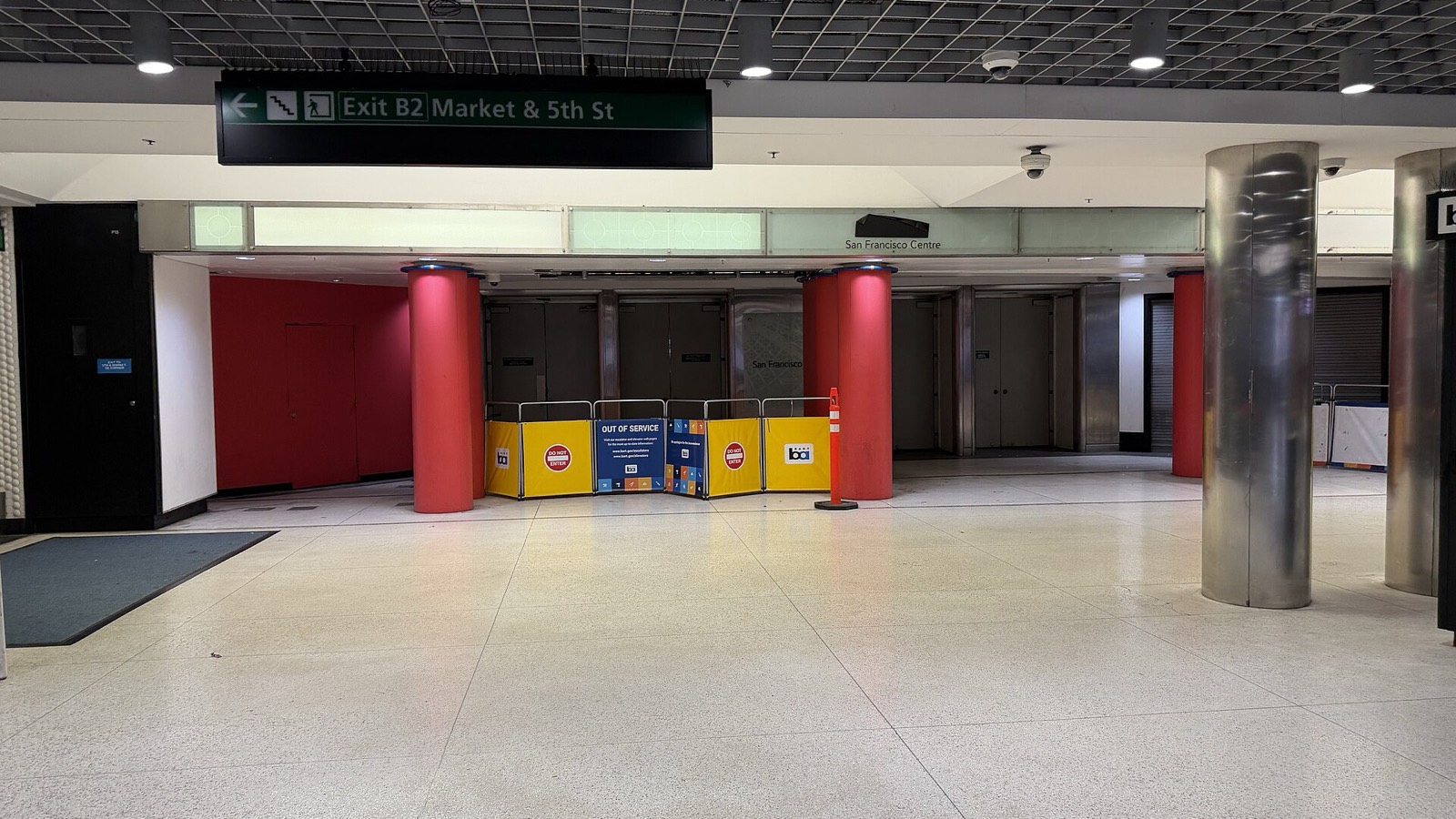
The last store, a shoe shop, traded its final Sunday and the mall closed for good on Monday 26 January 2026.23 BART locked the entrance connecting Powell Street station directly into the building, which had been partly closed since 2023.23 KBRA recorded the asset as 100% vacant as of January 2026; the Chronicle and the Standard date the shuttering of the building itself to February.7,24,25 Since the handback the property had lost more than 95% of its tenants, including both department stores, the cinema and a spa.19
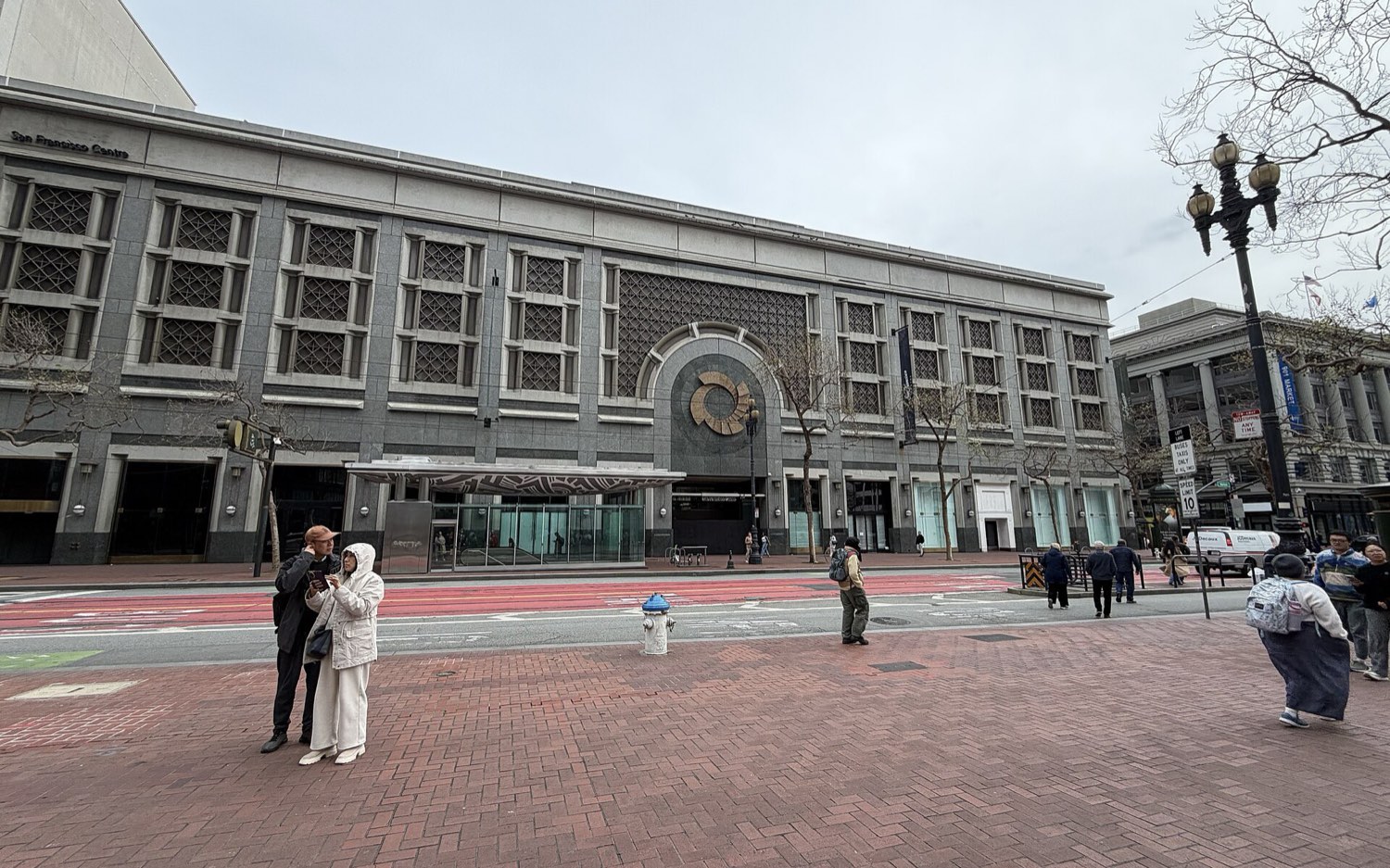
Who sells a building that hundreds of people own
CBRE ran a bidding process. At least four San Francisco developers looked — TMG Partners, Prado Group, Presidio Bay Ventures and the San Francisco Recovery Fund — with the sellers expected to seek at least $100 million and the servicer telling bondholders a closing was likely in the second or third quarter of 2026.7 In March 2026 Presidio Bay and Prado Group were selected, proposing to convert one of the empty department stores to offices and the fifth-floor cinema into a concert and events space, keeping a large amount of retail.24
On 8 July 2026 they walked. “After extensive diligence and thoughtful evaluation, we are not currently moving forward with the transaction,” the two firms said, adding that they remain “strong believers in the long-term future of downtown San Francisco.”25,26 Why is genuinely unresolved. One source told the Chronicle the deal died partly over the school district’s ground lease; another pushed back on that and said the buyers had struggled to fund a “high-risk” investment.25 Neither the price agreed nor the lease terms requested have been disclosed.25
The Standard’s reporting four days later argues the obstacle is structural rather than civic. The school district leased its parcel for commercial development in the 1980s on a contract running to 2043 with a renewal option, worth about $3.2 million a year to a budget that is being cut, and adjusting every five years.19,25,27 It is one counterparty with one interest. The sellers are not: they are a trust whose control passes down the stack of bondholders as each class is written to zero, so the party legally able to negotiate can change mid-negotiation, and the special servicer — Midland Loan Services — earns fees for as long as the process runs.27 The same structure that made the 2016 loan cheap is what makes the 2026 sale slow.
The city’s position has been consistent and, so far, non-financial. Mayor Daniel Lurie called the foreclosure “a critical step towards an exciting new chapter for this site and for Market Street,” tying it to “safe, clean streets and an activated Market Street.”20 His predecessor floated a soccer stadium.20 Neither administration has proposed buying it.
The city around it
The context is not a city that failed to recover. San Francisco office demand reached 8 million square feet at the end of 2025, an all-time high, on the back of artificial intelligence leasing, and CBRE put overall office vacancy at 29.2% in the second quarter of 2026 — very high, and falling.28,29 What has not come back is the thing a mall actually sells. Weekday daytime foot traffic in the central business district remains barely half of 2019, according to Downtown San Francisco Partnership data drawn from mobile phone movement, even as evening and weekend visits have overtaken pre-pandemic levels.29
A building that was underwritten on office workers walking downstairs at lunchtime cannot be rescued by a leasing market for offices. That is the whole difference between the city’s recovery and this asset’s.
The sequence
1988
San Francisco Shopping Centre opens — a vertical mall developed by Sheldon Gordon, with Nordstrom on its top five floors and BART’s Powell Street station underneath.1,2
2002
Westfield buys the mall and within months agrees a joint venture with Forest City, owner of the derelict Emporium building next door.1
28 Sep 2006
The $460M expansion opens: the two buildings joined, the 1908 Emporium dome restored, and the largest Bloomingdale’s outside New York.3
$460M expansion
Jul 2016
A $558.0M mortgage from Deutsche Bank and JPMorgan refinances the older debt and is sliced into bonds. The appraisal behind it: $1.2 billion.5,18
$558.0M loan · $1.2B appraisal
31 Jul 2018
Brookfield agrees to buy Forest City for $11.4B, inheriting the Forest City half of the mall partnership.4,14
2 May 2023
Nordstrom says it will not renew — 312,000 sq ft, an anchor since the doors opened. Westfield blames the city for “rampant criminal activity”.8,10
12 Jun 2023
Unibail-Rodamco-Westfield and Brookfield stop paying the loan and begin handing the property to the lender.10,11
Payments stop
27 Aug 2023
Nordstrom’s last day. Occupancy falls from 47% in March to about 25%.12,15
29 Sep 2023
Lenders sue to foreclose and appoint a receiver, saying the borrower stopped paying to maintain and secure the building on 12 September.14
Oct 2023
Trident Pacific is appointed receiver with a mandate to preserve the building and its cash flow — nothing more.16,19
Dec 2023
A fresh appraisal puts the property at $290 million, reported in January 2024. The Chronicle later dates the same figure to the end of 2022.15,16,20
$290M appraisal
Oct 2024
A notice of trustee’s sale is recorded. The auction is then delayed repeatedly for more than a year while bondholders argue.18,27
Jan–Mar 2025
Bloomingdale’s, the last anchor, announces its exit and closes — on a lease that ran to 2046.17,18
Mar 2025
The servicer declares the loan non-recoverable. Rated bondholders stop receiving interest the following month.7
Jul 2025
The servicer’s updated appraisal: $195.0 million, or $245 per square foot. The mall is 7% occupied and losing about $4.6M in the half-year.7,18
$195.0M appraisal
12 Nov 2025
Foreclosure auction on the steps of City Hall. The lenders credit-bid; no one else bids. CBRE is hired to sell the building on.7,19,20
$133–134M credit bid
26 Jan 2026
The last store closes. BART seals the entrance from Powell Street station, and the building is shuttered the following month.23,24
Mar–Jul 2026
Presidio Bay and Prado Group win the bidding, then walk away after months of diligence. The property returns to the market.24,25,26
The ledger, opened
Most case studies on this site end by adding up the cash. This one cannot, and saying so precisely is more useful than a chart that pretends otherwise.
Here is what is known. The mortgage was $558.0 million and the appraisal supporting it was $1.2 billion.5,18 Payments stopped on 12 June 2023.10,11 The servicer has advanced money and written the loan down in stages that are public: $201.9 million of appraisal reduction and $31.7 million of advances by February 2025, $268.5 million and $19.6 million of cumulative interest shortfalls by February 2026, with the loan declared non-recoverable in between.6,7 The building changed hands at $133–134 million in debt, not cash.7,19,20
Here is what is not. Neither Unibail-Rodamco-Westfield nor Brookfield has published what it held in this property, and because the 2016 loan refinanced older debt rather than funding a purchase, no acquisition price for the joint venture appears anywhere in the record read for this brief. The $1.7 million of fresh equity at the 2016 refinancing is the only equity figure in any source here.5 Nine years of net rent, and whatever the partners took out along the way, were never disclosed. So the honest sentence is: the lenders’ exposure is measurable and the owners’ loss is not.
The one number that behaves like a verdict is KBRA’s. In March 2026 the agency valued the asset at $53.0 million, or $67 a square foot — 40% of what the trust itself bid for it four months earlier, and about 4% of the 2016 appraisal.7 A rating agency has no incentive to be dramatic. That figure is what a building becomes when the income under it is zero and the exit is a redevelopment somebody else has to finance.
What transfers
Leverage is a ratchet on both sides. The 2016 loan was a comfortable 46% of the appraised value, which is a conservative-looking number until the value moves. Income of roughly $57 million supported a $1.2 billion mark; when the income went, the whole equity layer went with it, and then part of the debt. Ask what a loan-to-value ratio becomes if the income halves — not whether today’s ratio is comfortable.
An anchor tenant is infrastructure, not a tenant. Nordstrom occupied the top five floors of a building designed to route every shopper past everything else on the way up. Losing it did not remove 312,000 square feet of rent; it removed the reason to enter. Occupancy went from 47% to 25% in one season.12,15 When you underwrite a multi-tenant property, work out which tenant is the reason the others are there.
Handing back the keys is fast; getting the building fixed is not. From default in June 2023 to a foreclosure sale took twenty-nine months, and the sale that followed collapsed eight months after that. The delay was not the city’s doing. It was the ownership structure: a loan sliced across twenty-eight notes has no single owner able to say yes.6,27 Cheap debt at origination is expensive to unwind in distress, and the cost is measured in years of a dead block.
A sale price is only a market price if somebody had to compete for it. The $134 million that travelled around the internet as this mall’s value was a credit bid by its own lender at an auction where nobody else bid.19,20 It is a floor set by the party holding the debt, not a valuation. The next figure — whatever a buyer eventually pays — will be the first real one since 2016.
Common questions
- Why did Westfield give back the San Francisco Centre mall?
- Unibail-Rodamco-Westfield and Brookfield Properties stopped paying the $558 million mortgage on 12 June 2023 and began transferring the property to their lender. The company blamed conditions downtown, citing mall sales that fell from $455 million in 2019 to $298 million in 2022 and visits down 43%. It had also already told investors it planned a “radical reduction” of its US exposure across 2022 and 2023, and had sold Westfield Santa Anita the previous year.
- Did the mall really sell for $134 million?
- Not in the ordinary sense. At the foreclosure auction on 12 November 2025 the lenders themselves took the property with a credit bid — paying with the debt they were already owed, not cash — and no one bid against them. Reports put the figure at $133 million (San Francisco Standard) or $134 million (Chronicle and SFGATE); KBRA describes it as between $133.0 and $134.0 million. A subsequent sale to two San Francisco developers was agreed in March 2026 and collapsed in July 2026.
- How much did the mall lose in value?
- The appraisal behind the 2016 loan was $1.2 billion. A later appraisal put it at $290 million, dated December by SFGATE and The Real Deal and end-2022 by the Chronicle. The servicer’s updated appraisal as of July 2025 was $195.0 million, or $245 a square foot. In March 2026 KBRA valued the asset at $53.0 million, about 4% of the 2016 figure.
- How much did the lenders lose?
- No loss has been realised, because the lenders now own the building rather than cash. What is public: the trust recognised a $268.5 million appraisal reduction and $19.6 million of cumulative interest shortfalls by February 2026, the loan was declared non-recoverable in March 2025, and $558 million of principal was met by a $133–134 million credit bid. KBRA expects “significant principal losses” when the property is finally sold.
- Who owns San Francisco Centre now, and what happens to it?
- The trust that holds the 2016 CMBS loan, acting through an affiliate; the Chronicle and SFGATE identify the foreclosing lenders as Goldman Sachs and JPMorgan Chase. CBRE has been marketing it as a repositioning or redevelopment site within the existing 400-foot height limit. A sale to Presidio Bay Ventures and Prado Group fell through in July 2026, partly over a San Francisco Unified School District ground lease that runs to 2043 on land beneath part of the mall. The building has been closed since February 2026.
Sources
- The New York Times — Commercial Real Estate; San Francisco Emporium to Get New Life as Mall (2003-05-21)
- CBRE (company release) — CBRE to Market Landmark San Francisco Centre & Emporium (2025-11-12)
- San Francisco Chronicle via SFGATE — Westfield San Francisco Centre — long-awaited grand opening draws huge crowds downtown (2006-09-29)
- Brookfield (company release) — Brookfield and Forest City Announce Acquisition Agreement (2018-07-31)
- Asset Securitization Report — Deutsche Bank, JPMorgan Shopping a $300M Mall CMBS (2016-07-19)
- KBRA — KBRA Downgrades Three Ratings and Affirms Two Ratings for DBJPM 2016-SFC (2025-03-05)
- KBRA — KBRA Affirms All Ratings for DBJPM 2016-SFC (2026-03-05)
- The San Francisco Standard — Nordstrom to shutter both downtown San Francisco stores, citing difficult conditions (2023-05-02)
- San Francisco Chronicle — Westfield mall blamed ‘rampant criminal activity’ for Nordstrom closing in S.F. Here’s what the data says (2023-05-04)
- The Real Deal — Westfield and Brookfield to surrender San Francisco Centre mall (2023-06-13)
- Los Angeles Times — San Francisco is dealt another blow as Westfield walks away from downtown mall (2023-06-12)
- The San Francisco Standard — Inside the downtown San Francisco Nordstrom on its last day (2023-08-27)
- The Real Deal — Retail tenant sues Westfield, Brookfield for “full neglect” of SF mall (2023-09-13)
- The Real Deal — Westfield Centre lenders file suit to put SF mall in receivership and for sale (2023-10-09)
- The Real Deal — San Francisco Centre’s value falls $1B after Brookfield, Westfield default (2024-01-12)
- SFGATE — Troubled San Francisco Centre mall loses $1 billion in value (2024-01-17)
- The San Francisco Standard — Bloomingdale’s to exit downtown San Francisco Centre mall (2025-01-21)
- The Real Deal — How low can San Francisco Centre mall go? (2025-09-15)
- The San Francisco Standard — Downtown’s dead mall seized by lenders, opening door to a revival (2025-11-12)
- San Francisco Chronicle — S.F.’s struggling downtown mall has a new owner (2025-11-12)
- SFGATE — San Francisco’s most troubled mall sells for just $134 million (2025-11-12)
- The San Francisco Standard — Downtown’s dead mall is telling its last tenants to get the hell out (2025-11-21)
- ABC7 News — San Francisco Centre: The city’s largest mall will close permanently on Monday, January 26 (2026-01-22)
- The San Francisco Standard — Dead mall back on market: Buyers walk away from distressed sale of San Francisco Centre (2026-07-08)
- San Francisco Chronicle — Buyers walk away from S.F. Centre deal, sending shuttered mall back to market (2026-07-08)
- The Real Deal — Prado, Presidio Bay jump ship on deal to buy long-distressed SF Centre mall (2026-07-08)
- The San Francisco Standard — Untangling what’s actually holding up the sale of San Francisco’s dead mall (2026-07-12)
- CBRE — San Francisco Office Figures Q2 2026 (2026-Q2)
- The Real Deal — Downtown SF foot traffic still sluggish amidst return to office (2026-03-22)