
Case study Nº 14
Rick Caruso spent $160 million on The Grove — and $5 million of it on land he never bought
The famous contrarian bet was a half-sized version of a project the neighbourhood had already killed twice, built on a ground lease from the Farmers Market's owners. Here is the full cost stack from ULI's own case study, the five different sales-per-square-foot figures that have been published, and the parts of the record that are still missing.
Ben Fan, with Darryl WengJanuary 27, 202615 min readWatch the reel
Built for, 2002
$160M
Land cost in that budget
$5M
Rick Caruso did not buy the land under The Grove and still does not own it: it came on a long-term ground lease from the family that has held the Farmers Market block for a century, and the entire land line in the project budget is $5 million of ground rent.1 That is the first thing the popular telling gets wrong.
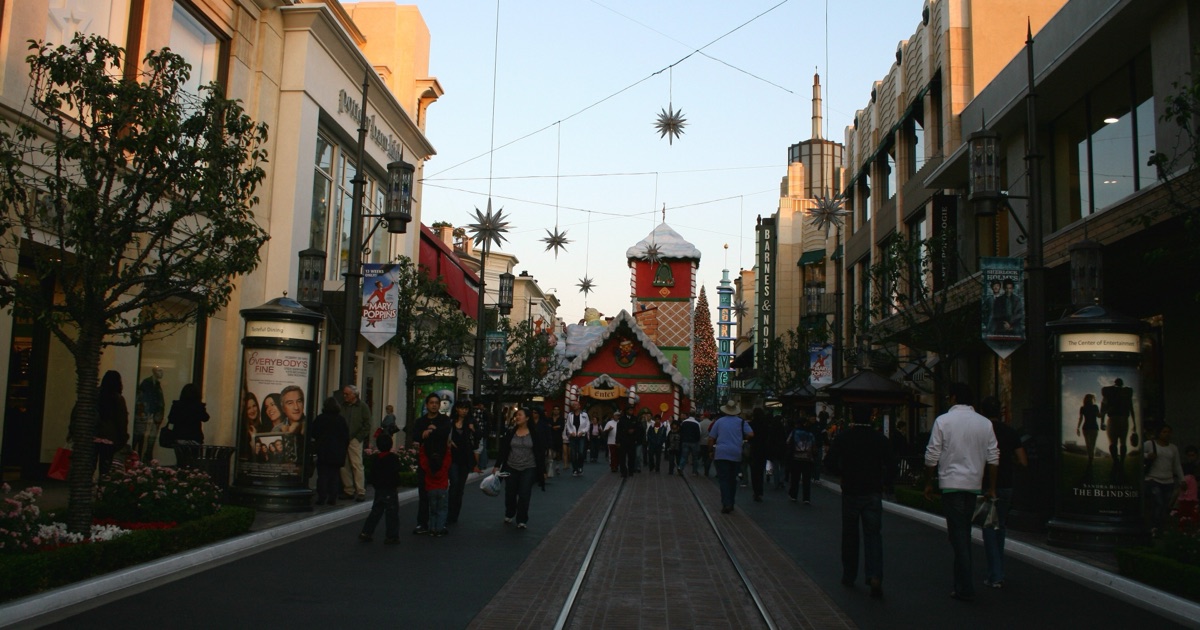
The Grove opened on 15 March 2002 at a total development cost of $160 million, on 17.5 acres beside the Original Farmers Market in Los Angeles that Rick Caruso did not buy and still does not own.1 The land came on a long-term ground lease from the A.F. Gilmore Company, the family that has held the Farmers Market block for more than a century, and the entire land cost in the project budget is a single line: $5 million of ground rent.1,2
That is the first thing the popular telling gets wrong, and it is not the biggest. The Grove is remembered as a contrarian bet against a market that wanted enclosed malls and department stores. What the record shows is a developer arriving at a site that had already been fought over for fifteen years, already entitled for more than a million square feet, and already undevelopable because nobody could get the neighbours past it.1 Caruso’s move was not to build something bolder. It was to build something roughly half the size, keep the Farmers Market intact, and get approved.
The famous number — sales per square foot — turns out to have five published versions. The Urban Land Institute recorded $605 in 2003. An International Council of Shopping Centers publication put it at $1,400 in 2012. Green Street Advisors told Forbes about $2,100 in 2016, Forbes printed $2,200 in 2018, and Caruso’s own site now claims $2,460.1,13,14,15,31 All five may be true of their own moment. None of them has ever been audited, because the company that owns The Grove is private, has never taken an outside investor, and has never published a rent roll.14
| The deal at a glance | Number |
|---|---|
| Ground lease with A.F. Gilmore Co., announced | May 19982 |
| Site | 17.5 acres — parking lots, a nursery, a bank1 |
| Opened | 15 March 20021 |
| Total development cost | $160 million1 |
| Land, as a share of that | $5 million of ground rent1 |
| Construction lenders | Bank of America, PNC, Union Bank1 |
| Permanent lender | Lehman Brothers Bank1 |
| Leasable area, 2002 → today (company) | 575,000 → ~600,000 sq ft1,31 |
| Parking | 3,500 spaces, seven levels1 |
| Sales per sq ft — 2003 / 2012 / 2018 / today | $605 / $1,400 / $2,200 / $2,4601,13,15,31 |
| Visitors a year, since 2018 | ~20 million (company and Forbes)15,26 |
| Public subsidy identified in the record | None found |
The land, and who keeps it
Start with the land, because the land is the whole trade.
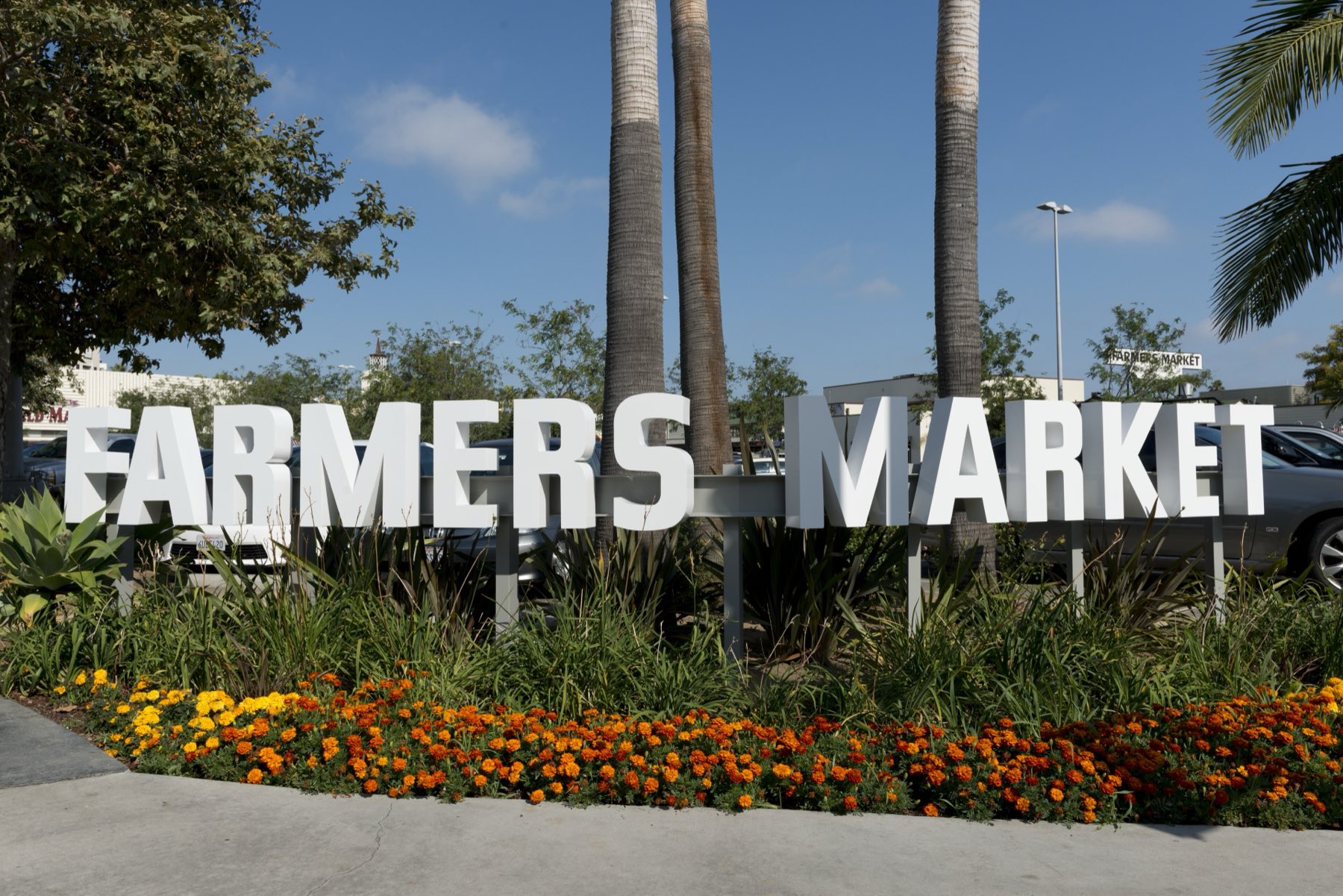
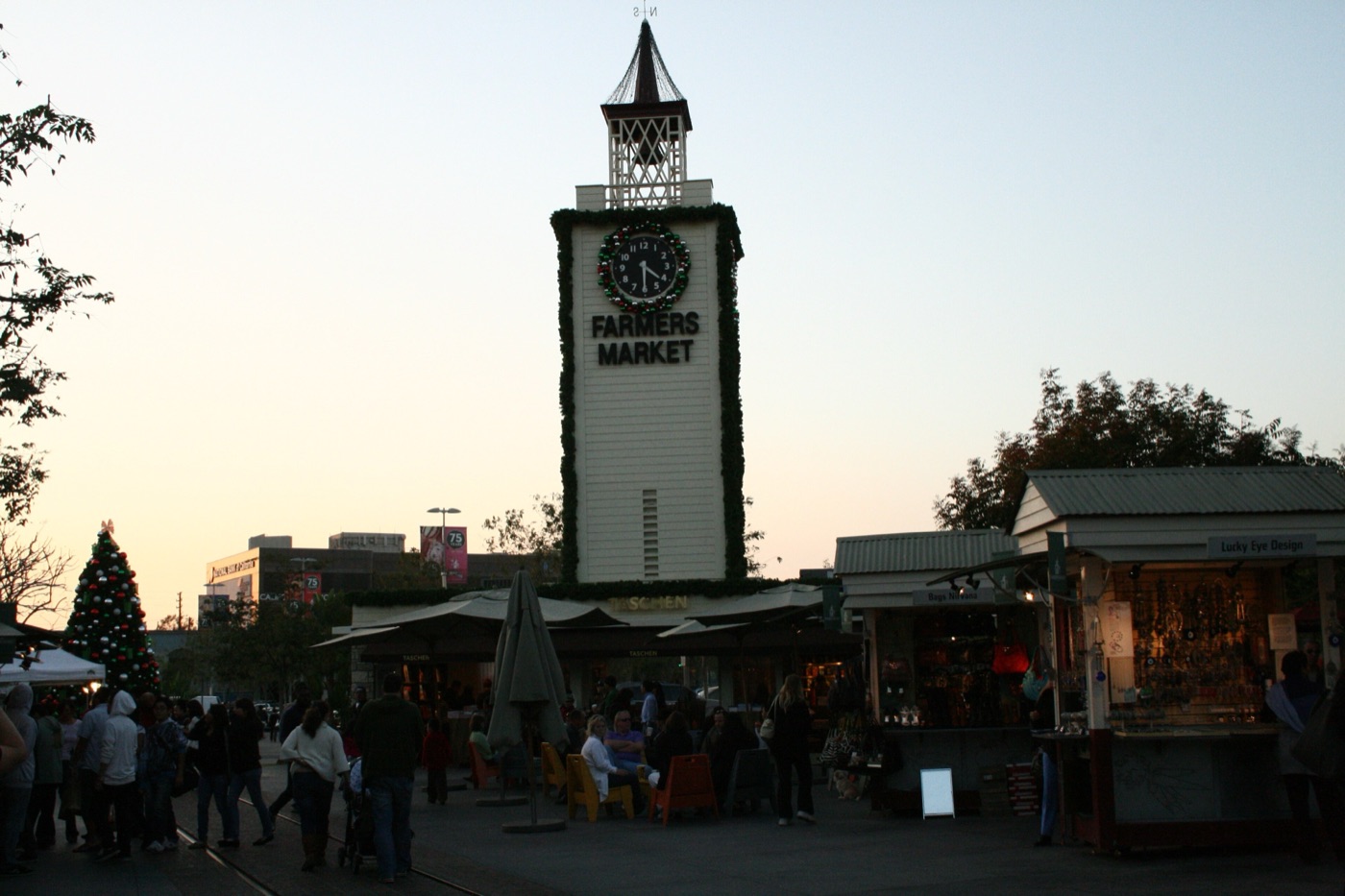
The Original Farmers Market at Third and Fairfax, photographed by Carol M. Highsmith in 2012. The A.F. Gilmore Company has held this block since the nineteenth century and still holds the freehold under The Grove next door.Carol M. Highsmith · Library of Congress · public domain
The fight was already lost before he arrived
Start with the land, because the land is the whole trade.
The A.F. Gilmore Company has owned the block at Third and Fairfax since the nineteenth century, when it was a dairy farm, and has run the Original Farmers Market on part of it since the 1930s. By the mid-1980s the family wanted to develop the rest. It teamed with a Chicago-based real estate company on a two-million-square-foot complex of offices, retail and a hotel. The neighbourhood fought it for five years. Councilman John Ferraro eventually brokered a compromise: a 700,000-square-foot shopping centre with two department stores, one of them Nordstrom. The city approved that in 1991, and then the Southern California recession killed almost all new construction and the approval sat there, unused.2
This is the condition Caruso walked into in July 1997. ULI’s own case study is blunt about what made the site hard: it had been eyed by developers for years and was entitled for more than a million square feet, “though no developer had been able to get past neighborhood opposition to such a large undertaking”.1
So he offered less. ULI lists the four terms of the bargain: a project about half the size of the existing entitlement; a promise to preserve the Farmers Market and the historic Gilmore Adobe; a neighbourhood-oriented mix of restaurants and a bookstore worked out in meetings with residents; and an outdoor setting in the spirit of the market next door.1 When the plan was unveiled in May 1998 it was 640,000 square feet at $100 million — about a third smaller than the Beverly Center a mile away.2
The opposition that everyone remembers did not really materialise this time. Jack Kyser of the Los Angeles County Economic Development Corporation predicted “very, very significant community opposition, because the whole Westside of town is very edgy about traffic”.2 A year later, Ferraro’s chief planning deputy said she had received only a few calls from opponents; Caruso had agreed to add traffic signals, widen streets and build a garage.3 Approvals came in May 2000 with unanimous support from the planning commission and the city council.1
Part of that is because the people he had to persuade already knew him, and not fondly. A decade earlier Caruso had taken over a La Cienega Boulevard property housing a rowdy nightclub called the Millionaire’s Club, and the neighbours had spent months petitioning him to end its lease. “He was insufferable at the time,” one of them, Diana Plotkin, told the Los Angeles Business Journal. Harold Hahn of the Burton Way Homeowners Association put it more directly: “We had fights. When Rick said he was going to continue renting to The Millionaire’s Club, we almost keelhauled him.” By 2002 Plotkin was president of the Beverly Wilshire Homes Association, and her verdict on the developer had inverted: “I don’t have a very high opinion of most developers in this city. But I gave Caruso a very, very good recommendation.”4
Read that sequence carefully, because the lesson in it is the opposite of the one the story usually carries. The bet was not that shoppers wanted an open-air street. The bet was that a smaller, quieter project on a pre-entitled site would clear a political process that had already destroyed two larger ones. Caruso bought the leftover approval, not the idea.
Where the $160 million went
ULI printed the budget line by line. The land is three per cent of it.
Total development cost, 1997–2002
$160,000,000
The Grove's own debt, rent roll and returnsNever published
- Construction, excluding tenant improvements1$100,000,000
- Soft costs1$35,000,000of which architecture and engineering$15,000,000of which title fees$12,000,000
- Site improvements, on and off site1$20,000,000
- Site acquisition — ground rent1$5,000,000
Never published
- The ground lease's term, escalations and expiry33Not in any source
- The Grove's own debt, rent roll and returnsNever published
Four sourced lines that sum to the sourced total, and two that have no number at all. The Grove has never carried a public loan, so it has never been independently appraised in a document anyone can read.
| Line | Amount | How it is counted |
|---|---|---|
| Construction, excluding tenant improvements | $100,000,000 | sourced, and part of the total |
| Soft costs | $35,000,000 | sourced, and part of the total |
| Site improvements, on and off site | $20,000,000 | sourced, and part of the total |
| Site acquisition — ground rent | $5,000,000 | sourced, and part of the total |
| The ground lease's term, escalations and expiry | Not in any source | never published |
| The Grove's own debt, rent roll and returns | Never published | never published |
| Total development cost, 1997–2002 | $160,000,000 | the sourced total |
Where the $160 million went
The budget is unusually well documented, because ULI printed it line by line.
Site acquisition: $5,000,000, described in the schedule simply as ground rent. Site improvements on and off site: $20,000,000. Construction: $100,000,000, excluding tenant improvements. Soft costs: $35,000,000, of which $15 million was architecture and engineering and $12 million was title fees. Total: $160,000,000.1
- Construction, excluding tenant improvements1$100,000,000
- Soft costs1$35,000,000of which architecture and engineering$15,000,000of which title fees$12,000,000
- Site improvements, on and off site1$20,000,000
- Site acquisition — ground rent1$5,000,000
Never published
- The ground lease's term, escalations and expiry33Not in any source
- The Grove's own debt, rent roll and returnsNever published
Four sourced lines that sum to the sourced total, and two that have no number at all. The Grove has never carried a public loan, so it has never been independently appraised in a document anyone can read.
The parts that were never supposed to pay
Three features get quoted as proof of Caruso’s willingness to burn money. Two are real and one is not.
The trolley is real, and it does go somewhere. A double-decker car runs down the centre of First Street at ten-minute intervals on steel wheels and in-ground rails, powered by a magnetic-induction battery system pioneered in Germany that made its American debut here.1 Its route is the quarter-mile spine of the site, and Dave Williams, Caruso’s senior vice president of architecture, gave the reason plainly: the distance is short, but “we wanted to make a real physical connection” to the Farmers Market.1 It is a link, not a ride to nowhere. What no source publishes is what it cost to build or what it costs to run, so the widely repeated claim that it consumes millions and earns nothing is not something the record can confirm either way.
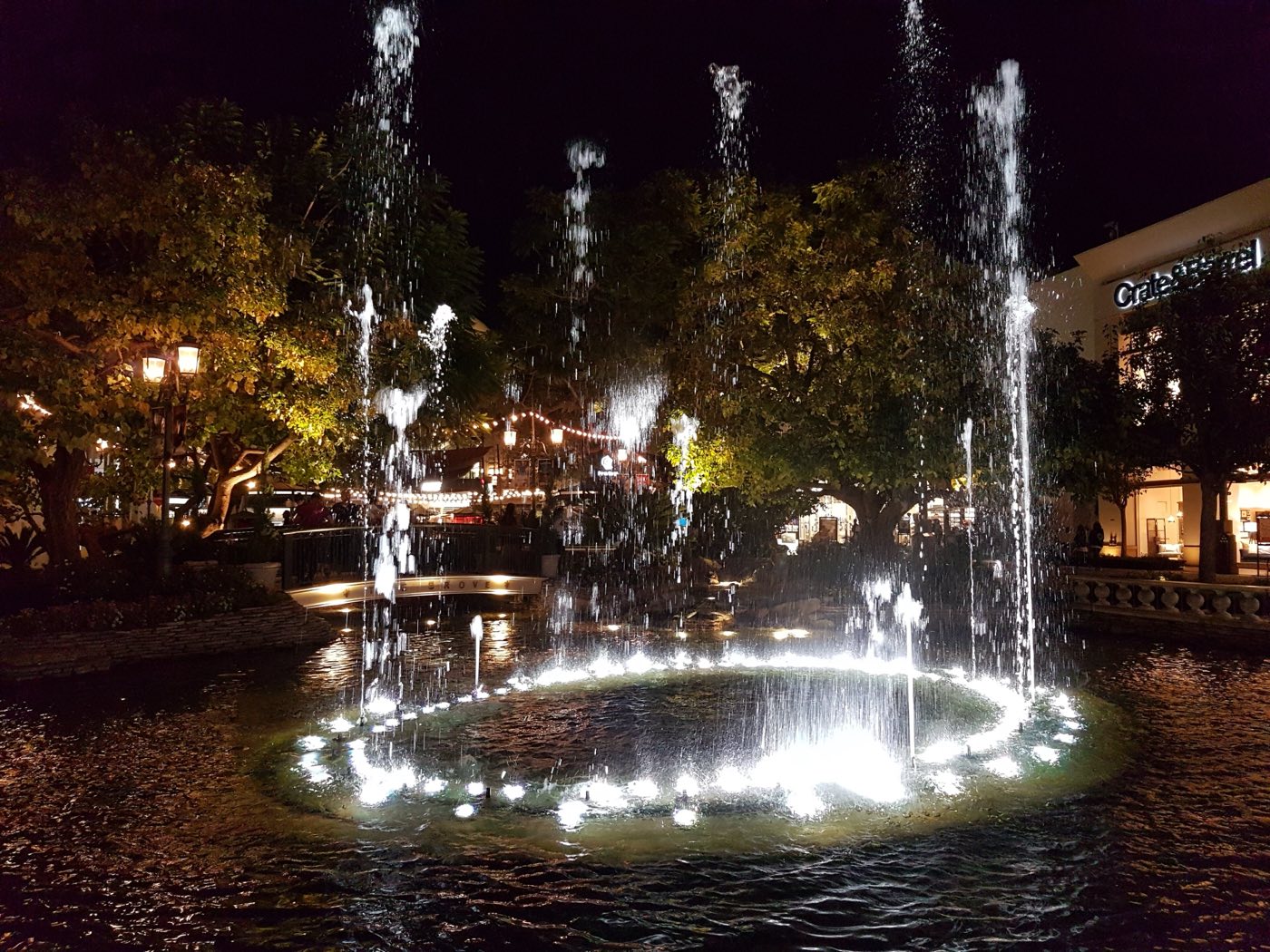
The hotel-grade service is real and specific. There is a concierge station offering store information and restaurant and theatre reservations, a valet drop-off built like a hotel roundabout, and — the detail that carries the point — every employee at The Grove, security staff included, is trained by the same firm that trains Ritz-Carlton staff.1 The parking garage claims that circulate online, marble floors and classical music, appear in no source we could obtain; ULI describes escalators from the garage descending to an outdoor lobby with an antique-styled table and a chandelier.1
The spending figure attributed to that service is a claim, not a measurement. ULI records it in Caruso’s own voice: “according to Rick Caruso, the average amount spent per visit is roughly twice the national average”.1 The conversion rate — the share of visitors who buy something — has been reported three ways: 92 per cent by ULI in 2003, 93 per cent by Forbes in 2018, and 90 per cent by the company today.1,15,31 All three are drawn from statistics the centre collects about itself.
The sequence
Mid-1980s
The Gilmore family and a Chicago partner propose two million square feet of offices, retail and a hotel around the Farmers Market. Neighbourhood opposition kills it over five years.2
1991
Councilman John Ferraro brokers a 700,000 square-foot shopping centre with two department stores. The city approves it; the recession buries it.2
Jul 1997
Caruso takes the site — 17.5 acres of surface parking, a nursery and a bank — and starts planning.1
May 1998
The Grove is unveiled: a $100 million, 640,000 square-foot open-air centre, roughly half the entitlement already on the land, with the Farmers Market and the Gilmore Adobe preserved.2
Announced at $100M
Jul 1999
Nordstrom signs for 120,000 square feet, alongside Gap, Banana Republic and Crate & Barrel. About half the centre is let.3
May–Dec 2000
Approvals obtained in May with unanimous support from the planning commission and the city council; construction starts in December.1
15 Mar 2002
The Grove opens. Total development cost $160 million, of which $5 million is ground rent — Caruso never buys the land.1
$160M in, $5M of it land
Dec 2002
Caruso sells the 14-screen cinema to its operator, Pacific Theatres, for about $30 million — roughly $2.1 million a screen.1,5
~$30M back
Feb 2004
Caruso sues General Growth Properties, owner of the Glendale Galleria, over interference with the Americana at Brand across the street.9
Nov–Dec 2007
A jury awards $74.2 million in compensatory damages, finds malice, oppression or fraud, and adds punitive damages. The judgment reaches $89.2 million.7,8,9
May 2008
The Americana at Brand opens in Glendale at a reported $400 million, four blocks of shops under 100 condominiums and 238 apartments.11
Jan 2009
General Growth settles the Caruso case for $48 million, paid out of the cash collateral posted for its own appeal, plus $5.5 million of costs.9,10
$48M in
Sep 2013
Nordstrom closes at the Glendale Galleria after 30 years and reopens across the street at the Americana, 135,000 square feet.12
May 2020
Nordstrom and Apple at The Grove are looted during protests over the killing of George Floyd; an LAPD kiosk is set on fire.16,17
Aug–Oct 2022
Activists sue over protest bans at The Grove during Caruso’s mayoral run. A judge grants an injunction; the Court of Appeal reverses it.20,21
Nov 2022
Caruso loses the mayoral race to Karen Bass after spending $104,848,887 — about eleven times what she spent.23
$104.8M out
Jul 2023
Caruso puts a $450 million CMBS loan on the Americana at 7.1%, against an $870 million appraisal, returning about $35 million to equity.24
$35M cash out
Feb 2025
The Grove and the A.F. Gilmore Company sue Los Angeles over the approval of the Television City studio expansion next door, on environmental grounds.28
Jul 2026
Television City’s lenders file a notice of default on more than $357 million. Caruso and the Gilmore family are named as possible bidders for the site.30
The number that has five versions
Here is where a good story and a good brief part company.
In the centre’s first full year, Caruso told the Los Angeles Business Journal its 41 retail stores were averaging “well above $500 a square foot”, with five units still vacant. For scale, the same article put Westfield Century City at $515 a foot and Villa Marina at $450 in 2001, on International Council of Shopping Centers data, while the newly opened Hollywood & Highland was averaging $294 on its own developer’s second-quarter numbers.5 ULI’s project data table, compiled the following year, records average annual sales of $605 a square foot and annual rents ranging from $20 to $120.1
Then the figure climbs. A 2012 ICSC publication, reported by California Apparel News in 2014, put The Grove at $1,400 a square foot and the Americana at $1,100.13 Green Street Advisors, which tracks more than 90 per cent of American malls, told Forbes in 2016 that The Grove was bringing in around $2,100.14 Forbes printed $2,200 in October 2018 and $2,460 in August 2020; the company’s own portfolio page carries $2,460 today, alongside a claim to be the second most productive shopping centre in the United States.15,19,31
- ULI project data, 20031$605
- ICSC, via California Apparel News13$1,4002012 data
- Green Street, via Forbes, 201614$2,100about
- Forbes, Oct 201815$2,200
- Caruso's own portfolio page31$2,460company claim
The reader is owed the shape of the series, not its last point — and the last point is the one the company publishes about itself.
None of that is evidence of dishonesty. A centre that opens at $605 and reaches $2,460 over two decades has simply re-tenanted upward, swapping Gap and Banana Republic for Gucci and Apple. But the reader is owed the shape of the series rather than its last point, because the last point is the one the company publishes about itself.
The comparison usually made — against a national mall average — is harder to pin down than it sounds. Green Street’s tiering, as reported by The Robin Report, puts a top-grade A++ mall as high as $1,100 a square foot, a B mall around $425 and a C mall around $250.25 No source we could obtain publishes a single national average, so the honest version of the claim is narrower and still striking: on any published figure since 2012, The Grove trades above the top of Green Street’s own top tier.
The first year was also not uniformly good, which the later telling drops entirely. In December 2002 the Business Journal reported that while the cinema, Nordstrom and the restaurants were doing well, brokers said a number of stores were not making the sales volume to justify the rents and common area charges. “For the retailers that you would find everywhere else, it’s nothing spectacular,” one said.5 Two chain restaurants were doing average or below. The Gap units were underperforming. The cinema, meanwhile, was the highest-grossing in Los Angeles County, and Caruso sold it that same month to its operator for about $30 million — roughly $2.1 million a screen, then a record.1,5
The play, run again
Six years later Caruso ran the play again, across the street from someone who could afford to object.
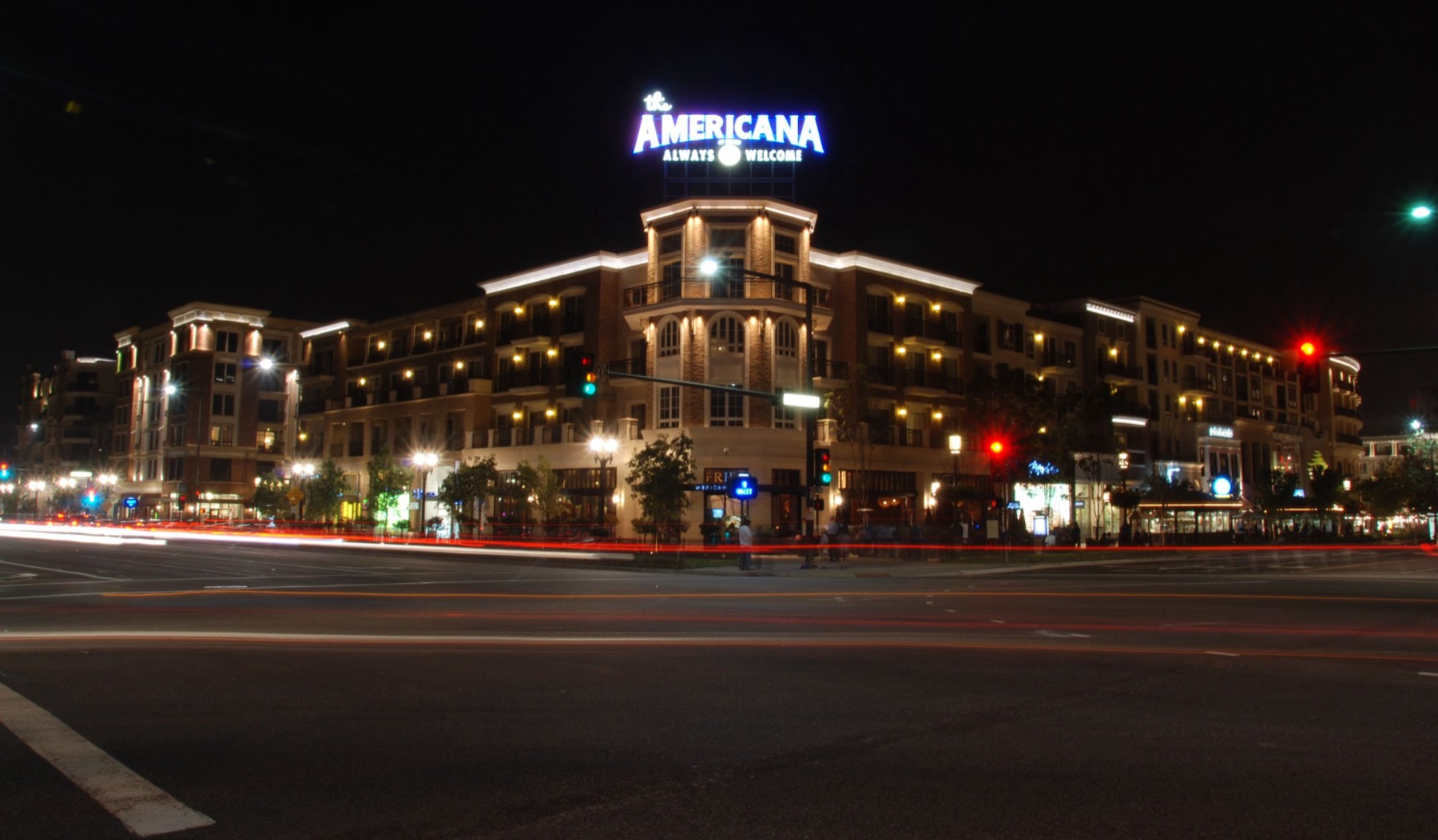
The Americana at Brand on South Brand Boulevard in Glendale, photographed in August 2008, three months after it opened. The apartments and condominiums stacked over the shops are the residential component The Grove never had.Photo: Fourbyfourblazer, CC BY 3.0, via Wikimedia Commons
Glendale: the same bet, with the fight in the open
Six years later Caruso ran the play again, across the street from someone who could afford to object.
The Americana at Brand rose on 15.5 acres over four city blocks in downtown Glendale, directly opposite the Glendale Galleria, an enclosed mall then owned by General Growth Properties. It opened in May 2008 at a reported cost of $400 million, with 100 condominiums and 238 apartments stacked above the shops — the residential component The Grove never had.11 A contemporaneous account by the Congress for the New Urbanism put the cost at $429 million and described the project as built in partnership with the city.7 Where the two figures differ, both are printed here.
General Growth fought it three ways. It collected signatures to force the project to a referendum — which then approved the development. It sued over the project’s environmental impact report. And it leaned on The Cheesecake Factory, a tenant in many of its own malls, to keep it from signing at the Americana.7
That third one is what cost it. Caruso sued in February 2004. In November and December 2007 a jury awarded $74.2 million in compensatory damages, found that General Growth had acted with “malice, oppression, or fraud”, and added punitive damages, taking the judgment to $89.2 million.7,8,9 General Growth’s chief executive said the company “emphatically” disagreed and would ask the court to overturn the verdict, while booking the full amount.8 On 5 January 2009 it settled for $48 million, paid out of the cash collateral it had posted for the appeal, and reimbursed a further $5.5 million of costs to its joint venture partner.9 The settlement reversed expenses General Growth had already booked, adding about $0.19 a share to its fourth-quarter 2008 earnings — a fight it had lost twice over, once in front of a jury and once on its own income statement.9
The tenant war ended the way the reel says it did. In September 2013 Nordstrom closed its Glendale Galleria store after thirty years and opened a 135,000-square-foot replacement across the street at the Americana.12
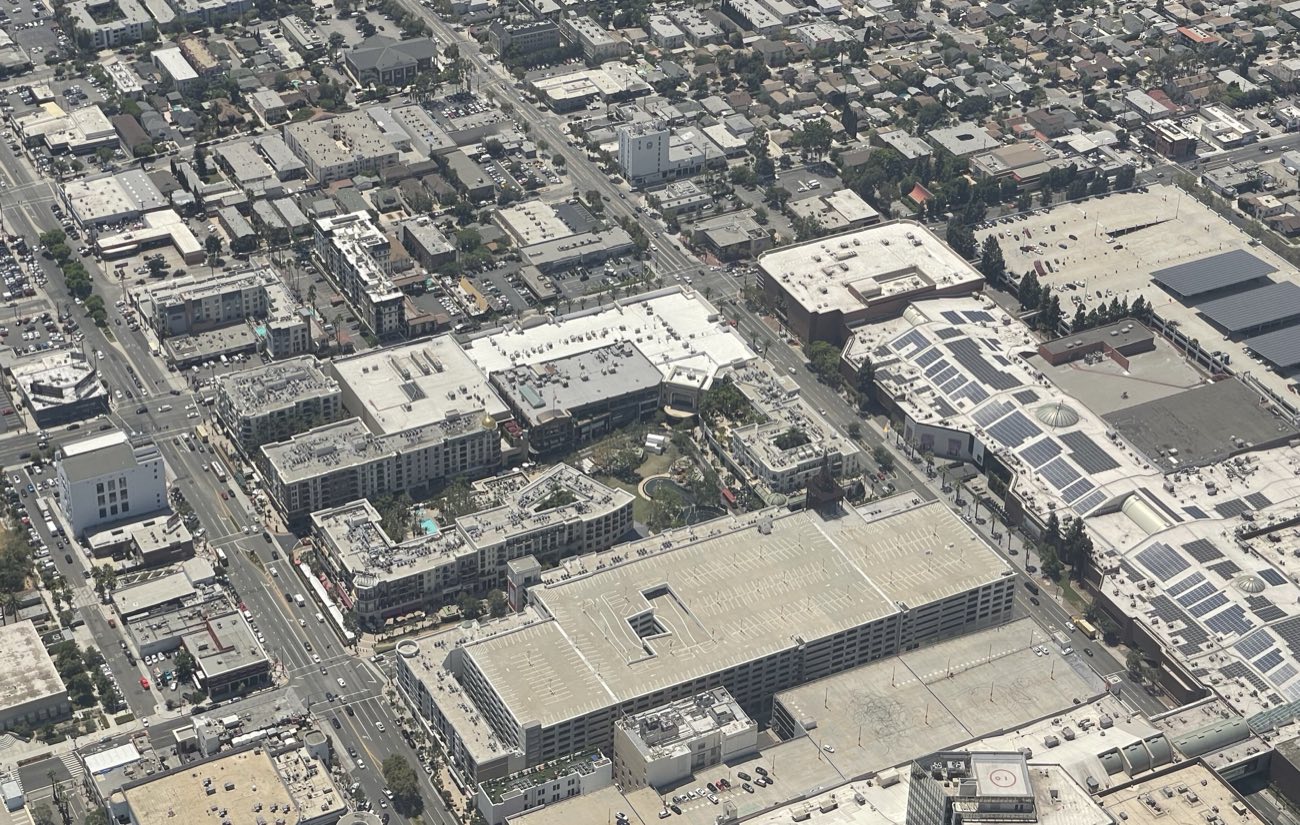
The Americana is also the only one of Caruso’s centres whose finances are partly public, because in July 2023 he borrowed against it in the securitised market for the first time. The loan was $450 million over five years at 7.1 per cent, originated by Morgan Stanley and Goldman Sachs, against a June 2023 appraisal of $870 million — roughly double what the centre cost to build. Almost 90 per cent of the proceeds repaid an existing $360 million MetLife loan from 2013, and about $35 million was returned to equity holders. DBRS Morningstar noted that it regards cash-out refinancings as less favourable, because a borrower with less of its own money at risk has less incentive to support a property through stress.24 The same report recorded the centre 99 per cent leased and 94 per cent occupied, with three anchors — Nordstrom, H&M and Amazon Style — running below sales expectations.24
Nothing equivalent exists for The Grove. No loan document, appraisal or rating-agency report on it has ever been public, which is a fact about the company rather than about the asset.
What went wrong, and when
A twenty-four-year record has stress in it, and this one has four episodes worth naming.
Traffic was the objection the neighbours raised in 1998, and by 2006 the Los Angeles Times was reporting that they had been right. “Traffic in this neighborhood is much worse than it was before the Grove,” a Farmers Market regular told the paper, in a story about the centre barring its own workers from the 3,500-space garage to free spaces for shoppers ahead of an American Girl store opening.6 The city’s transportation department agreed the area held some of the most congested locations on the Westside.6
The credit crisis arrived in the same month the Americana opened. The company’s position is that it came through untouched: its financials page states a compounded annual growth rate of 17 per cent since 1987 and says that “even amidst challenging economic environments, including the Great Recession, we have consistently increased our asset value, revenues, and profits every year”.32 That is the company’s account of itself and there is no filing against which to check it. What is externally verifiable is the shape of the balance sheet: Forbes described the portfolio as lightly mortgaged in 2018, and reported in 2016 that Caruso had kept the company private, taken no outside investments or partners, and sold only one thing he ever built — the condominiums at the Americana.14,15
The pandemic was the sharpest. Caruso told Forbes that revenue “went from roughly 100% to 25%” when the centres closed. By August 2020 he put net operating income back at 85 per cent of pre-Covid levels and occupancy at 97 per cent.19 Both figures are his.
Then, on the evening of 30 May 2020, a protest over the killing of George Floyd moved from Pan Pacific Park into the centre. Over about twenty minutes, looters broke into Nordstrom, the Apple Store and Sephora; a police kiosk near the cinema was set on fire; the Grove’s outdoor speakers kept playing.16,17 Police Chief Michel Moore gave a press statement standing beside the looted Nordstrom.16 Four weeks later Caruso said “for all lives to matter, Black lives must matter”, while criticising unnamed city officials for failing to prevent the violence.18 No published source gives a damage figure or an insurance recovery for that night.
The part that is not flattering
The Grove’s design argument is that a privately owned street can do the work of a public one. Caruso has made that claim himself, describing it as “a Main Street for a City that doesn’t have one”.20 In 2022 that claim was tested in court by people who wanted to use the street against him.
In August 2022, while Caruso was running for mayor with his campaign headquartered at The Grove, three plaintiffs — Gina Viola, Sim Bilal and Youth Climate Strike Los Angeles — sued Caruso Management Co. and an affiliated entity, alleging that the centre distributed pro-Caruso signs to visitors and allowed them to march with them, while refusing permission for small marches critical of the campaign.20,21 A Los Angeles Superior Court judge granted a preliminary injunction on 28 September setting terms for a demonstration before the election. A month later, on 28 October, a three-justice panel of the Second District Court of Appeal unanimously reversed it. A Caruso representative said the decision reaffirmed “the importance of upholding standard industry policies for the safety and well-being of our customers, tenants and other visitors”.21
He lost the election anyway, and expensively. Figures from the Los Angeles City Ethics Commission through 2 November 2022 put his spending at $104,848,887 against Karen Bass’s $9,060,958 — a ratio of about eleven to one, in a race she won.23
The design critique is older than the campaign and independent of it. Writing in Metropolis in November 2022, the critic Sam Lubell argued that Caruso’s projects “are simulacra, facades”, that they “are not based in their contexts, and they are not designed as true urban places”, and that the civic value they genuinely create sits on top of “an aspirational, culturally regressive nostalgia”.22 The Congress for the New Urbanism, broadly sympathetic to the form, noted as early as 2007 that The Grove “has been accused by some of being too ‘scripted’ and controlled to be an ‘authentic’ urban environment”.7
The most recent entry is the sharpest, because of who is using which tool. In February 2025 The Grove and the A.F. Gilmore Company — landlord and tenant, on the same side — sued Los Angeles over its approval of the $1 billion Television City studio expansion next door, challenging it on environmental review grounds. The Grove’s senior vice president said the project would create “additional traffic, parking problems, pollution and other harmful impacts”. The developer’s response was that the suits were “an unfortunate but predictable abuse of CEQA” against a project that had been unanimously approved at every step.28 Three of the four challenges came from the neighbourhood: Save Beverly Fairfax, the A.F. Gilmore Company, and the Beverly Wilshire Homes Association — the same association whose president had vouched for Caruso in 2002.4,28 Those are the same arguments, in the same order, that were made about The Grove itself in 1998, with the sides swapped.
In July 2026 that fight resolved itself in a way nobody sued for: a Deutsche Bank-led lender group filed a notice of default alleging Television City’s owner owed more than $357 million, and sources told the Los Angeles Times that Caruso and the Gilmore family could emerge as bidders for the site.30 Six months earlier, in January 2026, Caruso had ruled out running for mayor or governor.29
The ledger, opened
Put the sourced money in one column and the sourced outcomes in the other, and what is missing is as informative as what is there.
| The money, where it is documented | Amount or figure |
|---|---|
| 1997–2002 — total development cost | $160,000,0001 |
| …of which land, as ground rent | $5,000,0001 |
| …of which hard construction | $100,000,0001 |
| Dec 2002 — cinema sold to Pacific Theatres | ~$30M back, ~$2.1M a screen1,5 |
| Jan 2009 — General Growth settlement received | $48,000,0009,10 |
| Jul 2023 — Americana refinancing, cash to equity | ~$35M of a $450M loan24 |
| Jun 2023 — Americana appraised value | $870 million24 |
| Nov 2022 — mayoral campaign spending | $104,848,88723 |
| Oct 2024 — Rick Caruso net worth (LABJ) | $7.9 billion, from $6.9 billion27 |
| Company growth claim since 1987 | 17% compounded annually32 |
| The Grove's own debt, rent roll and returns | Never published |
| Public money identified in the record | None found |
Several of those lines cannot honestly be added to each other, and saying so is part of the answer. Caruso is private. There is no fund, no filing, no audited return, and the 17 per cent compounded growth figure is the company’s statement about the company. The ground lease’s term and rent are not public, so the single most important variable in a leasehold asset — how many years of it are left — is unknown outside the two families. The Grove has never carried a public loan, so it has never been independently appraised in a document anyone can read. And the May 2020 damage was never given a number.
What is verifiable is the arithmetic of the entry. A centre that cost $160 million all-in, including only $5 million attributable to land, was still trading at 100 per cent occupancy twenty-two years later and drawing an estimated 20 million visits a year.26,31 Against that, the enclosed competitor across town in Glendale lost its Nordstrom to Caruso, and the studio lot next door went into default owing more than $357 million — over twice what The Grove cost to build.12,30
The honest verdict has two halves. The retail thesis was right, and the record supports it on every published figure since 2003. The origin story is wrong: this was not a lone bet against a hostile market, it was a smaller, more negotiable version of a project that two better-known developers had already failed to build on the same dirt, financed conventionally by three banks and an investment bank, on land its developer never bought.
What transfers
The entitlement is the asset. The most valuable thing about this site in 1997 was not its location, which had not moved in a century — it was an unused 1991 approval and fifteen years of exhausted opposition. When a plan looks visionary, check whether the vision is the building or the permission.
Shrinking is a strategy, not a retreat. Two larger schemes died here. The one that got built was roughly half the size of the entitlement it inherited, and it is the one now claimed as the second most productive shopping centre in the country. Capacity you cannot get approved is worth nothing at all.
A ground lease turns the largest line item into a small one, and hides a clock inside the deal. Five million dollars of ground rent against $160 million of total cost is the reason this project pencilled. It is also the reason nobody outside the deal can value it, because the remaining term is the whole story and it is not published. Whenever land cost looks implausibly small, find the lease and read the expiry.
A private company’s best number is a claim until someone lends against it. The single most informative document in this entire file is the 2023 Americana loan, because it forced an outside appraisal, an occupancy figure, and a note that three anchors were selling below expectation. The Grove has generated no such document in twenty-four years. Absence of bad news from an unaudited owner is not evidence; it is absence of evidence.
Finally, the same lever gets pulled from both ends. Neighbourhood objections and environmental review nearly stopped The Grove, and in 2025 The Grove used environmental review to try to stop the project next door. Whoever holds the finished asset acquires an interest in the process that almost prevented it — which is worth remembering before treating any developer’s position on the rules as a principle.
Common questions
- How much did The Grove cost to build, and who paid for it?
- The total development cost was $160 million, per the Urban Land Institute’s 2003 case study: $5 million of site acquisition recorded as ground rent, $20 million of site improvements, $100 million of construction excluding tenant improvements, and $35 million of soft costs. Caruso Affiliated Holdings provided equity from internal sources, the construction loan came from a consortium of Bank of America, PNC and Union Bank, and permanent financing came from Lehman Brothers Bank. No public subsidy appears anywhere in the record.
- Does The Grove really do $2,200 per square foot in sales?
- That figure is Forbes’s, published in October 2018. It is one of five published numbers and they differ a lot: the Urban Land Institute recorded $605 a square foot in 2003, a 2012 International Council of Shopping Centers publication put it at $1,400, Green Street Advisors told Forbes about $2,100 in 2016, and Caruso’s own site now claims $2,460 and a rank of second most productive shopping centre in the United States. Caruso is private and has never published a rent roll, so no version has been independently audited.
- Does Rick Caruso own the land under The Grove?
- No. The site is held on a long-term ground lease from the A.F. Gilmore Company, the family business that has owned the block at Third and Fairfax since the nineteenth century and runs the adjacent Original Farmers Market. The lease is why land appears in the development budget as only $5 million of ground rent. Its term, escalations and expiry date are not in any public source, which means the remaining life of the leasehold — the single most important variable in valuing it — is unknown outside the two families.
- What actually happened between Caruso and the Glendale Galleria?
- General Growth Properties, which owned the Galleria, fought the Americana at Brand across the street three ways: it gathered signatures to force a referendum, which then approved the development; it sued over the environmental impact report; and it pressured The Cheesecake Factory not to sign a lease. Caruso sued in February 2004. In late 2007 a jury awarded $74.2 million in compensatory damages, found malice, oppression or fraud, and added punitive damages, reaching an $89.2 million judgment. General Growth settled for $48 million on 5 January 2009. Nordstrom left the Galleria for the Americana in September 2013.
- Has The Grove ever been in trouble?
- Its worst documented stretch was 2020. Caruso said revenue fell from roughly 100% to 25% during the closures, recovering to 85% of pre-Covid net operating income by that August. On 30 May 2020 looters broke into Nordstrom, the Apple Store and Sephora during protests over the killing of George Floyd, and a police kiosk was set on fire; no published source gives a damage or insurance figure. Earlier, in its first full year, brokers told the Los Angeles Business Journal that several chain stores were not making enough sales to justify the rents, even as the cinema became the highest-grossing in Los Angeles County.
Sources
- Urban Land Institute, Development Case Studies — The Grove — Los Angeles, California, Case No. C033020, Volume 33 Number 20 (2003-Q4)
- Los Angeles Times — Farmers Market to Unveil New Development (1998-05-22)
- Los Angeles Times — Nordstrom Joins Project Next to Farmers Market (1999-07-21)
- Los Angeles Business Journal — The Grove: Latest Example of Caruso's Main Street Feel (2002-03-24)
- Los Angeles Business Journal — For Whom the Registers Toll: Grove's Success Incomplete (2002-12-15)
- Los Angeles Times — Fun for Some, Irritation for Others (2006-04-19)
- Public Square: A CNU Journal — Defeat for another mall owner (2007-12-01)
- General Growth Properties (company release) — GGP Provides Updated 2007 Core FFO Guidance and Announces Land Impairment Charges (2007-12-10)
- General Growth Properties (company release) — General Growth Announces Litigation Settlement and Operating Partnership Unit Conversion (2009-01-05)
- Los Angeles Business Journal — General Growth Settles Glendale Mall Lawsuit (2009-01-05)
- Los Angeles Times — Americana: The Beautiful? (2008-04-27)
- Nordstrom (company release) — Nordstrom Opens New, Relocated Store at Americana at Brand in Glendale, CA (2013-09-20)
- California Apparel News — Caruso's Main Street Gamble (2014-04-03)
- Forbes — Los Angeles Developer Of 'Disneyland-Like' Open-Air Malls Has Amassed $3.5 Billion Fortune (2016-03-18)
- Forbes — The Walt Disney Of Retail: Meet The Billionaire Building The Malls Of The Future (2018-10-11)
- Los Angeles Times — As looters hit the Grove mall, a security guard begs them to stop: 'We're one of you' (2020-05-30)
- ABC7 Los Angeles — Protesters loot stores at The Grove, cause damage on Rodeo Drive (2020-05-31)
- Los Angeles Times — Centrist and conservative business leaders support protests (2020-06-25)
- Forbes — California Shopping Center King Rick Caruso Is Back—And Cheering On The Demise Of The American Mall (2020-08-07)
- Law Office of Matthew Strugar (plaintiffs’ counsel) — Los Angeles Activists Sue Rick Caruso Companies for Illegally Suppressing Criticism of Caruso Campaign at the Grove (2022-08-16)
- MyNewsLA.com — Appellate Court Reverses Judge's Order Concerning Grove Protests (2022-10-28)
- Metropolis — The Anti-civic Architecture of Rick Caruso's Fantasy Worlds (2022-11-03)
- Newsweek — Rick Caruso Spent Over $100m in Loss to Karen Bass (2022-11-17)
- The Real Deal — Caruso scores $450M refi on Americana at Brand mall (2023-07-13)
- The Robin Report — Mall Fall and Rebirth (Green Street Advisors mall tiers) (undated)
- Glossy — How The Grove turned an empty walkway into LA's most exclusive pop-up (2024-02-05)
- Los Angeles Business Journal — Wealthiest Angelenos 2024 — No. 13, Rick Caruso (2024-10-07)
- Commercial Observer — Rick Caruso's The Grove Files Lawsuit Challenging L.A.'s Television City Expansion (2025-02-18)
- NBC Los Angeles — Billionaire Rick Caruso says he will not run for public office (2026-01-16)
- Commercial Observer — Hackman's Television City Heads Toward Sale as Studio Distress Grips Hollywood (2026-07-13)
- Caruso (company claim) — Our Portfolio — The Grove (undated)
- Caruso (company claim) — About — Financials (undated)
- Samuels & Company — The Original Farmers Market — Los Angeles, CA (undated)