
Case study Nº 27
One loan wearing seven addresses: the Macklowe towers were due all at once
In February 2007 Harry Macklowe put $50 million of his own cash under $7 billion of one-year debt and bought Blackstone’s Manhattan slice of Equity Office in about ten days. The credit window closed that August, the loans matured in February, and the unwind took sixteen months — no bankruptcy, no auction, the lender financing the final buyer itself, and no published total, then or since, of what anyone got back.
Ben Fan, with Darryl WengAugust 6, 202616 min readWatch the reel
Macklowe’s own cash, Feb 2007
$50M
Debt due within about a year
$7B
In February 2007 Harry Macklowe bought Blackstone’s Manhattan slice of the Equity Office portfolio with $50 million of his own money and $7 billion of borrowed money, due back in about a year.1 The purchase was negotiated in about ten days.2 Eighteen months later the towers belonged to the lenders, the GM Building — the building he had spent a career acquiring — had been sold to cover a personal guarantee, and the record of what everyone actually recovered had already begun to go unwritten. Jump to the money ↓
The usual telling — including the reel this brief grew from — is that Harry Macklowe bought seven towers with almost none of his own money, the debt was one big cross-collateralized bet, and when credit froze the default took everything at once. The spine of that is right, and it is worth being precise about, because every part the retelling compresses is more instructive than the compression.
The record disagrees with the retelling about the number of buildings. It disagrees about what happened to the GM Building. It contains no bankruptcy, no auction, and a sixteen-month unwind in which the lender ended up financing the final buyer itself. And it has a hole where the bottom line should be: no one has ever published what the lending group got back.
| The deal at a glance | Number |
|---|---|
| What Blackstone paid for all of Equity Office, closed 9 Feb 2007 | About $39 billion, at $55.50 a share4 |
| What Macklowe paid for the Manhattan portfolio, concurrently | $6.8 billion — $7 billion in the day-one wire copy1,3,7 |
| How many buildings | Eight on the day-one wire; seven in every later account3,6 |
| Days of negotiation | About ten2 |
| Macklowe’s own cash in | About $50 million1 |
| Deutsche Bank’s senior loan | $5.8 billion, pieces sold to as many as 20 lenders1,6 |
| Fortress’s bridge loan | $1.2 billion, reported north of 15%, personally guaranteed1,23 |
| When it was all due | February 20081 |
| The default | February 2008 — consensual handover, no bankruptcy9,22 |
| The unwind | Seven sales, June 2008 to July 20095,7,8 |
| The seven resales, summed here | About $3.77 billion — a total no source publishes5,7,8,20,21 |
| The GM Building, sold to cover the guarantee, Jun 2008 | $2.8 billion by the buyer’s filing; $2.9 billion by the seller’s14,18 |
| What Deutsche Bank recovered on the $5.8 billion | Never published |
| What Macklowe lost in all | Never published; off the Forbes 400 in 2008, for good27 |
Ten days in February
By the start of 2007 Harry Macklowe was seventy years old and had already been to the edge twice. In 1985 he ordered four buildings on West 44th Street demolished in the middle of the night, without permits, two days before a moratorium on demolishing single-room-occupancy housing took effect; his company and one of its officers pleaded guilty, $2 million went to the city, and Macklowe himself escaped indictment because the state could not establish criminal intent.24,25 In the early-1990s crash his bankers called in about $1 billion of loans and took back five buildings, including the hotel that carried his name.1 What rebuilt his standing was the General Motors Building, bought from the bankrupt insurer Conseco in September 2003 for $1.4 billion — a price his peers thought excessive until the sunken Apple cube he had sketched before he even owned the plaza made the corner famous.1,17
Late in 2006 Sam Zell decided the market had peaked and sold Equity Office Properties — the largest office landlord in the country — to Blackstone, which raised its bid to $55.50 a share against a rival, a transaction valued at about $39 billion, closing on 9 February 2007.1,4 Blackstone’s Jonathan Gray had let it be known before the deal even closed that the Manhattan buildings would be sold on.1 Macklowe took them the same day the merger closed — the purchase was done concurrently with the EOP closing, not after it — for $6.8 billion, having negotiated the whole thing in about ten days.1,2,7 “We thought capturing a dominant position in the Plaza district was a real plus,” he said, still confident, in January 2008.1
The financing is the study. Macklowe put in about $50 million of his own cash. Deutsche Bank lent $5.8 billion against the towers. The remaining $1.2 billion had to be raised in about two weeks, and the only lender prepared to move at that speed was Fortress, at a rate reported north of 15 per cent, with personal guarantees from Macklowe himself.1,23 All of it was due in about a year — “$7 billion in loans, due in February,” as Fortune put it while the February in question was arriving.1 The reel’s cross-collateralization claim holds in the record at the level that mattered: the towers secured pooled debt rather than seven separate mortgages. A mezzanine lender’s own SEC-filed materials describe four of them as collateral for a single financing pool, and two more were held — and later sold — through one owning entity.11,21 One deal, wearing seven addresses.
Notice what is missing from that structure: time. A 99 per cent loan-to-cost position is survivable if the debt is long. Seven Midtown towers were never going to stop being worth something close to $7 billion by 2027. The bet Macklowe actually made was not on Manhattan offices; it was that the refinancing window would still be open in twelve months. His son Billy said exactly that, jaw clenched, in February 2008: “We always maintained it was interim acquisition financing. We had a plan to provide for a long-term capital solution. The events in August have slowed the process down.”1
The wire said eight buildings. Every retelling says seven.
On the day the deal closed, the Associated Press reported that Macklowe had bought eight buildings for $7 billion, about 6.5 million square feet, and the list that circulated named 717 Fifth Avenue, Worldwide Plaza, 1301 Avenue of the Americas, Park Avenue Tower, 527 Madison Avenue, 1540 Broadway, 850 Third Avenue and Tower 56.3 Within eighteen months the portfolio was universally “the seven towers” — in Fortune’s deep report, in the Observer’s accounting of the unsold, in Reuters’s description of Worldwide Plaza as the last of seven.1,6,7
No published source explains the difference. What the record does show is that the disposition history — the sale, tower by tower, of everything Deutsche Bank took back — accounts for exactly seven addresses, and 717 Fifth Avenue is not one of them: it appears in no account of the unwind, and Blackstone itself was still selling an interest at that address years later. The likeliest reading is that the eighth building never actually travelled to Macklowe. But that is a reading; the count in the day-one record and the count in every retrospective simply disagree, and a reader who has seen this deal cited a hundred times has almost certainly been given the number seven with no mention that the original wire said otherwise.
The dollar figures swim the same way. Fortune says he paid $6.8 billion and borrowed $7 billion; the wire said the price was $7 billion; the New York Times, retelling it in 2013, put the price at $7 billion and the debt at $6.8 billion — the same two numbers, assigned to opposite roles.1,2,3 The $50 million of equity, at least, is consistent in every source that states a figure at all. One cut of the reel this study grew from says $15 million; no source we could find says that anywhere, and the $50 million cut is the one linked below.
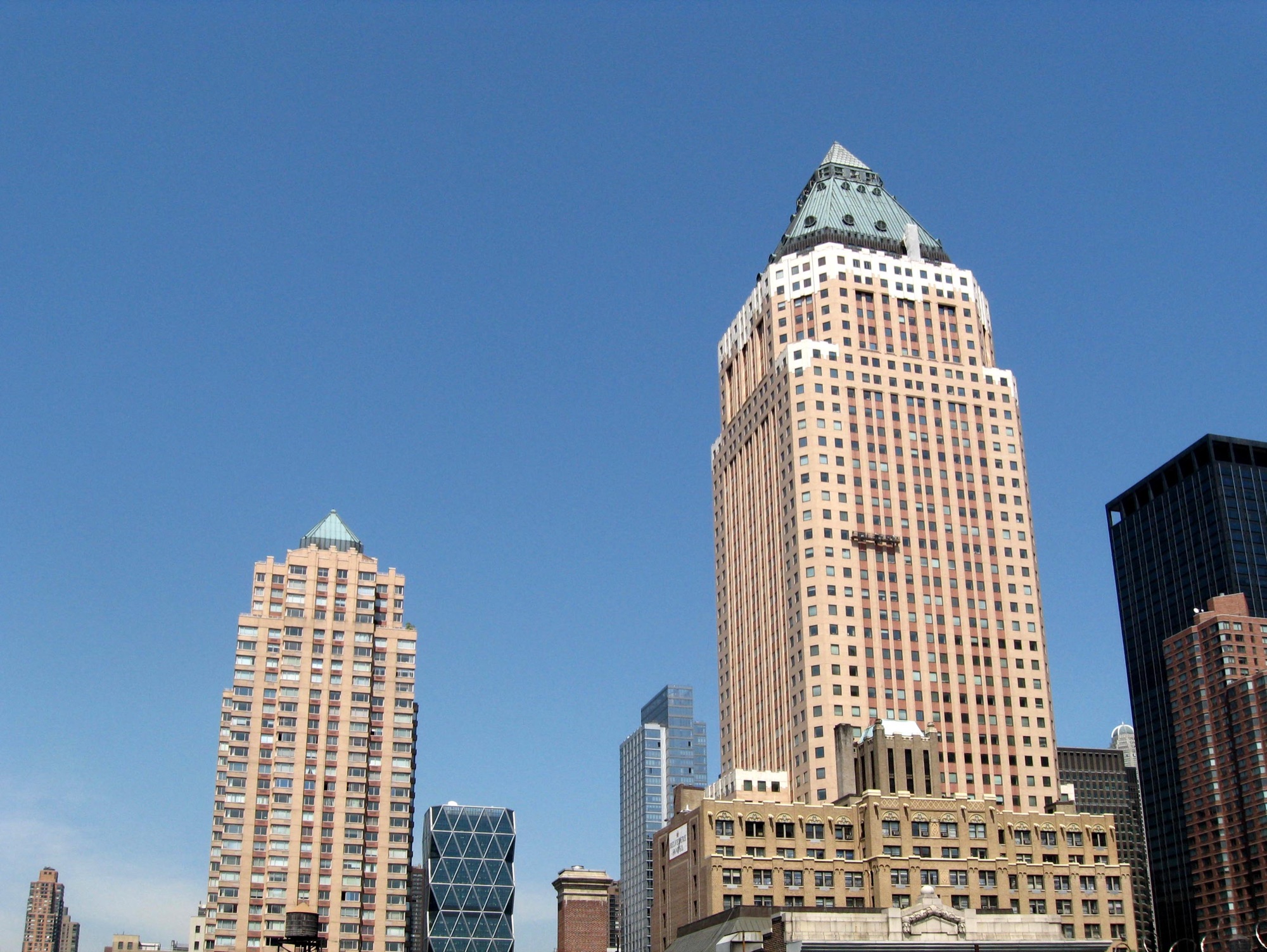
825 Eighth Avenue, May 2008
The default was not an event. It was sixteen months of selling.
Worldwide Plaza, photographed in May 2008 — three months after the default, fourteen months before it became the last of the seven towers to sell. Macklowe had paid $1.74 billion for it; Deutsche Bank let it go at $600 million, and financed the buyer itself.Photo: Jim.henderson, public domain, via Wikimedia Commons
Six months of music, then no chair
In August 2007 the securitization market that every one-year bridge loan in America was counting on stopped. “There was a game of musical chairs,” said Ben Lambert, the Eastdil Secured chairman who had sold Macklowe the buildings on Blackstone’s behalf. “The music stopped, and there was no chair for Harry.”1 By January 2008 Deutsche Bank was talking to the Macklowes about taking the buildings back — complicated by the fact that it had sold pieces of its $5.8 billion to as many as twenty other lenders, some of whom stood first in line and some of whom would get, in Fortune’s phrase, leftovers.1
What happened in February 2008 is usually told as a seizure, and the word the contemporaneous record uses again and again is quieter: consensual. Macklowe defaulted and handed the towers back to his senior lender rather than filing for bankruptcy or forcing a foreclosure auction.9,22 A mezzanine lender in the stack, Capital Trust, told its investors that May that its Macklowe position had “come due in February but was subsequently extended by the lending group to February 2009,” and that the properties were being offered for sale “pursuant to a consensual arrangement with the borrower, with the proceeds going to the lenders to repay the debt.”10 The default was real and total. It just did not look like the movie version. It looked like a workout — sixteen months of brokers, extensions, re-trades and closings, run by the same people who had signed the loans.
The sales themselves tell the story of 2008 in seven receipts. In June, before Lehman, Shorenstein paid $930 million for the pair that travelled together — Park Avenue Tower and 850 Third Avenue, held and sold through a single owning entity.5,21 In August, Paramount and Allianz took 1301 Avenue of the Americas at about $1.5 billion, slightly above Macklowe’s $1.46 billion — the only line in the ledger that went up.5,19 Then the market turned. A $2 billion bundle of Worldwide Plaza and 1540 Broadway fell apart; Transwestern re-traded and then lost Tower 56; and the prices on everything that closed after September carry the crash in them: 527 Madison at $225 million, Tower 56 to Pearlmark at $158 million, 1540 Broadway at about $355 million — a third of what Macklowe had paid — and finally, in July 2009, Worldwide Plaza at $600 million against his $1.74 billion.5,6,8,9,20
That last sale is the detail the retellings never carry. Deutsche Bank did not just accept $600 million for a tower that had stood at $1.74 billion on the 2007 closing statement — it provided the buyer’s $470 million mortgage itself, put up roughly $135 million of the equity beside them, and wrote down the $1 billion mortgage it had held.8 A lender financing the purchase of its own collateral, at a third of the price it lent against, is what the end of a bubble actually looks like from inside the bank.
The whole stack, opened
Three sources of money bought the towers in February 2007, and the one that was Macklowe's own is a sliver. Sixteen months of sales brought part of it back. The first total is in the record. The second has never been published anywhere — it is summed here from the seven recorded sales.
Assembled to buy the towers, Feb 2007
$7.05 billion
What the seven resales brought, Jun 2008 – Jul 2009 · $3.77 billion
What Macklowe lost in allNever published
- Macklowe’s own cash1$50,000,000
- Fortress bridge loan1,23$1,200,000,000
- Deutsche Bank senior loan1,6$5,800,000,000
What the seven resales brought, Jun 2008 – Jul 2009 · $3.77 billion
- Park Ave Tower + 850 Third, to Shorenstein, Jun 20085,21$930,000,000
- 1301 Sixth Ave, to Paramount + Allianz, Aug 20085,19≈$1,500,000,000
- 527 Madison Ave, to Mitsui Fudosan, Oct 20085,6$225,000,000
- Tower 56, to Pearlmark20$158,000,000
- 1540 Broadway, to CBRE Investors, Mar 20099≈$355,000,000
- Worldwide Plaza, to George Comfort & Sons + RCG Longview, Jul 20097,8$600,000,000
Never published
- What the lending group recovered on the $5.8 billionNever published
- What Macklowe lost in allNever published
Two structures on one scale. The top bar is the money that closed in February 2007 — the sources sum to $7.05 billion against a reported price of $6.8 to $7 billion, and no public document itemises the difference. The bottom bar is our own sum of the seven recorded resales; each line is sourced, and the total appears in no publication we could find. The gap between the bars belonged to the lending group, whose splits were never published; the sliver at the far left of the top bar belonged to Macklowe, and was gone either way.
| Line | Amount | How it is counted |
|---|---|---|
| Assembled to buy the towers, Feb 2007 — Macklowe’s own cash | $50,000,000 | sourced, and part of the total |
| Assembled to buy the towers, Feb 2007 — Fortress bridge loan | $1,200,000,000 | sourced, and part of the total |
| Assembled to buy the towers, Feb 2007 — Deutsche Bank senior loan | $5,800,000,000 | sourced, and part of the total |
| What the seven resales brought, Jun 2008 – Jul 2009 — Park Ave Tower + 850 Third, to Shorenstein, Jun 2008 | $930,000,000 | sourced, and part of the total |
| What the seven resales brought, Jun 2008 – Jul 2009 — 1301 Sixth Ave, to Paramount + Allianz, Aug 2008 | ≈$1,500,000,000 | sourced, and part of the total |
| What the seven resales brought, Jun 2008 – Jul 2009 — 527 Madison Ave, to Mitsui Fudosan, Oct 2008 | $225,000,000 | sourced, and part of the total |
| What the seven resales brought, Jun 2008 – Jul 2009 — Tower 56, to Pearlmark | $158,000,000 | sourced, and part of the total |
| What the seven resales brought, Jun 2008 – Jul 2009 — 1540 Broadway, to CBRE Investors, Mar 2009 | ≈$355,000,000 | sourced, and part of the total |
| What the seven resales brought, Jun 2008 – Jul 2009 — Worldwide Plaza, to George Comfort & Sons + RCG Longview, Jul 2009 | $600,000,000 | sourced, and part of the total |
| Assembled to buy the towers, Feb 2007 — What the lending group recovered on the $5.8 billion | Never published | never published |
| Assembled to buy the towers, Feb 2007 — What Macklowe lost in all | Never published | never published |
| Assembled to buy the towers, Feb 2007 | $7.05 billion | the sourced total |
| What the seven resales brought, Jun 2008 – Jul 2009 | $3.77 billion | the sourced total of the second structure |
What went in, and what came back
Open the purchase and the reel’s argument draws itself. Macklowe’s $50 million is there — it is simply too small to see. On a bar the width of this page it is a couple of pixels against Deutsche Bank’s $5.8 billion and the $1.2 billion Fortress raised in about two weeks at a rate north of 15 per cent.1,23
Leverage that steep does not change what you can make. It changes who decides when you sell. Every dollar of the towers’ value above $7 billion belonged to Macklowe; every dollar below it belonged to somebody with a maturity date and a guarantee in a drawer.
- Macklowe’s own cash1$50,000,000
- Fortress bridge loan1,23$1,200,000,000
- Deutsche Bank senior loan1,6$5,800,000,000
What the seven resales brought, Jun 2008 – Jul 2009 · $3.77 billion
- Park Ave Tower + 850 Third, to Shorenstein, Jun 20085,21$930,000,000
- 1301 Sixth Ave, to Paramount + Allianz, Aug 20085,19≈$1,500,000,000
- 527 Madison Ave, to Mitsui Fudosan, Oct 20085,6$225,000,000
- Tower 56, to Pearlmark20$158,000,000
- 1540 Broadway, to CBRE Investors, Mar 20099≈$355,000,000
- Worldwide Plaza, to George Comfort & Sons + RCG Longview, Jul 20097,8$600,000,000
Never published
- What the lending group recovered on the $5.8 billionNever published
- What Macklowe lost in allNever published
Two structures on one scale. The top bar is the money that closed in February 2007 — the sources sum to $7.05 billion against a reported price of $6.8 to $7 billion, and no public document itemises the difference. The bottom bar is our own sum of the seven recorded resales; each line is sourced, and the total appears in no publication we could find. The gap between the bars belonged to the lending group, whose splits were never published; the sliver at the far left of the top bar belonged to Macklowe, and was gone either way.
The building he sold to keep the promise
The seven towers went back to the bank. The GM Building did not — and the distinction is the part of this story the one-line versions flatten. Fortress’s $1.2 billion was personally guaranteed, and the building at 767 Fifth Avenue was pledged behind that guarantee; by February 2008 the fund was, in Fortune’s words, salivating at the possibility of foreclosing, and had begun pricing Macklowe’s art collection, his homes and his yacht in case the building was not enough.1 Fortress extended its deadline to 15 February 2008 precisely so that Macklowe could sell the building himself.1
Nor was the GM Building the debt-free trophy of the retelling. Macklowe’s own investment summary shows $1.2 billion of debt on the 2003 purchase, a German partner’s $300 million of preferred equity until December 2006, and a $1.9 billion recapitalization — two months before the towers deal — that made him sole owner of a building mortgaged for more than it had cost him.18 “Owned outright since 2003” is not what the owner’s own document says.
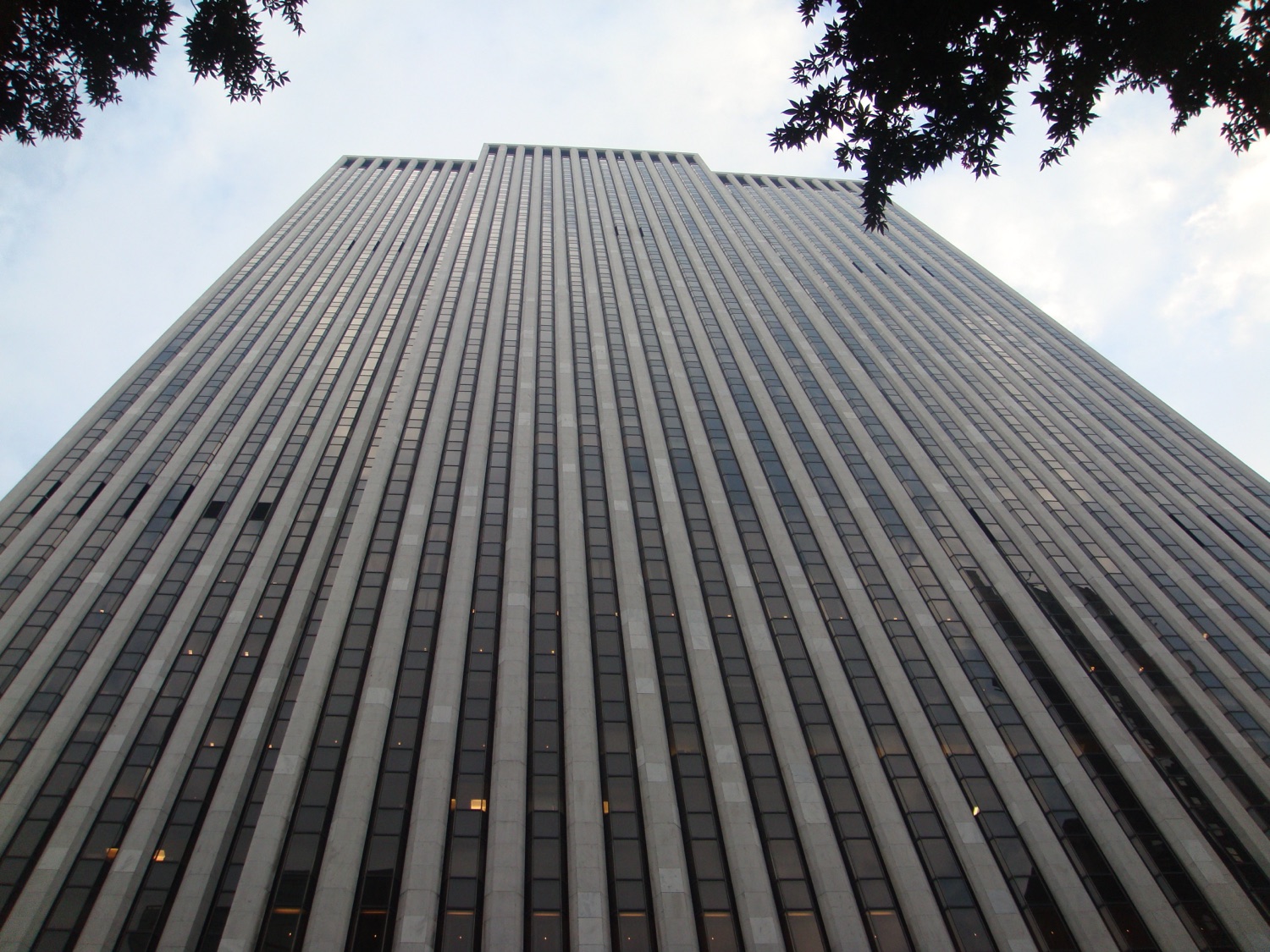
The sale, when it came, was enormous and fast. Agreements signed on 23 May 2008 sold the GM Building and three other buildings from Macklowe’s own pre-EOP portfolio — 540 Madison Avenue, Two Grand Central Tower and 125 West 55th Street — for an aggregate $3.949 billion.13 The GM Building closed on 9 June at approximately $2.8 billion by Boston Properties’ SEC filing — the seller’s own summary says approximately $2.9 billion, and this study reports both — through a venture in which Boston Properties holds 60 per cent, beside a Goldman Sachs-managed fund whose principal investors were the governments of Kuwait and Qatar, and Dubai’s Meraas Capital at 20 per cent.14,15,16,18 Mortimer Zuckerman called it a commitment to the best real estate performing “even better in more challenging times”.15 The proceeds repaid Fortress; Macklowe kept a non-controlling interest in the building he had spent forty years wanting, and later testified that the forced sale left him with roughly $900 million of taxable gains and, eventually, hundreds of millions underwater on the tax.18,22,26
Three weeks after the GM Building closed, Billy Macklowe ousted his father as head of the firm and spent the next year shepherding the tower sales he had opposed financing in the first place.9
The sequence
1985
Macklowe orders the overnight demolition of four buildings on West 44th Street without permits, two days ahead of a moratorium on demolishing single-room-occupancy housing. His company and a vice president plead guilty; he is not indicted, the state being unable to establish criminal intent, and $2 million is paid to the city.24,25
$2M paid
Sep 2003
Macklowe buys the General Motors Building at 767 Fifth Avenue from Conseco for $1.4 billion — $735 a square foot, then among the highest prices ever paid for an American office building — with $1.2 billion of debt on the purchase.17,18
$1.4B
Dec 2006
The GM Building is recapitalized with $1.9 billion of new senior debt, and Macklowe uses the proceeds to buy out Jamestown’s $300 million preferred equity stake. He is now the building’s sole owner, two months before the towers deal. He was never its unencumbered owner.18
$1.9B borrowed
6 Feb 2007
Equity Office Properties announces its amended merger with Blackstone at $55.50 a share — a transaction valued at approximately $39 billion — expected to close on or about 9 February. Sam Zell is selling the whole company at what he judges to be the top.4
$39B
9 Feb 2007
Blackstone closes on EOP and, concurrently, flips its Manhattan portfolio to Macklowe. The wire copy that day says eight buildings and $7 billion; nearly every later account says seven towers and $6.8 billion. The deal was negotiated in about ten days.2,3,7
$7B
Feb 2007
The financing closes: about $50 million of Macklowe’s own cash, $5.8 billion from Deutsche Bank, and a $1.2 billion bridge loan from Fortress at a rate reported north of 15 per cent — personally guaranteed, and all of it due in about a year.1,23
$50M of $7.05B
Aug 2007
The credit market closes. “There was a game of musical chairs,” Eastdil’s Ben Lambert says later of the refinancing that never came. “The music stopped, and there was no chair for Harry.”1
Jan 2008
Deutsche Bank begins talking to the Macklowes about taking the buildings back. The bank had sold pieces of its $5.8 billion to as many as twenty other lenders, and the dissenting queue of debt holders is, for a while, the borrower’s best friend.1
Feb 2008
The loans mature and Macklowe defaults. There is no bankruptcy and no auction: he hands the towers back to Deutsche Bank consensually, and Fortress extends its own deadline to 15 February so the GM Building can be sold to cover the guarantee.1,9,22
$7B in default
23 May 2008
Agreements are signed to sell the GM Building and three other Macklowe buildings — 540 Madison Avenue, Two Grand Central Tower and 125 West 55th Street — to Boston Properties and partners for an aggregate $3.949 billion.13
$3.949B agreed
Jun 2008
The GM Building sale closes on 9 June at approximately $2.8 billion by the buyer’s SEC filing — approximately $2.9 billion by the seller’s own account — through a venture 60% Boston Properties, with a Goldman Sachs-managed fund whose principal investors are the governments of Kuwait and Qatar, and Dubai’s Meraas Capital at 20%. The same month, Shorenstein buys Park Avenue Tower and 850 Third Avenue for a combined $930 million, and Billy Macklowe ousts his father as head of the firm.5,9,14,15,16,18
$2.8B + $930M
Jul 2008
Capital Trust, a mezzanine lender in the towers’ debt stack, books a $50 million loss reserve — its entire economic exposure — and tells investors that bids are coming in low because buyers can smell that the lending group is a forced seller.11,12
−$50M reserved
Aug 2008
Paramount Group and Allianz buy 1301 Avenue of the Americas at a valuation of about $1.5 billion — the only tower that resold above Macklowe’s 2007 price. The same month, Deutsche Bank sues to foreclose on $482 million on his separate Drake Hotel site.5,19,27
$1.5B
Oct 2008
A month after Lehman Brothers fails, Mitsui Fudosan agrees to buy 527 Madison Avenue for $225 million. Two other pending deals — Transwestern at Tower 56, and a $2 billion bundle of Worldwide Plaza with 1540 Broadway — fall apart in the turn of the market.5,6
$225M
Mar 2009
CB Richard Ellis Investors closes on 1540 Broadway alone for about $355 million — roughly a third of the $967.6 million Macklowe had paid two years earlier. Deutsche Bank sells Tower 56 to Pearlmark for $158 million in the same stretch of the unwind.5,9,20
$355M + $158M
Jul 2009
The last tower goes. George Comfort & Sons and RCG Longview complete the $600 million purchase of Worldwide Plaza — financed by Deutsche Bank itself, which provides a $470 million mortgage, puts up about $135 million of the equity, and writes down its original $1 billion mortgage on the building.7,8
$600M
2012–2015
CIM Group buys the discounted debt on Macklowe’s lost Drake site and partners with him to build 432 Park Avenue, at 1,396 feet briefly the tallest residential tower in the western hemisphere. Forbes had estimated his fortune at $2 billion in 2007; he fell off the Forbes 400 in 2008 and never returned.2,28
The lender’s own filings never say his name
Here is a silence worth reporting. Fortress was a public company from February 2007, and the $1.2 billion Macklowe bridge loan was among the most discussed credit positions in America in the winter of 2008 — yet a full-text search of Fortress Investment Group’s SEC filings returns not one mention of Macklowe, or of the General Motors Building, anywhere. The loan lived in managed fund vehicles that never had to name their borrower. The most consequential lending relationship of the cycle, from the lender’s side, is publicly documented only in journalism.
Which is why the one lender that did have to write things down matters more than its $50 million suggests. Capital Trust’s earnings materials are SEC exhibits, and they show the unwind from inside the lending group in real time: the February maturity, the extension to February 2009, the consensual sale process — and then, in July 2008, the decision to reserve its entire economic exposure while bids came in low because “buyers sensed that the lending group was a forced seller.”10,11,12 A junior lender announcing to its own shareholders that it expects nothing back is the closest thing the record holds to a statement of what this deal cost the people who financed it.
Macklowe after
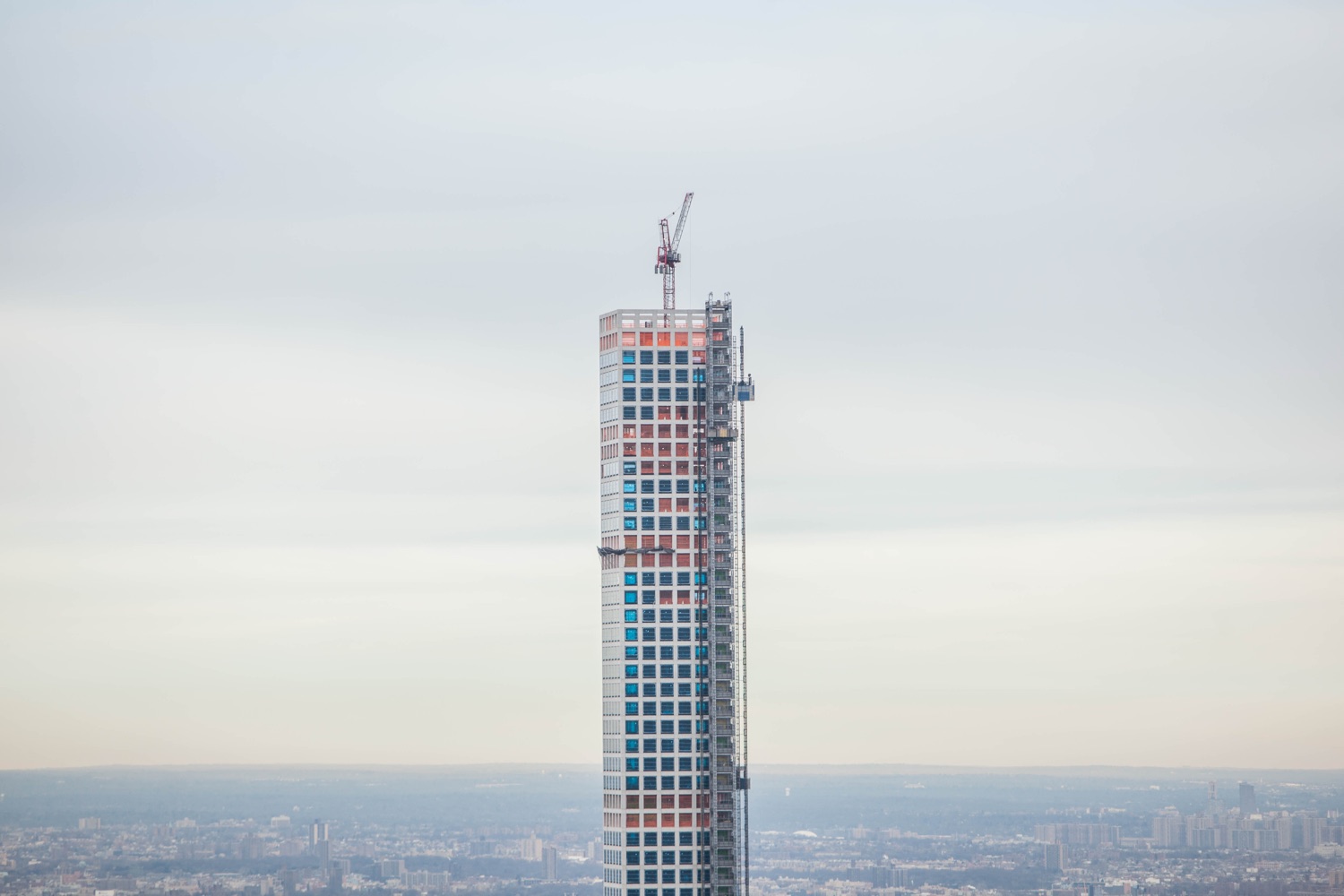
The Drake Hotel site on Park Avenue — bought in 2006, demolished, then caught in the same credit collapse — drew a Deutsche Bank foreclosure suit over $482 million in August 2008.27 It became the one loss that circled back: CIM Group bought the site’s discounted debt in the workout years and partnered with Macklowe to build 432 Park Avenue on it, the 1,396-foot pencil tower that opened as the tallest residential building in the hemisphere.2 He never regained the fortune — Forbes had him at $2 billion in 2007 and he left the Forbes 400 in 2008 for good28 — and his own accounting of the arc, delivered to a room of Cornell students in 2014, is the cleanest summary anyone has produced: “I have been extremely fortunate, 1) to be successful, 2) to make money, 3) to lose money, 4) to make money, 5) to lose it again, 6) to make it back.”29
The retrospective verdict that matters most came from the man who sold him the towers. Blackstone’s Jonathan Gray, as quoted in Vicky Ward’s The Liar’s Ball: “His mistake was not the price he paid … it was the way he financed it.”22 Seven Midtown towers in 2007 were a defensible thing to want. Seven Midtown towers on twelve months of money were a clock.
What transfers
The first thing is the reel’s own lesson, which the record strengthens rather than softens: leverage does not decide how much you make; it decides who can force you to sell, and when. Macklowe’s buildings did not fail — their tenancies, their addresses and their long-run values were fine, and one of the seven even resold above his price seventeen months after he bought it. What failed was a maturity date. The instrument to study in any levered deal is not the price or even the rate; it is the calendar, and who holds the pen when it runs out.
The second is that a default has a mechanism, and the mechanism is most of the outcome. Macklowe filed nothing. He handed the towers back consensually, sold the GM Building himself before his lender could seize it, and kept enough standing — and enough residual interests — to be building the hemisphere’s tallest apartment tower on a lost site within five years. The borrowers who fought their lenders through bankruptcy that cycle mostly kept neither the assets nor the relationships. “Lost everything” is the retelling; the record shows a man who chose which everything to lose, in which order, and it mattered.
The third is about what the record cannot show you. This is one of the most cited deals of the century, and its bottom line does not exist in public: no total of what the lending group recovered, no accounting of Macklowe’s full loss, not one mention of the borrower’s name in the public lender’s own filings. A workout that never touches a courtroom never has to add itself up. When a deal this famous is quoted at you with confident totals, it is worth knowing that the confident totals are reconstructions — including the $3.77 billion this study summed, which is offered as arithmetic on seven sourced receipts, not as a number anyone published.
And the count is a parable in miniature. Eight buildings in the wire that day; seven in every account since; no document reconciling them. A story told often enough acquires a shape, and the shape sheds whatever does not fit. The retelling is how the deal is remembered. The record is what it was.
Common questions
- How much of his own money did Harry Macklowe put into the seven-tower deal?
- About $50 million, against roughly $7 billion of debt — $5.8 billion from Deutsche Bank and a $1.2 billion bridge loan from Fortress at a rate reported north of 15 per cent, personally guaranteed, all of it due in about a year. That is a loan-to-cost above 99 per cent. Every source that states a figure says $50 million; a version of the reel this study grew from says $15 million, and no published source states that number anywhere we could find.
- Did Harry Macklowe go bankrupt in 2008?
- No. There was no bankruptcy filing and no foreclosure auction. When the loans matured in February 2008 he handed the seven towers back to Deutsche Bank consensually, and the lending group sold them over sixteen months — an SEC-filed lender transcript from May 2008 describes the sale process as “a consensual arrangement with the borrower, with the proceeds going to the lenders to repay the debt.” He separately sold the GM Building himself, under pressure but in a negotiated transaction, to cover the Fortress guarantee.
- Was it seven towers or eight?
- The record disagrees with itself. The Associated Press wire on the day the deal closed in February 2007 reported eight buildings for $7 billion, naming 717 Fifth Avenue among them. Every account from 2008 onward — including the lenders’ own descriptions — says seven towers, and the disposition record accounts for exactly seven, with 717 Fifth Avenue appearing nowhere in the unwind. No published source reconciles the two counts; the likeliest reading is that the eighth building never actually transferred to Macklowe.
- Why did Macklowe have to sell the GM Building?
- Because the Fortress bridge loan was personally guaranteed, and the GM Building was pledged behind the guarantee. The building was not the debt-free trophy of the retelling — Macklowe’s own investment summary shows it was bought in 2003 with $1.2 billion of debt and remortgaged for $1.9 billion in December 2006. In June 2008 it sold to a venture of Boston Properties, a Goldman Sachs-managed fund backed by Kuwait and Qatar, and Meraas Capital — $2.8 billion by the buyer’s SEC filing, approximately $2.9 billion by the seller’s account — and the proceeds repaid Fortress. Macklowe kept a non-controlling interest.
- How much did the lenders lose on the Macklowe towers?
- Nobody has ever published it. The seven resales, summed from the individual recorded sales, come to about $3.77 billion against $5.8 billion of senior debt — but that sum appears in no publication, and interim rents, fees and the syndication’s internal splits were never disclosed. The one hard number in the record is junior lender Capital Trust’s SEC-filed $50 million reserve, described as its entire economic exposure, taken while it noted that many others in the lending group faced losing their entire investments.
Sources
- Fortune (Devin Leonard) — Reckoning for a real estate mogul — the $50 million of cash, the $7 billion due in February, the personal guarantee, the January talks with Deutsche Bank, and the principals in their own words. The live URL no longer resolves; cited from the Internet Archive’s capture (2008-02-15)
- The New York Times (Alan Feuer and Charles V. Bagli) — Harry Macklowe Gambles Again — the ten days of negotiation, the towers turned over to lenders, the $3.95 billion Zuckerman sale, and 432 Park Avenue (2013-10-04)
- Crain’s New York Business (Associated Press) — Macklowe buys 8 NYC Equity Office buildings — the day-one wire copy: eight buildings, $7 billion, about 6.5 million square feet. Cited from the Internet Archive’s capture (2007-02-09)
- Equity Office Properties Trust (Form 8-K exhibit) — Press release: the amended Blackstone merger at $55.50 per share, a transaction valued at approximately $39 billion, expected to close on or about February 9, 2007 (2007-02-06)
- The Real Deal — No real spark from Macklowe resales — Macklowe’s 2007 price for each tower against its 2008 resale. Cited from the Internet Archive’s capture (2008-10-14)
- The New York Observer (via NBC New York) — Old Macklowe Midtown Towers Search for Closure — Deutsche reclaimed the $7 billion, seven-tower portfolio; the four towers still unsold in September 2008 (2008-09-03)
- Reuters (Ilaina Jonas) — Deutsche Bank in deal to sell NY skyscraper — Worldwide Plaza as the last of the seven, and the purchase done concurrently with Blackstone’s EOP closing. Cited from the Internet Archive’s capture (2009-06-04)
- The Real Deal — George Comfort completes Worldwide Plaza deal — the $600 million price, Deutsche Bank’s $470 million mortgage to its own buyer and roughly $135 million of equity, and the writedown of the original $1 billion mortgage (2009-07-07)
- The Real Deal (David Jones) — Billy Macklowe: no longer “the kid” — the February 2008 default, the year of shepherding the sales, 1540 Broadway at about $355 million, and the June 2008 ouster (2009-06-02)
- Capital Trust Inc. (SEC exhibit, Q1 2008 earnings call transcript) — The Macklowe/EOP mezzanine position that came due in February and was extended by the lending group to February 2009, and the sale process described as a consensual arrangement with the borrower (2008-05-07)
- Capital Trust Inc. (SEC exhibit, Q2 2008 earnings release) — The $50 million loan loss reserve against the Macklowe position, representing the company’s entire economic exposure (2008-07-29)
- Capital Trust Inc. (SEC exhibit, Q2 2008 earnings call transcript) — The scent of blood: buyers sensing the lending group was a forced seller, and the prospect that many in the group would lose their entire investments (2008-07-29)
- Boston Properties (Form 8-K) — Agreements of May 23, 2008: the $3.949 billion aggregate price, allocated $2.8 billion to the General Motors Building, $277.1 million to 540 Madison Avenue, $444.0 million to 125 West 55th Street and $427.9 million to Two Grand Central Tower (2008-05-28)
- Boston Properties (Form 8-K) — The General Motors Building acquisition completed June 9, 2008, for approximately $2.8 billion, through a venture 60% Boston Properties, with a Goldman Sachs-managed partnership and Meraas Capital (2008-06-12)
- Boston Properties (press release) — Boston Properties forms joint venture and completes acquisition of the General Motors Building — the cash, units and assumed debt, and Mortimer Zuckerman’s statement (2008-06-10)
- Cleary Gottlieb (deal announcement) — Meraas Capital in acquisition of GM Building — the governments of Kuwait and Qatar as principal investors in the Goldman Sachs-managed fund, and Meraas’s 20% interest (2008-06-16)
- Conseco, Inc. (press release) — Conseco completes sale of GM Building — $1.4 billion, $735 per square foot, one of the highest prices ever paid for a New York office building (2003-09-26)
- Macklowe Properties (investment summary) — The GM Building — the $1.2 billion of debt on the 2003 purchase, Jamestown’s $300 million of preferred equity, the December 2006 recapitalization at $1.9 billion, and the 2008 sale at approximately $2.9 billion with a retained non-controlling interest (undated)
- Property Week — Macklowe sells $1.5bn New York office — Paramount at 75% and Allianz at 25% of the equity in 1301 Avenue of the Americas (2008-09-03)
- The Real Deal — Pearlmark’s Tower 56 starts forced selling — Deutsche Bank’s sale of Tower 56 to Pearlmark for $158 million after the Macklowe handback (2023-02-06)
- The Real Deal — Shorenstein looks to sell 850 Third Avenue — the 2008 acquisition of 850 Third and Park Avenue Tower for a combined $930 million, out of the seven-building Macklowe portfolio (2015-03-19)
- The Real Deal (Konrad Putzier) — The developer default club — Macklowe cutting deals instead of filing for bankruptcy, and Jonathan Gray’s verdict as quoted in Vicky Ward’s “The Liar’s Ball” (2015-11-01)
- The Real Deal (Rich Bockmann) — 5 deals that made Fortress famous — the $1.2 billion raised in two weeks, the rate north of 15 percent, and the personal guarantees (2022-08-11)
- The New York Times (Marcia Chambers) — Guilty pleas entered in demolition at Times Sq. — the $2 million paid to the city, and why Macklowe himself was not indicted (1985-05-08)
- The New York Times (Martin Gottlieb) — Contractor guilty in demolition of 44th Street buildings at night — Macklowe acknowledging he ordered the work without a permit ahead of the moratorium (1985-12-21)
- The Real Deal — Harry Macklowe says GM Building sale stuck him with a massive tax bill — the sale to repay Fortress, the roughly $900 million of taxable gains, and the testimony about losing the building (2017-10-20)
- The Real Deal — Macklowe facing foreclosure on Drake site — Deutsche Bank’s August 2008 suit over the $482 million on the 57th Street assemblage (2008-09-03)
- Forbes (Chase Peterson-Withorn) — Why billionaire real estate mogul Harry Macklowe is not really a billionaire — the $2 billion estimate in 2007, and falling off the Forbes 400 in 2008 for good (2019-11-02)
- Cornell Baker Program in Real Estate (Jason W. Henderson) — NYC real estate developer Harry Macklowe visits campus — “to be successful, to make money, to lose money, to make money, to lose it again, to make it back” (2014-12-16)