
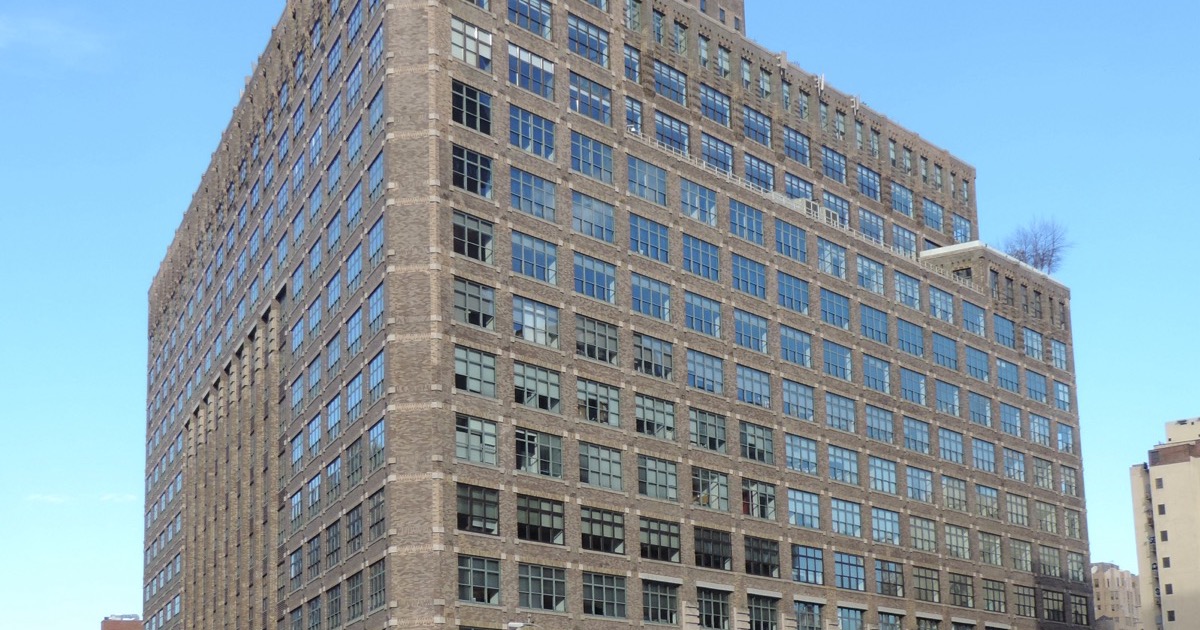
Case study Nº 24
Brookfield came back eleven years later — same price, two more buildings.
In 2015, Norway’s sovereign fund paid $1.56 billion for 44% of Trinity Church’s Hudson Square campus — 11 printing-district buildings on land the church has held since Queen Anne’s 1705 grant — valuing it at $3.55 billion. In July 2026, at the crest of the AI leasing boom, Brookfield entered exclusive talks for 10% at a reported $3.5 billion: the same nominal price for 13 buildings and a quarter more floor area, in a deal that — against the reel’s telling — has not closed, has no disclosed price, and appears in no principal’s own record. The tenant boom is real; almost none of its marquee names are tenants of the campus being priced.
Ben Fan, with Darryl WengJuly 22, 202617 min readWatch the reel
The campus as priced, Nov 2015 — 11 buildings
$3.55B
As priced in the Jul 2026 talks — 13 buildings
$3.5B
In November 2015, Norway’s sovereign wealth fund paid $1.56 billion for 44% of Trinity Church’s Hudson Square portfolio — 11 buildings, 4.9 million square feet — “valuing the properties at 3.55 billion dollars.”1 In July 2026, at the crest of the AI leasing boom the reel describes, Brookfield entered exclusive talks for a 10% stake at a reported valuation of $3.5 billion — for 13 buildings and 6.25 million square feet.16,17 The two numbers are the same size. The campus between them grew by a quarter. And the second number, unlike the first, has no primary document behind it yet: it is one newspaper’s report of an unclosed negotiation, which this study treats as exactly that. Jump to the slices ↓
The reel’s tenant story survives every check we could run. Anthropic really did take all sixteen floors of 330 Hudson Street — 466,000 square feet, with New York headcount doubling to 1,000 this year and room for 1,700 desks.19,20,21 PayPal’s 261,000 square feet at 345 Hudson is real.22 Google and Disney each occupy more than a million square feet in the neighborhood; asking rents on the campus jumped nearly 20% to more than $87 a square foot while citywide availability sat near 14%; New York is the country’s second venture market; January’s startup funding really was up 93.5% year over year.15,17,23,27,29,32 What fails is the frame around the deal. “Brookfield’s taking a 10% stake” describes a transaction that, as of every checkable source, has not closed — and “pay full price” runs backwards against the one record that exists: the campus’s own price history, kept in the seller’s primary disclosures since 2015.1,16
That history is unusually good, because one partner is a sovereign wealth fund that publishes its transactions. This study reads the reel’s deal against it — and against a landlord whose records begin with a rent of one peppercorn.1,10
| The campus at a glance | Number |
|---|---|
| The land | 215 acres granted by Queen Anne in 1705; 14–15 acres retained (the church and the NYT disagree by an acre)8,12,13 |
| The campus | 13 buildings, 6.25M sq ft — the old Printing District’s lofts plus the ground-up 555 Greenwich9,37,38 |
| The 2015 mark | $3.55B — Norges pays $1.56B for 44% of a 75-year interest, debt-free, 94% leased1 |
| The settled split | Trinity 51% · Norges 48% · Hines 1%, from June 20164,5 |
| The later cheques | $223M for 48% of 375 Hudson (2017) · ≈$98M to extend the term to 99 years (2019)6,7 |
| The 2026 talks | Brookfield, 10% at a reported $3.5B valuation, replacing Hines as operator — exclusive talks, unclosed, price undisclosed16,17,18 |
| The arithmetic the reel skips | ≈$720/sq ft in 2015 → ≈$560/sq ft in the 2026 talks — our division, roughly a fifth lower1,17 |
| The anchor tenant’s landlord | Anthropic’s 330 Hudson is AEW Capital Management’s building — not one of the venture’s 1320,37 |
| The campus’s own AI-era lease | PayPal: 261,000 sq ft at 345 Hudson, ten years, signed before 2025 ended22 |
| The giants next door | Google owns 550 Washington ($2.1B, 2022) · Disney holds a 99-year Trinity ground lease ($650M, 2018)15,23 |
| The rent and the vacancy, both true | Asking rents up ~20% to $87+/sq ft — while C&W puts the submarket’s vacancy at 23% against Manhattan’s 19%17,18 |
| The landlord’s balance sheet | A $6B endowment; $1.73B of partnership proceeds by 2019; $502M given since 20198,13 |
| The buyer’s decade | 2015: loses the auction for this campus · 2023: $784M of DTLA defaults · 2026: returns for 10%2,24,16 |
Two hundred and fifteen acres and one peppercorn
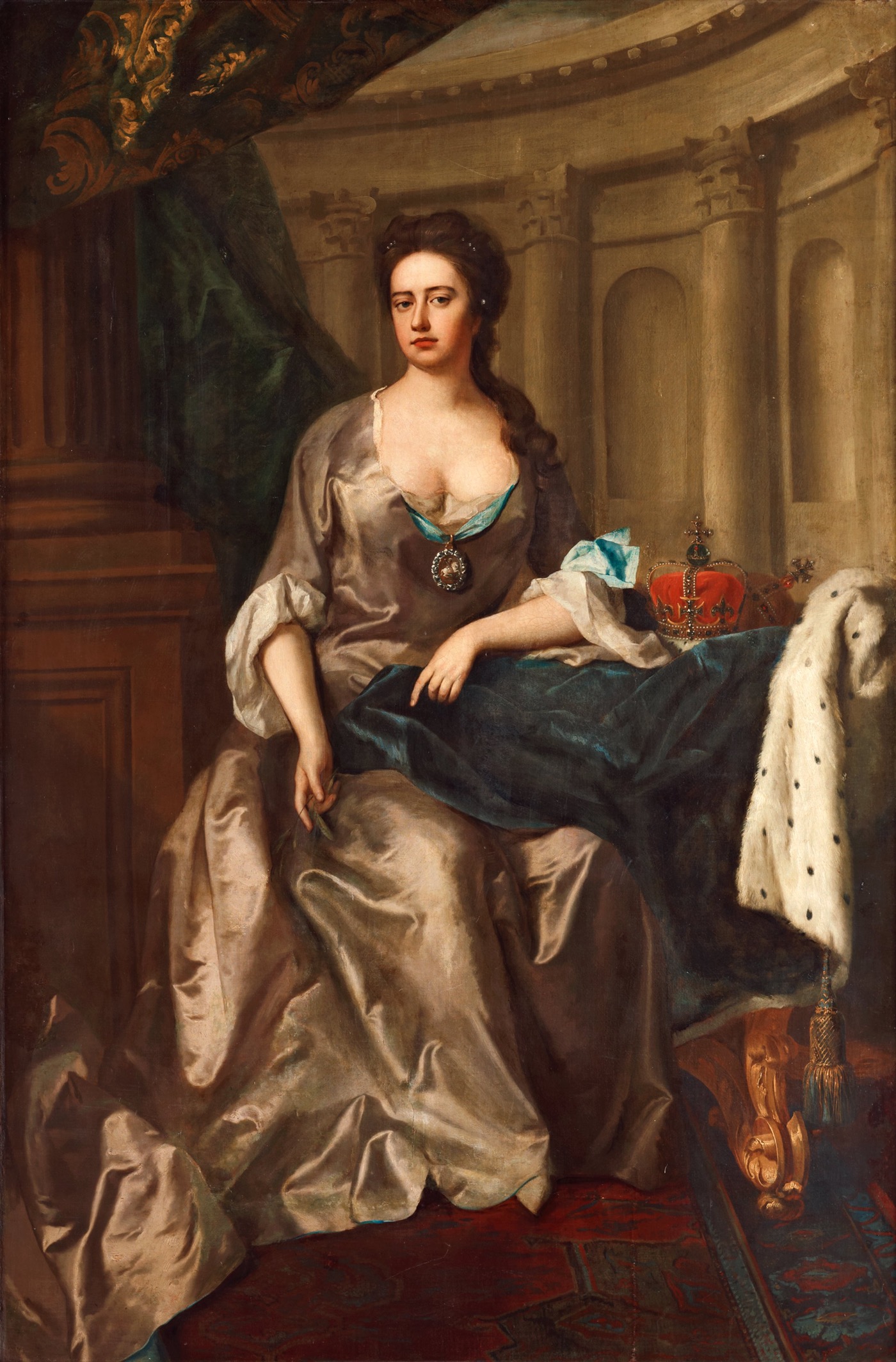
The landlord in this deal predates the United States by seven decades. King William III chartered Trinity Church in 1697 — the incorporation document sets its rent to the crown at one peppercorn a year — and in 1705 Queen Anne granted it the Queen’s Farm: 215 acres of the island’s west side, from today’s Fulton Street to Christopher Street.8,10 The title was contested almost immediately and almost forever: the grant brushed against England’s mortmain limits on church landholding, and the heirs of Anneke Bogardus — the Dutch farm wife whose Dominie’s Bouwerie the Queen’s Farm had absorbed — sued for 62 of the acres across a century and a half. Trinity won on possession, in cases that became national law.11 As for the peppercorn: the record shows it paid exactly once, in 1976, when the rector handed Queen Elizabeth II 279 of them — back rent, on the church steps.10
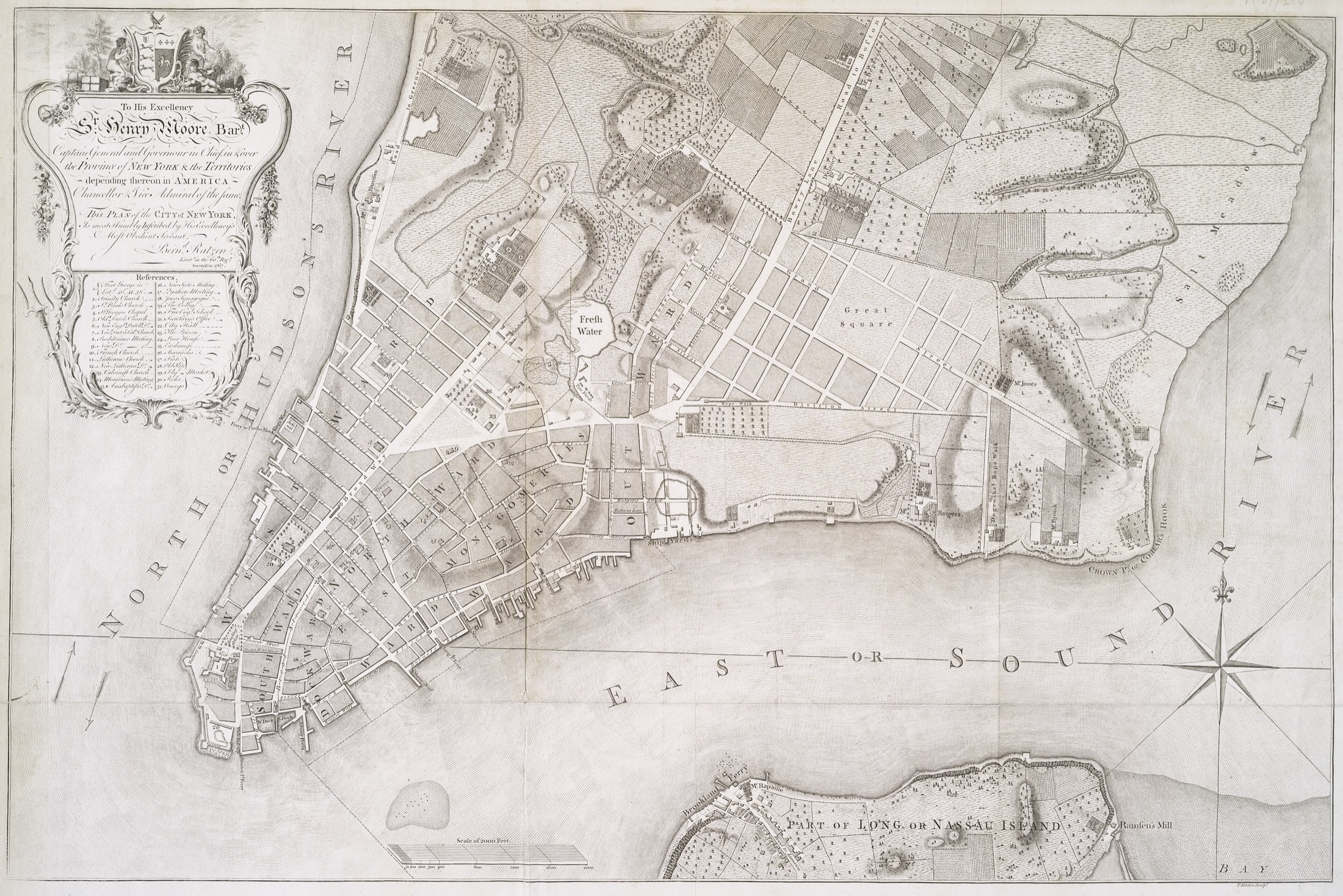
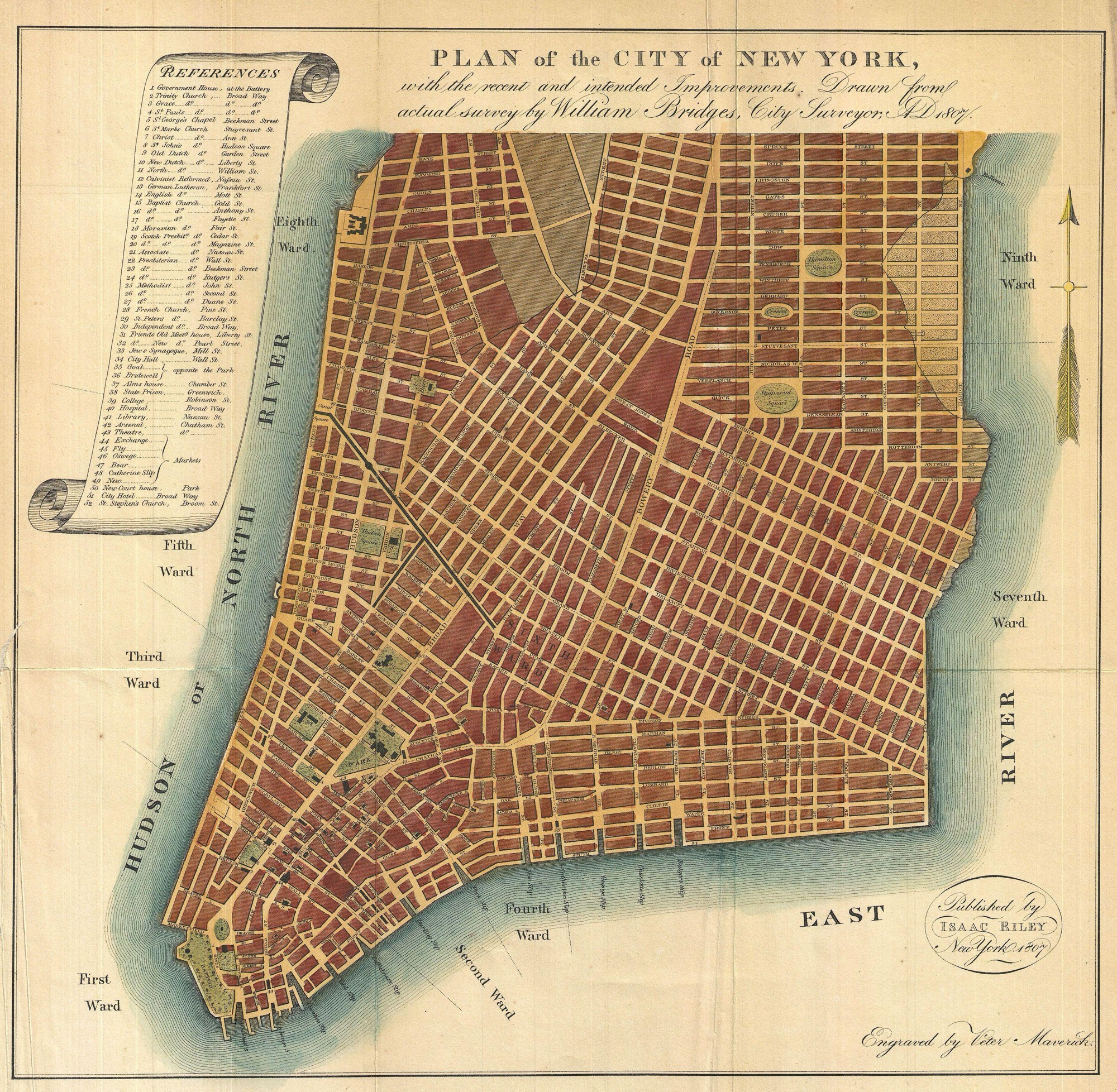
The church gave away or sold most of the 215 acres across three centuries; what it kept is the point. The New York Times put the remainder at 14 acres and 5.5 million square feet of commercial space in 2013 and again in 2019; Trinity’s own materials now say 15 acres. No source explains the extra acre, and this study carries the disagreement rather than resolving it.8,9,12,13 What is not in dispute is where those acres sit: the old Printing District between the Holland Tunnel and SoHo — drawn and named Hudson Square on William Bridges’ city plan as early as 1807.35,36
The re-slicing of the farm
The modern structure begins with a rezoning and a lawsuit. In 2013 Trinity — advised by Carl Weisbrod, hired in 2005 to run its real estate — won its own Special Hudson Square District through the Council, opening the printing lofts’ neighborhood to residential towers and lifting the value of everything the church had kept.13,14 The same year, a parishioner’s lawsuit forced the first public accounting: assets above $2 billion, $158 million of real estate revenue in 2011 — against roughly $3 million a year of grant-making. Nearly half the vestry had just resigned or been pushed out in the fight over what a wealthy church owes; one departing member wrote that the leadership had “created a glaring atmosphere of deceit.”12 That tension — a tax-exempt landlord richer than most REITs, giving away a sliver of its yield — is the stain this study carries on the landlord, and the church’s answer since is also in the record: giving rose from $3.2 million a year to $10 million by 2019 to $502 million cumulatively since 2019.8,12,13
Then, rather than sell its farm, the church sold slices of time on it. The 2015 auction drew SL Green, Vornado, Ivanhoe Cambridge — and Brookfield. Norway’s fund won: $1.56 billion for 44% of a 75-year ownership interest in 11 buildings, valuing them at $3.55 billion, debt-free.1,2,3 Norges added 4% for $142 million in 2016 as Hines came in to operate with 1%; bought 48% of 375 Hudson Street for $223 million in 2017; and in 2019 paid roughly $98 million more to reset the venture’s term to a fresh 99 years.4,5,6,7 Disney arrived in 2018 the same way everyone deals with Trinity — as a tenant: a 99-year ground lease on the full block at Four Hudson Square, valued at $650 million.15 By 2019 the partnership had produced $1.73 billion of proceeds, folded into a diversified endowment the church now states at $6 billion.8,13 The farm was never sold. It was converted into a perpetual annuity, one 99-year slice at a time.
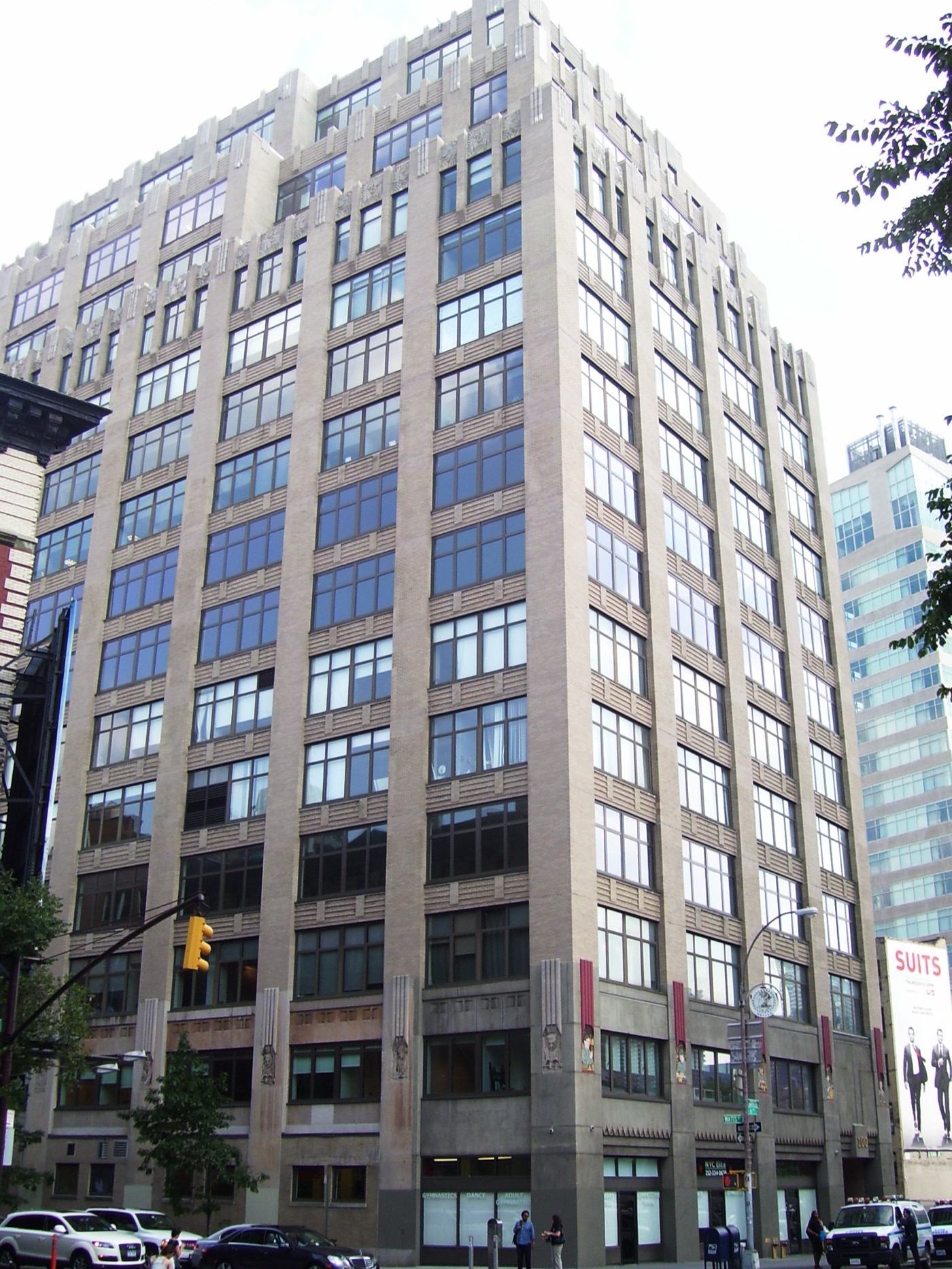
Broadway and Wall Street
The landlord has outlasted every tenant it has ever had.
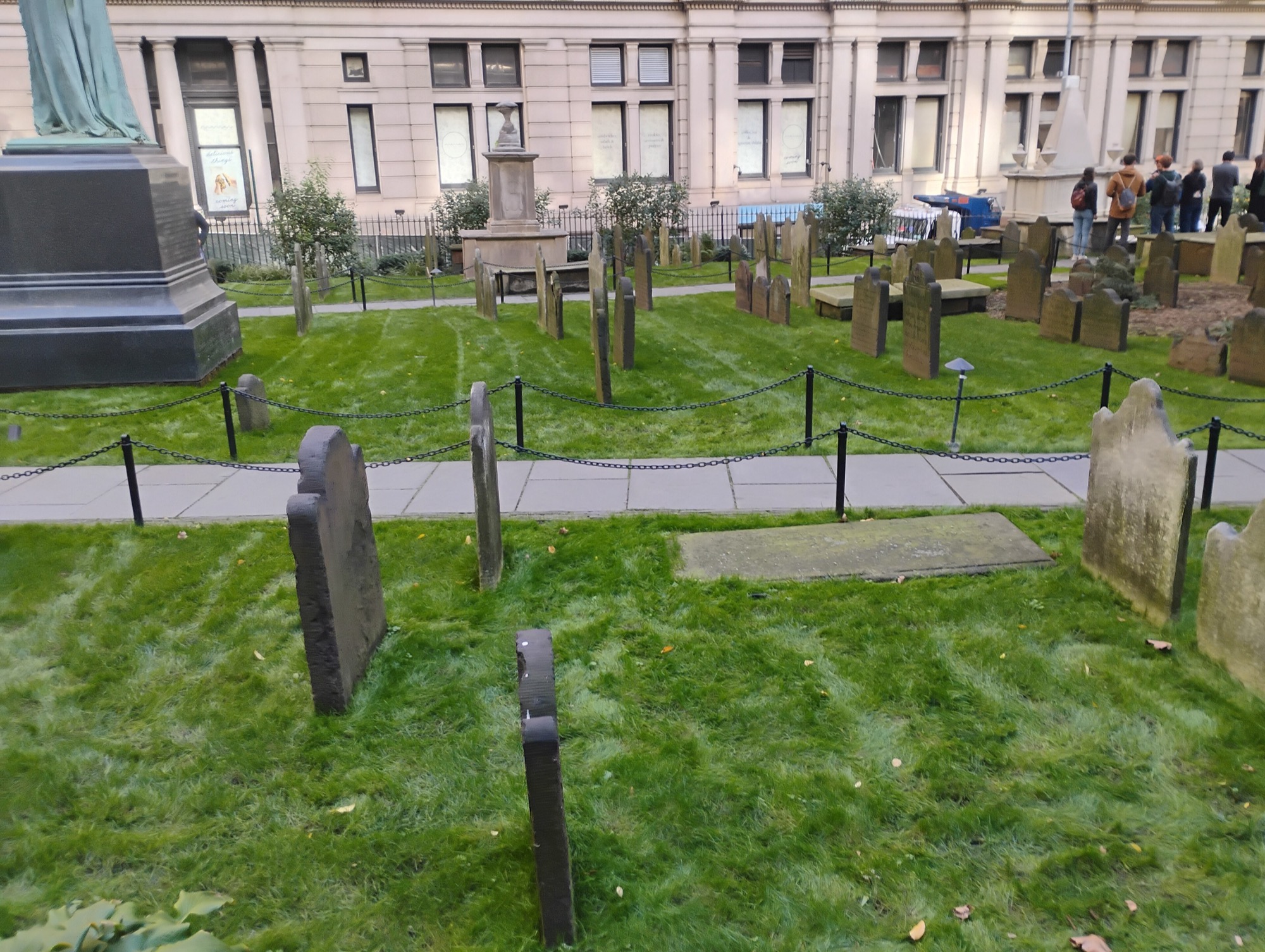
Trinity's churchyard against the towers. The parish buried its first tenants' generation in this yard; the venture it majority-owns is negotiating with its newest tenant's operator across three centuries of the same land.Photo: Ferfive, CC BY 4.0, via Wikimedia Commons
One campus, sliced twice
The settled 2016 structure of the $3.55 billion valuation, above the proposed 2026 structure of the reported $3.5 billion. Two bars of almost identical length, eleven years apart — with two more buildings and 1.35 million more square feet inside the second one.
As reportedly priced by the 2026 talks — 13 buildings, 6.25M sq ft, unclosed
$3.5 billion
As reportedly priced by the 2026 talks — 13 buildings, 6.25M sq ft, unclosed · $3.5 billion
Trinity and Norges — the remaining 90%≈$3.15B
- Trinity Church Wall Street — 51%1,5 ⁘≈$1.81B
- Norges Bank Investment Management — 48%1,4$1.70B
- Hines — 1%, the operator5 ⁘≈$36M
As reportedly priced by the 2026 talks — 13 buildings, 6.25M sq ft, unclosed · $3.5 billion
Sourced, and not part of that total
Never published
- Hines’ exit — its stake’s priceUndisclosed
Stack A’s only sourced dollar figure is Norges’ own: $1.56 billion plus $142 million, disclosed by the fund itself. The Trinity and Hines lines apply the Hines-announced percentages to the NBIM-announced valuation — our arithmetic, drawn hatched.1,4,5 Stack B is one reported number and one reported percentage from an unclosed negotiation; every dollar shown in it is inference, and the resulting Trinity–Norges split is not disclosed anywhere.16,17,18 The per-foot comparison — roughly $720 then, roughly $560 now — is also ours, and appears in no fetched article. What the record states plainly is only this: the same nominal price, eleven years and two buildings apart.
| Line | Amount | How it is counted |
|---|---|---|
| As priced by the 2015 deal — 11 buildings, 4.9M sq ft, debt-free — Trinity Church Wall Street — 51% | ≈$1.81B | inferred from the sourced total, drawn hatched |
| As priced by the 2015 deal — 11 buildings, 4.9M sq ft, debt-free — Norges Bank Investment Management — 48% | $1.70B | sourced, and part of the total |
| As priced by the 2015 deal — 11 buildings, 4.9M sq ft, debt-free — Hines — 1%, the operator | ≈$36M | inferred from the sourced total, drawn hatched |
| As reportedly priced by the 2026 talks — 13 buildings, 6.25M sq ft, unclosed — Brookfield — the proposed 10% | ≈$350M | inferred from the sourced total, drawn hatched |
| As reportedly priced by the 2026 talks — 13 buildings, 6.25M sq ft, unclosed — Trinity and Norges — the remaining 90% | ≈$3.15B | inferred from the sourced total, drawn hatched |
| As reportedly priced by the 2026 talks — 13 buildings, 6.25M sq ft, unclosed — Hines’ exit — its stake’s price | Undisclosed | never published |
| As priced by the 2015 deal — 11 buildings, 4.9M sq ft, debt-free — 375 Hudson Street — the twelfth building, 2017 | $223M | sourced, but a different kind of number — not added to the total |
| As priced by the 2015 deal — 11 buildings, 4.9M sq ft, debt-free — The 99-year term reset, 2019 | ≈$98M | sourced, but a different kind of number — not added to the total |
| As priced by the 2015 deal — 11 buildings, 4.9M sq ft, debt-free | $3.55 billion | the sourced total |
| As reportedly priced by the 2026 talks — 13 buildings, 6.25M sq ft, unclosed | $3.5 billion | the sourced total of the second structure |
One campus, sliced twice
The majority slice never moves. Trinity’s 51% is the constant across every transaction in the record — the church has re-sliced its farm for three centuries without ever selling the whole of it, and the venture’s 99-year term is the modern form of the same instinct.5,8,9 By 2019 the slicing had yielded $1.73 billion of proceeds and a $6 billion diversified endowment.8,13
Set the two bars against each other and the reel’s “pay full price” inverts. $3.55 billion bought the 2015 campus at roughly $720 a square foot; $3.5 billion is said to price the 2026 campus — two buildings and 1.35 million square feet larger, after the strongest Manhattan leasing half-year since 2002 — at roughly $560.1,17,31 That division is ours and appears in no article; the flat nominal number is simply what the record says twice. Eleven years of boom, and the campus is marked at its old price with more building inside it.
- Trinity Church Wall Street — 51%1,5 ⁘≈$1.81B
- Norges Bank Investment Management — 48%1,4$1.70B
- Hines — 1%, the operator5 ⁘≈$36M
As reportedly priced by the 2026 talks — 13 buildings, 6.25M sq ft, unclosed · $3.5 billion
Sourced, and not part of that total
Never published
- Hines’ exit — its stake’s priceUndisclosed
Stack A’s only sourced dollar figure is Norges’ own: $1.56 billion plus $142 million, disclosed by the fund itself. The Trinity and Hines lines apply the Hines-announced percentages to the NBIM-announced valuation — our arithmetic, drawn hatched.1,4,5 Stack B is one reported number and one reported percentage from an unclosed negotiation; every dollar shown in it is inference, and the resulting Trinity–Norges split is not disclosed anywhere.16,17,18 The per-foot comparison — roughly $720 then, roughly $560 now — is also ours, and appears in no fetched article. What the record states plainly is only this: the same nominal price, eleven years and two buildings apart.
The tenant story, audited
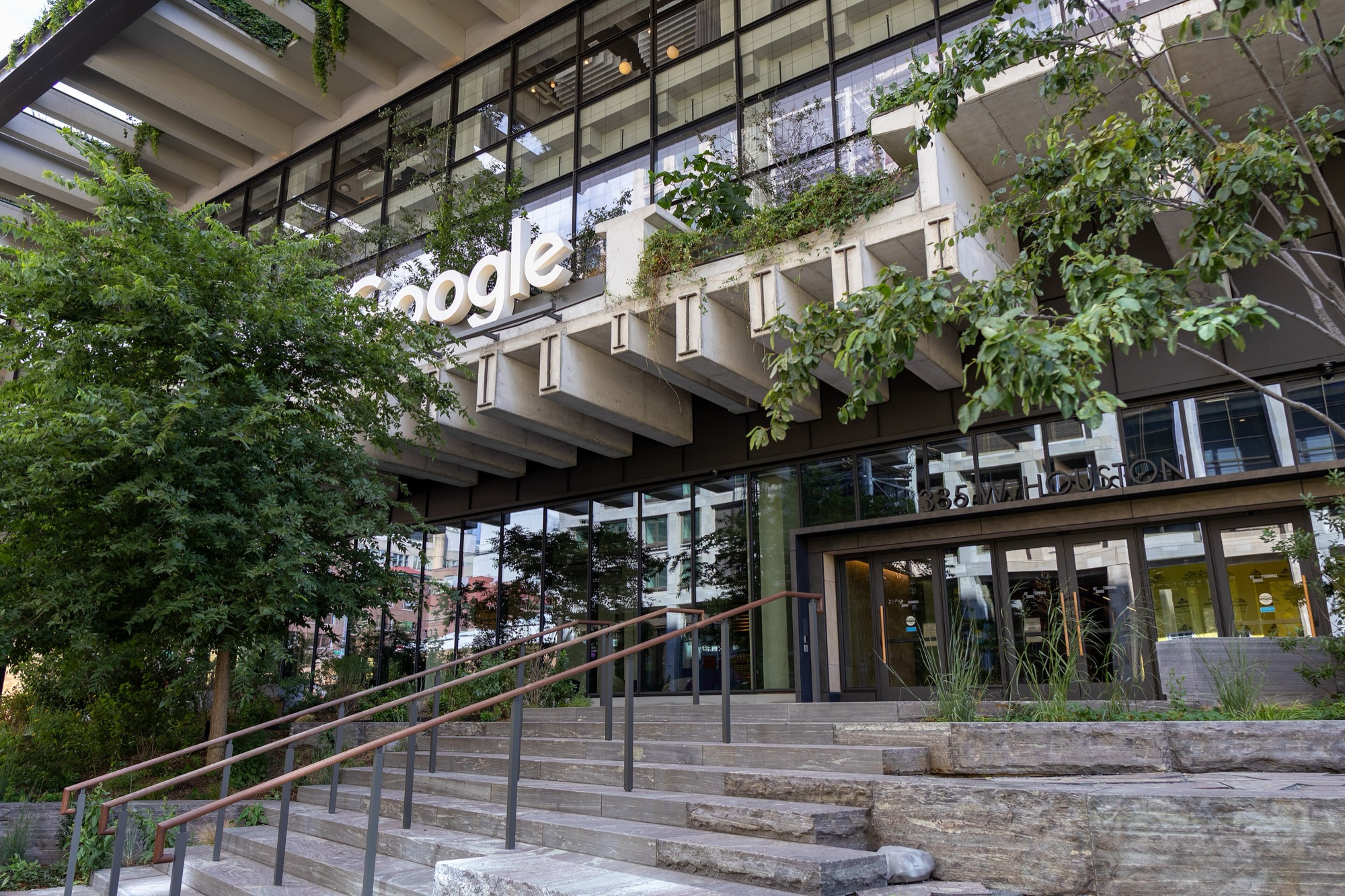
The reel’s strongest material is its most checkable, and it checks out — with one systematic slippage: almost none of the marquee names are tenants of the campus being priced. Anthropic’s sixteen floors at 330 Hudson belong to AEW Capital Management’s building, not to the venture’s thirteen.20,37 Google’s 1.3 million square feet at St. John’s Terminal sit in a building Google has owned outright since paying Oxford $2.1 billion in 2022.23 Disney’s million square feet rise on a Trinity ground lease — the church gets paid, but outside the portfolio the talks would price.15 The campus’s own AI-era trophy is PayPal: 261,000 square feet at 345 Hudson, ten years, signed before 2025 closed — joined by Tennr, and by renewals from Notion and RadicalMedia inside the portfolio.16,22 The boom is real and it is genuinely nearby. It is mostly other people’s buildings.
The cluster arithmetic behind the tenants holds too, with its labels straightened. New York is the country’s second venture market — $28.5 billion and 13.3% of national funding in 2024, against the Bay Area’s $99.4 billion — and January 2026’s $1.68 billion really was up 93.5% year over year.27,29 The city’s own development corporation counts more than 2,000 AI startups and about 40,000 workers with AI-related skills — its phrase; the reel’s “40,000 AI engineers” hardens a soft category, and its “biggest cluster outside San Francisco” appears in no published source, where NYCEDC itself claims a top-three market alongside the Bay Area and Seattle.28 And AI’s office appetite is best stated as a slope, not a level: 265,000 square feet leased in 2023, 414,000 in 2024, 486,000 in nine months of 2025, then roughly 800,000 in the second quarter of 2026 alone — more than a third of tech demand by Colliers’ count, and 40% of July’s ten largest deals by square footage.20,30,31,34 Against Manhattan’s 22.8 million square feet of first-half leasing, it is still the garnish, not the meal — the fastest-growing small number in the market.31
- Hudson Square & West Village submarket (Cushman & Wakefield, Q2 2026 — vacancy)1823%The hottest-story neighborhood in the city runs its highest published emptiness figure — C&W’s broad-submarket cut, quoted in the same week’s deal coverage.
- The 13-building portfolio itself (Avison Young — availability)1717.1%Avison Young’s portfolio-specific figure, alongside its finding that asking rents rose nearly 20% to $87+. High availability and rising rents, in the same buildings, at once.
- Manhattan citywide (Colliers 13.0 · CBRE 14.4 · Comptroller ≈14 — availability)31,32,33≈14%The reel’s "rest of the city runs ~14%" is right — which means the celebrated submarket is emptier than the city it is supposedly outperforming, on every methodology published.
All three rungs are real, current, and mutually contradictory only if you expect one number called “vacancy” to exist. Scope and methodology differ — a broad submarket, a specific portfolio, a whole borough — and the reel quotes the only rung that flatters the story. The honest composite: Hudson Square’s rents are rising fastest exactly where measured emptiness remains highest, because the AI tenancy is bidding for a specific kind of loft floor, not for space in general.17,18
The buyer’s decade
The reel’s Brookfield arc — “mailed the keys back in 2023, paid full price in 2026” — compresses a stranger record. The keys: in February 2023 Brookfield’s DTLA fund defaulted on $784 million tied to two Los Angeles towers — $465 million on the Gas Company Tower, $319 million on 777 South Figueroa — a figure Bloomberg’s same-week count renders as $755 million, package versus outstanding balance; by May the fund’s defaults reached roughly $1.1 billion across three towers, and bondholders put them into receivership. Los Angeles, not New York; taken, not mailed.24,25,26 The return: a 10% minority slice of a campus it tried to buy into in 2015 and lost — at a valuation flat to that year — pitched to its investors while the firm refinances $8 billion of office debt and plans $10 billion of sales by decade’s end.2,16,18 Even the trade press strained against the number: the same article that reports $3.5 billion three times also prints “$35 billion, or $5,600 per square foot” — an uncorrected slip this study leaves exactly as published, as the record’s own reminder to check arithmetic against sources.17 The reel’s last line says AI mailed the keys back to Brookfield. The record says Brookfield is negotiating to carry the church’s keys, for a fee and a tenth of the equity, at 2015’s price.
The sequence
1697
King William III charters Trinity Church — its incorporation document, with a yearly rent to the crown of one peppercorn. The record holds no payment until 1976, when the rector hands Queen Elizabeth II 279 peppercorns of back rent on the church steps.10
1705
Queen Anne grants the church 215 acres of the west side — the Queen’s Farm, formerly Dominie’s Bouwerie, running from today’s Fulton Street to Christopher Street. The Bogardus heirs contest 62 acres of the title for a century and a half; Trinity wins on possession, in cases that shape American adverse-possession law.8,11
1807
William Bridges’ city plan draws the grid across the church’s farm — with a park on it already named Hudson Square. The neighborhood that grows there prints: by the twentieth century this is the Printing District, and in 1920 ground breaks at Canal and Washington for the Holland Tunnel.36
2013
Trinity, holding 14 acres and 5.5 million square feet of the original grant, wins its own rezoning of Hudson Square (Council, 13 March, with a $5.6 million open-space contribution) — and a parishioner’s lawsuit forces the first public estimate of its wealth: assets above $2 billion, against $3 million of annual grant spending. Half the vestry has just resigned or been pushed out.12,13,14
Aug–Nov 2015
The church auctions a partner’s share of 11 buildings: SL Green, Vornado, Ivanhoe Cambridge and Brookfield bid; Norway’s sovereign wealth fund wins. NBIM’s own disclosure fixes the record: 44% of a 75-year ownership interest for $1.56 billion, "valuing the properties at 3.55 billion dollars," debt-free, 94% leased.1,2,3
$1.56B · $3.55B mark
2016
Norges adds 4% for $142 million; Hines becomes operating partner with a 1% equity stake. The settled structure, from Hines’ own release: Trinity 51, Norges 48, Hines 1.4,5
+$142M
2017–2019
The venture grows by disclosure: 48% of 375 Hudson Street for $223 million (an $865 million valuation, carrying the campus’s only stated mortgage), then roughly $98 million to extend the term to a fresh 99 years, with two ground-up towers agreed — including 555 Greenwich.6,7,9
+$223M · +$98M
Jul 2018
Disney takes the full block at Four Hudson Square on a 99-year lease from Trinity valued at $650 million — the neighborhood’s first giant, arriving as a ground-lease tenant of the church, not a buyer.15
$650M lease
Feb 2024
Google opens 1.3 million square feet at St. John’s Terminal — a building it bought outright for $2.1 billion in 2022. The second giant is an owner-occupier: on the campus’s doorstep, in nobody’s portfolio but its own.23
$2.1B purchase
2025
The AI tenancy arrives in the record: AI-core companies lease 486,000 square feet in nine months, more than 2023 and 2024 combined; PayPal signs 261,000 square feet at 345 Hudson — the venture’s flagship — before year-end.22,30
Jul 2026
Anthropic finalizes all sixteen floors of 330 Hudson Street — 466,000 square feet, from AEW Capital Management, with headcount doubling to 1,000 — and six days later the WSJ reports Brookfield in exclusive talks for 10% of Hudson Square Properties at a $3.5 billion valuation, taking over as operator as Hines exits. No principal comments; no price is disclosed; no primary release exists.16,17,19,20
$3.5B talks
Aug 2026
As of this study, the record still holds no closing: NBIM’s press archive and Brookfield’s carry no Hudson Square announcement, and the operator’s own portfolio page still names Hines. The deal the reel narrates as done remains, in every checkable source, a report of talks.16,38
What transfers
The first lesson is the difference between a reported deal and a recorded one. Every prior transaction on this campus exists as a primary document — a seller’s disclosure with dollars in it. The 2026 deal exists as one newspaper’s account of talks, relayed by every other outlet, converging on the same three facts because they share one anonymous source. Neither kind of knowledge is worthless, but they are different substances, and a two-minute video renders both identically. When a deal matters to your thinking, find out which substance you are holding.
The second is that flat nominal is a verdict, not a neutral fact. A campus that adds two buildings and a quarter more floor area while its headline valuation stands still has been repriced downward per foot by about a fifth — through the exact boom the market narrative celebrates. Sellers understand this, which is why headline numbers are the ones that travel. Divide by the denominator before accepting any “full price.”
The third is the vacancy paradox as a general instrument. One neighborhood simultaneously supports a 23% submarket vacancy figure, a 17% portfolio availability figure, and rents rising 20% — because averages, portfolios, and marginal deals are three different markets. The reel quoted the city’s 14% to make the neighborhood look tight; the neighborhood’s own published figures run looser than the city. Any time a location story leans on one occupancy number, ask which of the three markets it was measured in.
And the last is the landlord lesson, which is the oldest thing in this room. Trinity has converted one royal grant into three centuries of income by refusing, in every era, to sell the thing itself — leasing development rights to Disney for 99 years, selling Norges a 75-year interest and then selling it back the years it had used, letting operators come and go on 1% and a fee. The tenants change — typesetters, admen, Disney, Anthropic’s neighbors — and the landlord has outlasted every tenant it has ever had. Whoever operates the campus next, the peppercorn stays where it has been since 1697: with the church.
Common questions
- What is Hudson Square Properties, and who owns it?
- It is a joint venture holding 13 office buildings totaling about 6.25 million square feet in Hudson Square, the old Printing District between SoHo and the Holland Tunnel. Trinity Church Wall Street owns 51% — the land descends from Queen Anne’s 1705 grant of 215 acres — Norway’s sovereign wealth fund (Norges Bank Investment Management) owns 48% through a 99-year ownership interest bought in stages from 2015, and Hines has operated the portfolio since 2016 with a 1% stake. In July 2026 the Wall Street Journal reported Brookfield in exclusive talks to buy a 10% interest at a $3.5 billion valuation and replace Hines as operating partner.
- Did Brookfield actually buy the stake?
- Not in any record this study could check. As of mid-August 2026 the transaction exists only as reports of exclusive talks — first broken by the WSJ on July 13, sourced to unnamed people, "expected to close in the coming months," with no purchase price disclosed. Trinity and Hines declined comment; Brookfield and Norges did not respond. Norges publishes a press release for every unlisted real-estate transaction and has published none for this; Brookfield’s own press feed carries nothing; Hines’ portfolio page still lists itself as operator. The reel presents a done deal. The record holds a negotiation.
- Is Brookfield paying a premium for an AI-hot campus?
- The available arithmetic says the opposite. NBIM’s own 2015 disclosure valued 11 buildings and 4.9 million square feet at $3.55 billion — roughly $720 per square foot, debt-free, 94% leased. The reported 2026 talks value 13 buildings and 6.25 million square feet at $3.5 billion — roughly $560 per square foot, about a fifth lower, with the same nominal headline. That per-foot division is this study’s own and appears in no published article; the two valuations themselves are the record’s. Eleven years, an AI boom, and two additional buildings produced a flat headline number — which is a statement about how far Manhattan office values fell in between, not about froth.
- Are Anthropic, Google, and Disney tenants of the campus Brookfield is buying into?
- No — and that is the reel’s systematic slippage. Anthropic’s 466,000-square-foot, 16-story lease at 330 Hudson Street is with AEW Capital Management, whose building is not among the venture’s thirteen. Google owns St. John’s Terminal outright, having bought it for $2.1 billion in 2022. Disney’s headquarters rises on a 99-year ground lease from Trinity valued at $650 million — the church collects, but outside the portfolio being priced. The campus’s own marquee AI-era lease is PayPal’s 261,000 square feet at 345 Hudson, with Tennr, Notion, and RadicalMedia deals inside the portfolio too. The neighborhood boom is real; the buildings it fills are mostly other landlords’.
- How can rents be up 20% if the neighborhood’s vacancy is higher than the city’s?
- Because three different measurements are all true at once. Cushman & Wakefield puts the broad Hudson Square/West Village submarket at 23% vacancy against Manhattan’s 19%; Avison Young puts the 13-building portfolio’s availability at 17.1% against roughly 14% citywide; and the same Avison Young data shows portfolio asking rents up nearly 20% to more than $87. Averages describe all space; marginal deals price specific space. AI tenants are bidding hard for a particular kind of large, character loft floor while plenty of ordinary space sits empty nearby — so the neighborhood can be simultaneously emptier than the city and repricing faster than it. Any story quoting one vacancy number chose it.
Sources
- Norges Bank Investment Management (press release) — Fund makes new investment in New York City — the primary record of the 2015 deal: 44% of an 11-building, 4.9M sq ft portfolio for $1.56 billion, a 75-year ownership interest, "valuing the properties at 3.55 billion dollars," unencumbered by debt, 94% leased (2015-11-20)
- The Real Deal — Trinity, Norges ink massive Hudson Square deal — the auction record: bids taken in August 2015 from SL Green, Vornado, Brookfield Property Partners and Ivanhoe Cambridge, CBRE’s Darcy Stacom marketing (2015-09-10)
- The Real Deal — Trinity–Norges deal values buildings at $3.6B — the binding contract, the 215-acre 1705 grant, and the church on diversifying assets "overwhelmingly in real estate" (2015-11-25)
- Norges Bank Investment Management (press release) — Fund acquires larger share of Hudson Square portfolio — 4% more for $142 million in 2016, taking Norges to 48% and its total investment to $1.7 billion (2016-06-07)
- Hines (press release) — Trinity Church Wall Street and Norges Bank Real Estate Management select Hines as operating partner — the settled split in one sentence: Trinity 51%, Norges 48%, Hines a 1% equity stake, effective 1 June 2016 (2016-04-29)
- Norges Bank Investment Management (press release) — Fund expands Hudson Square portfolio — 48% of 375 Hudson Street for $223 million in 2017, an $865 million valuation, a 93-year interest, and the campus’s only disclosed mortgage: $400 million (2017-08-21)
- Norges Bank Investment Management (press release) — Fund extends partnership with Trinity Church Wall Street and Hines — roughly $98 million in 2019 to stretch the remaining 72-year term to a fresh 99 years, plus agreements on two to-be-built assets (2019-04-17)
- Trinity Church Wall Street — Trinity’s historic endowment — the church’s own account: the 1705 grant of 215 acres from Fulton to Christopher Street, the $6 billion endowment, $502 million in giving since 2019, and the 2015 decision to diversify a portfolio "almost exclusively composed of real estate" (2025-12-18)
- Trinity Church Wall Street — The gift of land — "for centuries… the largest landholder on the island of Manhattan"; the remaining 15 acres, the 13-building, 6.3M sq ft portfolio, and 555 Greenwich rising 16 stories from the ground up (2025-11-12)
- Trinity Church Wall Street — Top ten things to know about Trinity Church NYC — the 1697 charter from King William III, the yearly rent of one peppercorn, and the 279 peppercorns of back rent presented to Queen Elizabeth II in 1976 (2026-04-15)
- American Bar Association, Probate & Property (Jerry L. Anderson) — Adverse possession in Lower Manhattan — the land’s deed chain from Dominie’s Bouwerie to the Queen’s Farm, the mortmain-law doubts over the grant, and the Bogardus heirs’ 150-year title fight Trinity won on possession (2026-05-01)
- The New York Times (Sharon Otterman) — Trinity Church split on how to spend its wealth — the 2013 disclosure forced by a parishioner’s lawsuit: assets above $2 billion, 14 acres and 5.5M sq ft kept from the original 215, $158 million of 2011 real estate revenue against $3 million of grant spending, and half the vestry gone (2013-04-24)
- The New York Times (Jane Margolies) — The church with the $6 billion portfolio — Carl Weisbrod’s 2013 rezoning, the JV with Norges managed by Hines, $1.73 billion of proceeds folded into diversified investments since 2015, and giving at $10 million a year (2019-02-08)
- CityLand (New York Law School) — Trinity Church’s Special Hudson Square District wins Council approval — 13 March 2013, with modifications, and the church’s $5.6 million open-space contribution (2013-03-18)
- The New York Times (Charles V. Bagli) — Disney’s move to Hudson Square — the 2018 deal in the paper of record: a 99-year lease from Trinity Church on the full block at Four Hudson Square, "valued at $650 million," for a one-million-square-foot complex (2018-07-09)
- Commercial Observer (Emily Davis) — Brookfield seeks stake in Hudson Square Properties portfolio — the deal as it actually stands: exclusive talks, first reported by the WSJ, 10% of 13 properties at a $3.5 billion valuation, Hines exiting per an unnamed source, all four principals declining comment (2026-07-13)
- The Real Deal — Brookfield eyes 10% stake in Manhattan tech hub — the $3.5 billion valuation, Avison Young’s rent and availability figures, and, two paragraphs later, the same portfolio stated as "$35 billion, or $5,600 per square foot": the record’s own uncorrected arithmetic (2026-07-13)
- Bisnow (Sasha Jones) — Brookfield in talks for Hudson Square Properties stake — the recapitalization framing, Hines’ exit, Brookfield’s own decade ($3B+ of assets offloaded at discounts; plans to refinance $8B of office debt and sell $10B by 2030), and Cushman & Wakefield’s 23% submarket vacancy against Manhattan’s 19% (2026-07-13)
- The New York Times (Fitzsimmons & Lohr) — Anthropic leases a 16-story building as AI booms in New York — doubling the workforce to 1,000 this year, room for more than 1,700 desks, and OpenAI’s 90,000 sq ft for contrast (2026-07-07)
- The Real Deal — Anthropic finalizes Hudson Square lease — 466,000 sq ft at 330 Hudson Street from AEW Capital Management; the 15,000 sq ft at 155 Sixth Avenue it replaces; and Colliers: AI took more than a third of tech demand in Q1 2026, up from 12% in 2025 (2026-07-08)
- New York Post — Anthropic to occupy all 16 floors at 330 Hudson — headcount from under 500 at the start of 2026 to more than 1,000 by year-end, and the company’s own framing: "New York is one of the main hubs for how AI is being put to work" (2026-07-08)
- The Real Deal — PayPal inks deal for Hudson Square office — 261,000 sq ft at 345 Hudson Street, a ten-year lease in the Trinity–Norges–Hines joint venture’s flagship building; Newmark’s broader-submarket rent at $99.13 and availability at 21.3% (2026-01-12)
- Commercial Observer (Rebecca Baird-Remba) — Google opens its offices at St. John’s Terminal — 1.3 million sq ft at 550 Washington Street, February 2024, in a building Google bought outright from Oxford Properties for $2.1 billion in 2022 (2024-02-22)
- The Real Deal — Brookfield defaults on $784M of loans on DTLA office towers — the 2023 record the reel compresses: $465 million on the Gas Company Tower, $319 million on 777 South Figueroa, both in downtown Los Angeles (2023-02-13)
- Fortune (Bloomberg, John Gittelsohn) — Brookfield defaults on two Los Angeles office towers — the same event counted as $755 million, because outstanding balance and loan package are different numbers; the record keeps both (2023-02-14)
- The Real Deal (2023 retrospective) — Brookfield’s DTLA towers lead SoCal’s top defaults of 2023 — the full tally: about $1.1 billion across three towers including EY Plaza, and the CMBS bondholders’ receivership suits that followed (2024-01-02)
- Office of the New York State Comptroller — Venture capital investment in New York City (Report 13-2026) — 2024: $28.5 billion and 13.3% of national VC, second only to the Bay Area’s $99.4 billion and 46.3% (2025-10)
- NYCEDC (New York City’s AI Advantage, 2025 report) — The cluster measured — over 2,000 AI startups, roughly 40,000 workers with AI-related skills (the report’s wording, broader than "engineers"), 35 AI unicorns, and a top-three talent market alongside the Bay Area and Seattle (2025-01)
- AlleyWatch (January 2026 NY venture report) — NYC startups raised $1.68B in January 2026 — a 93.5% year-over-year surge on Crunchbase data, 26.3% of national venture funding that month (2026-02)
- Bisnow (Savills data) — AI’s NYC office footprint hits a growth spurt — 486,000 sq ft leased by AI-core companies in nine months of 2025, against 414,000 in all of 2024 and 265,000 in 2023; still a drop in Manhattan’s 31M sq ft bucket (2025-10-02)
- The Real Deal (Colliers Q2 2026 data) — Tightening office market pushes Manhattan rents higher — 22.8M sq ft leased in the first half, the strongest since 2002; availability at 13%; AI tenants took roughly 800,000 sq ft in Q2 alone, more than all of 2025 (2026-07-01)
- CBRE (Manhattan office figures, Q2 2026) — The broker’s own quarterly read — leasing 24% above the five-year average, availability down 310 bps year-over-year to 14.4% (2026-07)
- NYC Comptroller — NYC’s office market: doom loop or boom loop? — availability down from 18% at mid-2024 to roughly 14%, against a national rate that barely moved (2025-11-13)
- CRE Daily (via Yahoo Finance) — Anthropic leads NYC office leases — July 2026’s top ten: AI companies were three of the ten largest deals and more than 40% of their square footage; Anthropic alone nearly a third (2026-08-10)
- Hudson Square BID — About the BID — approved unanimously as the city’s 64th BID on 28 January 2009; 55,000 people; a $4.1 million assessment budget (undated)
- Hudson Square BID (history) — History of Hudson Square — ground broken for the Holland Tunnel at Canal and Washington on 12 October 1920, the world’s first mechanically ventilated tunnel, in the middle of the Printing District (undated)
- Hudson Square Properties (portfolio site) — The venture’s own roster — "13 heirloom-quality buildings," 6M rentable sq ft, listed address by address (undated)
- Hines (Hudson Square Properties page) — The operator’s page of record, still unrevised — Hines as "Acquisition, Owner & Property Manager" of 13 buildings totaling 6,250,000 sq ft, with no mention of Brookfield (undated)