
Case study Nº 19
Every dollar the High Line cost is measured. Every dollar it returned is a projection.
New York created a tradeable asset out of a zoning restriction — no eminent domain, no cheque written — and about a million square feet of development capacity changed hands at up to $800 a foot. The $153 million it spent is itemised government accounting. The $1.4 billion it is said to have returned has never been measured by anyone without a stake in the answer.
Ben Fan, with Darryl WengMarch 31, 202614 min readWatch the reel
Public cost, measured
$153M
Tax return, projected
$1.4B
New York spent $153 million on the first two sections of the High Line, and that figure is ordinary capital accounting: city, federal and state dollars, itemised.5 The return everyone quotes is not accounting at all. Every version of it — $900 million, a billion, $1.4 billion — descends from one consultancy retained to make the case for the park.9 No independent fiscal body has ever measured what came back. Jump to the money ↓
That asymmetry is worth holding onto, because the mechanism underneath it is genuinely clever and worth learning. In 2005 New York created a tradeable asset out of a zoning restriction — no eminent domain, no cheque written to anybody — and it worked.
What it did not do is settle who ends up holding the value it created. The park’s own co-founder has been blunter about that than most of its critics.
| The trade at a glance | Number |
|---|---|
| The “demolition order” | An agreement for voluntary abandonment, 20 Dec 20018 |
| Rezoning approved | 23 June 2005, West Chelsea Special District4 |
| Development capacity made tradeable | About one million square feet4 |
| What a receiving site could reach | Roughly 7.5 to 12 times lot area4 |
| Compensation to corridor owners | The transfer right itself — no condemnation award1 |
| A transfer, priced | $3.92 million for 4,900 sq ft · about $800/sq ft15 |
| The city’s fallback rate, from Oct 2017 | $625 a square foot16 |
| Public cost, sections one and two | $153 million5 |
| Public cost, all phases, as of 2018 | Closer to $200 million9 |
| Claimed private investment | $2 billion across 29 projects5 |
| Projected tax return, latest version | About $1.4 billion9 |
| Independent measurement of that return | Never published |
| Share of the park’s operating budget raised privately | More than 90%6 |
The city made a market out of a restriction
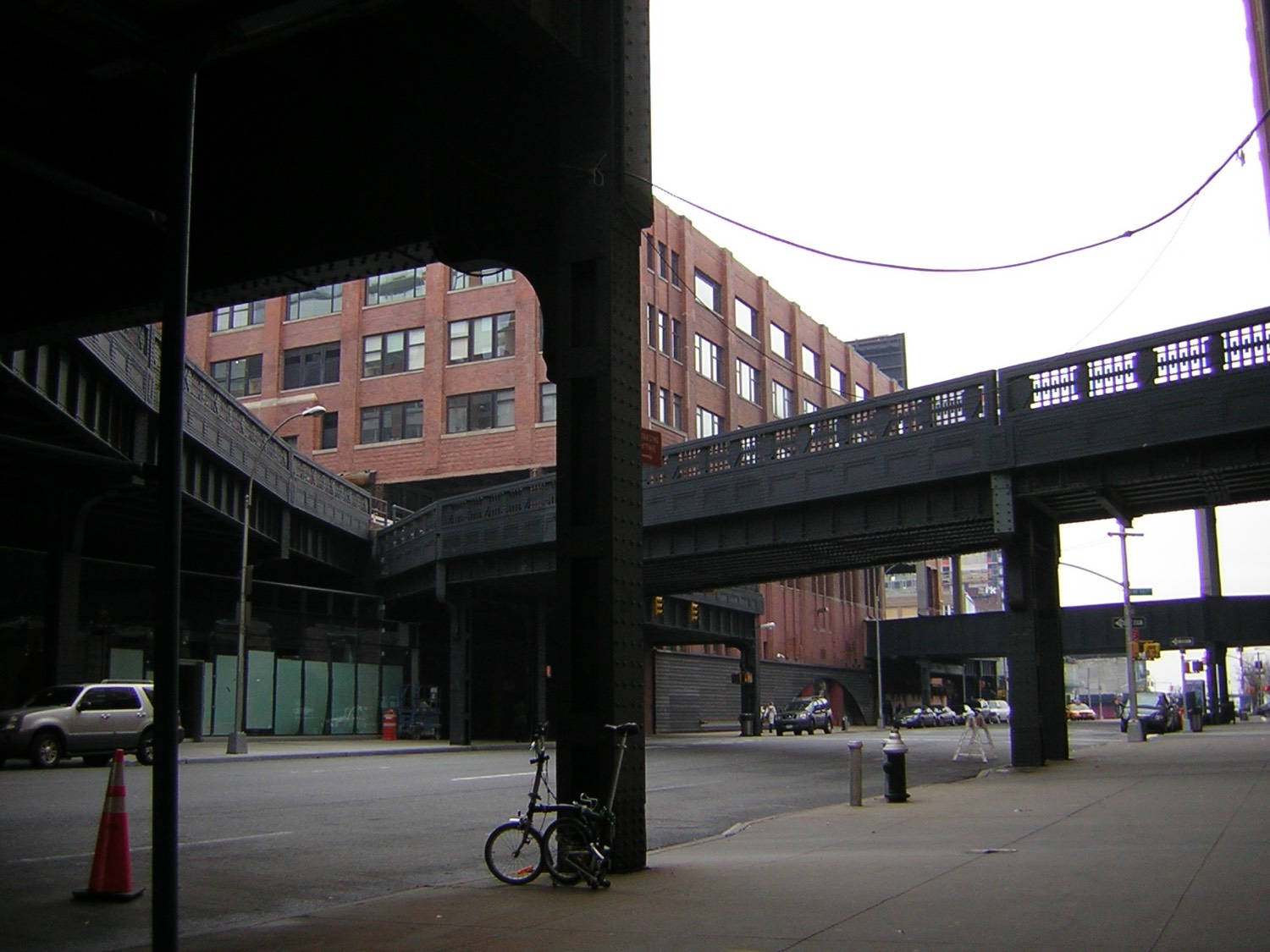
Here is the problem the 2005 rezoning had to solve. If you preserve a viaduct running above and beside private lots, you have taken something from the owners of those lots: they can no longer build what the zoning would otherwise let them build. The usual answers are to buy them out or to condemn the property, and both cost money the city did not intend to spend.
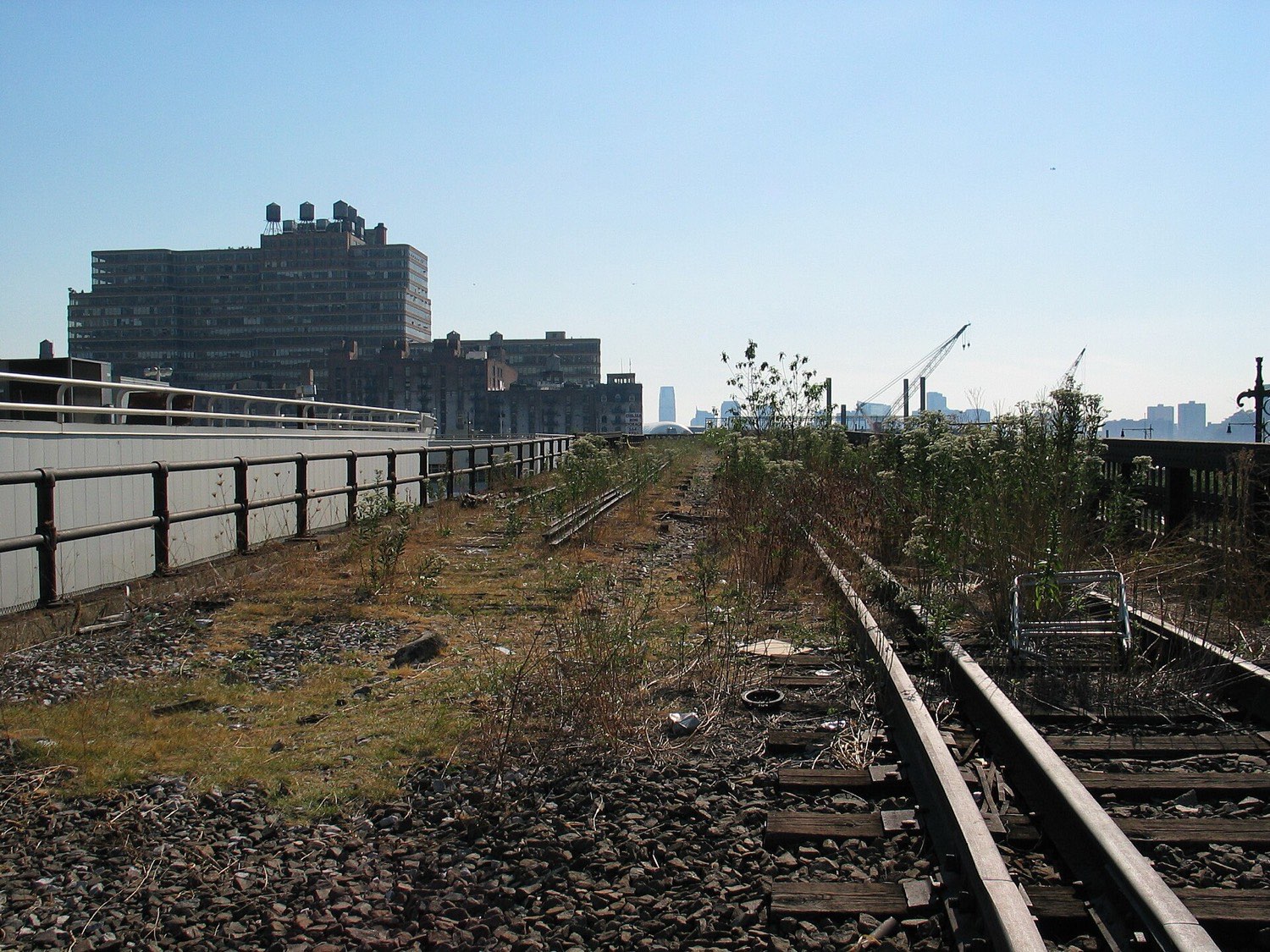
The West Chelsea Special District did neither. It created a High Line Transfer Corridor, and gave the owners inside it the right to sell their unused development capacity to receiving sites elsewhere in the district — any zoning lot outside three named subareas.2 The stated purpose, in the zoning text itself, is“to permit light and air to penetrate to the High Line”.3 About a million square feet became transferable, enough to lift a receiving site from roughly seven and a half times its lot area to twelve.4
Two design choices made it work. The transfer is essentially as-of-right: it needs a notification to the planning department, a recorded easement and a restrictive declaration — not a public hearing and a special permit for every deal.2 And the compensation is the right itself. The Planning Commission’s own report required owners to certify they had received no condemnation award, and provided that the easements would be modified “without condemnation award or similar compensation”.1 The city did not pay for the easements it needed. It manufactured something the owners could sell instead.
Community Board 4 opposed exactly this, recommending in a twenty-two page disapproval that the corridor be eliminated. The Commission rejected it, calling the ability of those owners to sell their rights “of paramount importance in ensuring the preservation of the High Line and success of the resulting open space”.1,4
It did work, on its own terms. A single 2016 deal moved 4,900 square feet three blocks north for $3.92 million — about $800 a foot.15 By late 2017 roughly ninety per cent of the corridor’s private rights had traded, enough for the city to set its own fallback rate at $625 a foot, computed as a weighted average of nineteen arm’s-length transactions.16 The Furman Center, comparing it with New York’s landmarks transfer programme — which it describes as largely illusory — calls the West Chelsea market “fairly robust”.14
What a zoning line is worth
The city wrote a restriction and then sold the right to escape it.
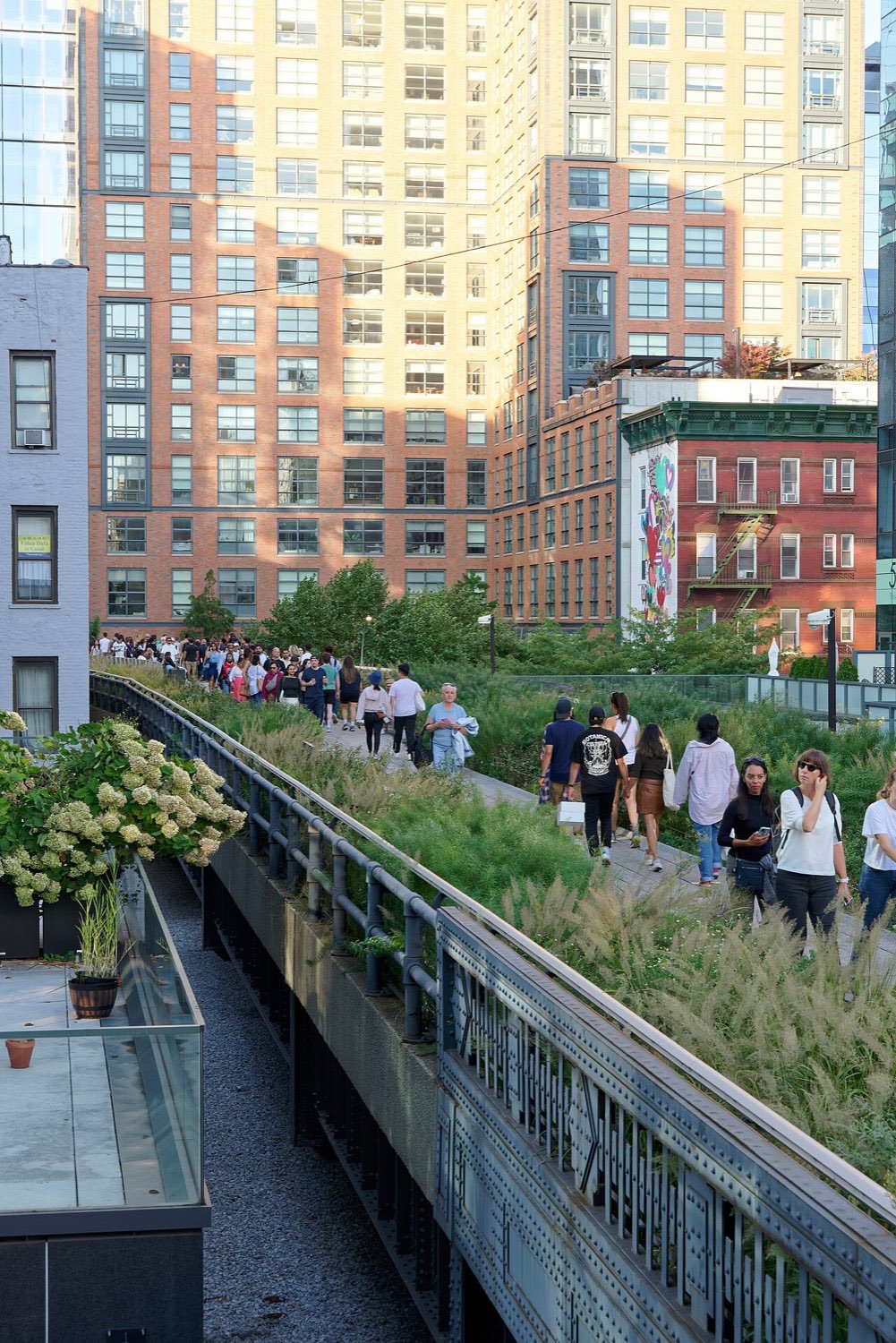
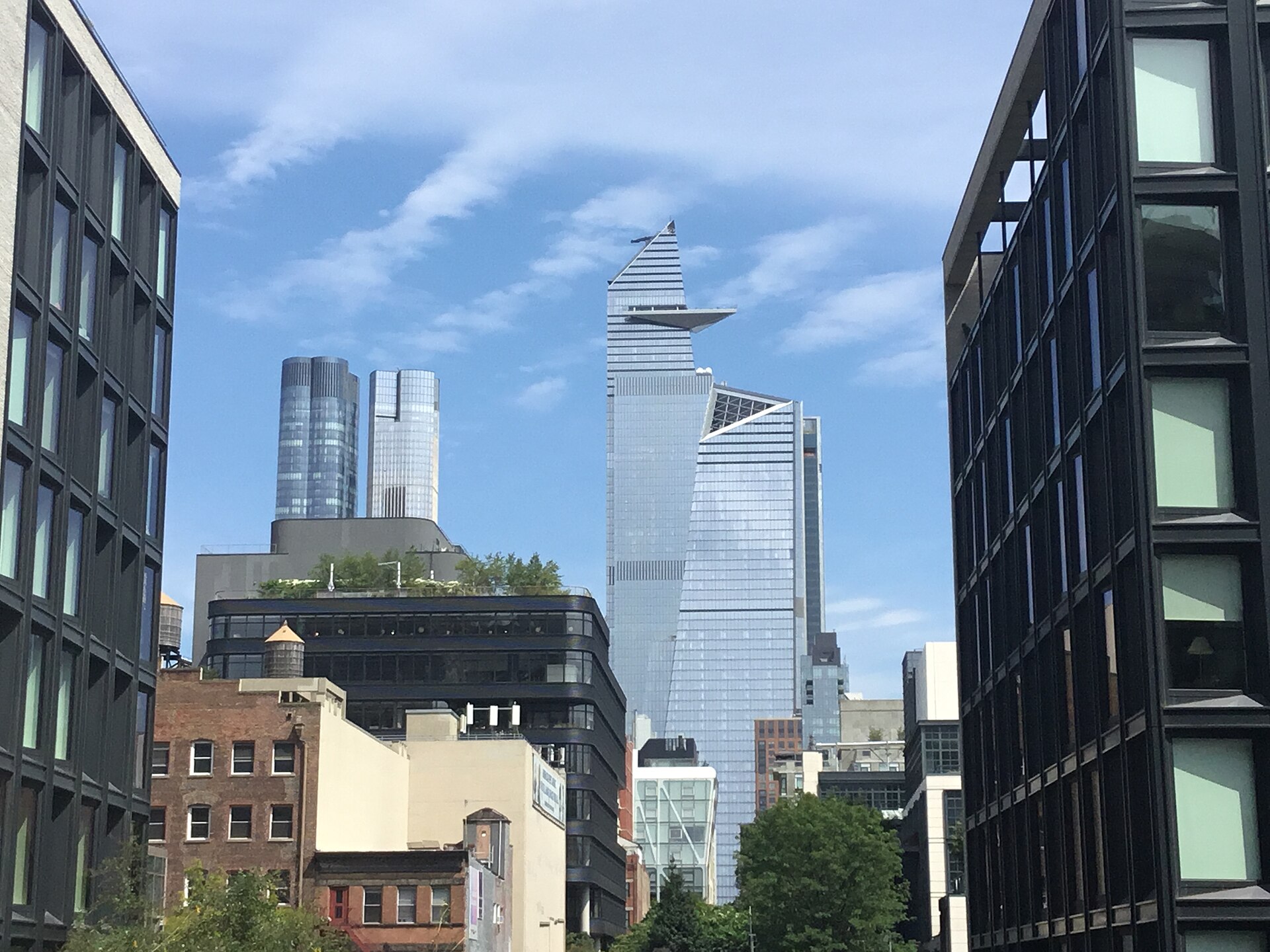
The High Line looking north, with the towers the rezoning made possible pressing in on both sides.Photo: Jakub Hałun, CC BY 4.0, via Wikimedia Commons
One side of the ledger is accounting
The ledger, opened
The cost is itemised by government. The return is a projection by a consultancy the park's own advocates retained. Those are not the same kind of number, and almost every retelling adds them as though they were.
Public cost, sections one and two, as of Jun 2011
$153 million
Tax revenue actually collected and attributed, measured by an independent bodyNever published
- New York City capital funds5$112.2 million
- Federal funds5$20.7 million
- Friends of the High Line and developer payments5 ⁘~$19.4 million
- New York State funds5$0.7 million
Sourced, and not part of that total
Never published
- Tax revenue actually collected and attributed, measured by an independent bodyNever published
- A reconciled all-phases total, in one documentDoes not exist
Four sourced parts that sum to the total, three real numbers of a different kind that cannot join it, and two absences. The distance between the cost side and the return side of this figure is the distance between an audit and an argument.
| Line | Amount | How it is counted |
|---|---|---|
| New York City capital funds | $112.2 million | sourced, and part of the total |
| Federal funds | $20.7 million | sourced, and part of the total |
| Friends of the High Line and developer payments | ~$19.4 million | inferred from the sourced total, drawn hatched |
| New York State funds | $0.7 million | sourced, and part of the total |
| Capital cost across all phases, as of 2018 | ~$200 million | sourced, but a different kind of number — not added to the total |
| Private investment claimed by the city | $2 billion | sourced, but a different kind of number — not added to the total |
| Tax return, as most recently projected | ~$1.4 billion | sourced, but a different kind of number — not added to the total |
| Tax revenue actually collected and attributed, measured by an independent body | Never published | never published |
| A reconciled all-phases total, in one document | Does not exist | never published |
| Public cost, sections one and two, as of Jun 2011 | $153 million | the sourced total |
The ledger, opened
The cost is the easy half, and it is genuinely well documented.
Of the $153 million spent on the first two sections, $112.2 million was city capital, $20.7 million federal and $0.7 million state, with the balance from Friends of the High Line and payments by developers.5 Those are budget lines somebody had to appropriate and account for. Across all phases the figure is nearer $200 million, with the city’s own share around $140 million.9
- New York City capital funds5$112.2 million
- Federal funds5$20.7 million
- Friends of the High Line and developer payments5 ⁘~$19.4 million
- New York State funds5$0.7 million
Sourced, and not part of that total
Never published
- Tax revenue actually collected and attributed, measured by an independent bodyNever published
- A reconciled all-phases total, in one documentDoes not exist
Four sourced parts that sum to the total, three real numbers of a different kind that cannot join it, and two absences. The distance between the cost side and the return side of this figure is the distance between an audit and an argument.
The number that grew each time it was told
- The original case, 20029$130–195 millionStated as 200–300% of an estimated $65 million construction cost
- City officials, Nov 200810$900 millionOver thirty years
- Trade press, 2014$900 millionThe same figure, now over twenty years rather than thirty
- Friends of the High Line, 201711~$1 billionOver the next twenty years
- The consultancy’s update, 20189$1.4 billionNet present value through 2027 — “more than 900% of the capital costs”
Every one of these is a projection, and every one descends from the same lineage: HR&A Advisors, retained by the park’s advocates and the city. Note what happens between the second and third marks — the figure holds at $900 million while the period it covers shortens from thirty years to twenty, which is a substantial upgrade stated as a restatement. None of the five has ever been checked against collected revenue by anyone without a stake in the answer.
The record has a stain, and the founder named it
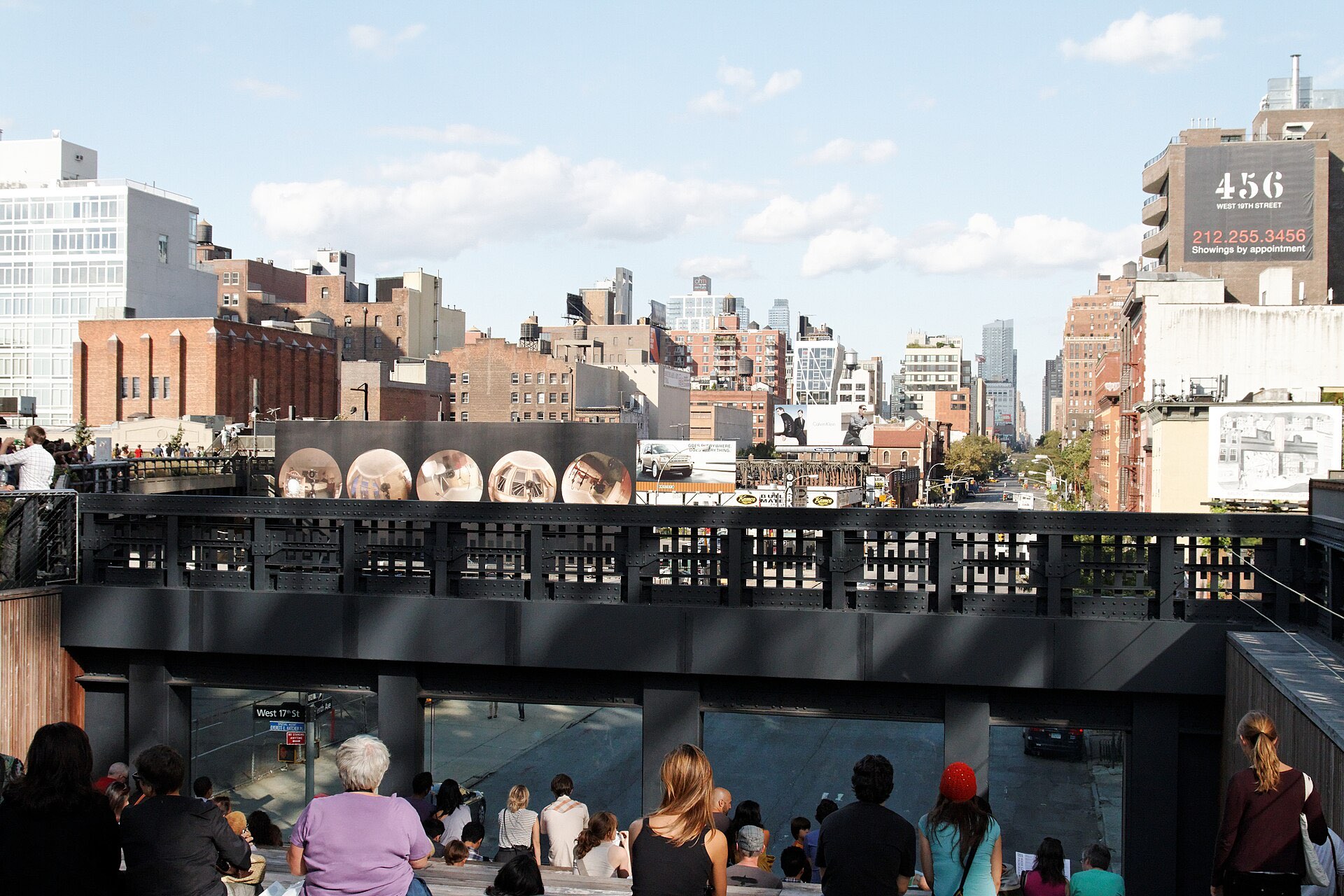
In February 2017 Robert Hammond, who had co-founded Friends of the High Line to save the structure and was by then its executive director, said this about the thing he built:“We were from the community. We wanted to do it for the neighborhood. Ultimately, we failed.”11
He was specific about why. The park’s visitors were overwhelmingly tourists. Listening sessions with public-housing residents did not begin until 2011, two years after opening, and found people who avoided the park because they did not feel it had been built for them. His own summary of the design process: “Instead of asking what the design should look like, I wish we’d asked, ‘What can we do for you?’”11
A peer-reviewed study in Urban Geography the year before had measured it rather than felt it, finding the crowd “overwhelmingly White, to a degree that is far out of line with the racial/ethnic demographics of the borough and city”, that the homogeneity significantly exceeded comparable parks, and that it could not be explained by who lived nearby. Its conclusion: the High Line “is failing as a democratic public space”.12
The displacement is real but more particular than the usual telling. Average household income in Chelsea reached about $140,000, roughly five times that of the neighbouring public-housing households, and median asking rent hit $3,490 — fourth highest in the city.13 Residents of the adjacent NYCHA developments were not evicted, because federal rules cap their rent at thirty per cent of income. What went were market-rate renters, small businesses, and the gallery district: a councilman’s studio went from $900 a month in 2003 to $2,700 for the same 319 square feet.13
And there is a structural point in who pays to run it. Friends of the High Line raises more than ninety per cent of the park’s annual operating budget from private sources.6 A park whose quality depends on the wealth of its neighbours is a different kind of public good from one funded out of general taxation — and the gap between it and the city’s under-resourced parks widens with the property values it helped create.
The sequence
20 Dec 2001
The city executes an agreement for voluntary abandonment of the line — the “demolition order” — days before Giuliani leaves office. Robert Hammond, weeks later: “We thought it was appalling. What’s all the hurry to sign a demolition order?”8
25 May 2005
The City Planning Commission adopts the West Chelsea rezoning, creating the High Line Transfer Corridor. It rejects Community Board 4’s recommendation to delete the corridor entirely, calling the ability to sell those rights “of paramount importance”.1,4
23 Jun 2005
The City Council approves the rezoning. About one million square feet of development capacity becomes transferable, able to lift receiving sites from roughly 7.5 to 12 times their lot area.4
~1M sq ft made tradeable
9 Jun 2009
The first section opens between Gansevoort and 20th Street.7
7 Jun 2011
The second section opens. The city puts the cost of the two sections at $153 million and claims $2 billion of private investment and 12,000 jobs across 29 projects — nineteen completed and ten still under way.5
$153M spent
24 Jul 2012
The city acquires the final section from CSX and restates the same figures verbatim. The same release records that Friends of the High Line raises more than 90 per cent of the park’s annual operating budget privately.6
>90% privately funded
23 Oct 2015
The New York Times reports the divide: average household income in Chelsea around $140,000, roughly five times that of nearby public-housing households, and a median asking rent of $3,490 — the fourth highest in the city.13
21 Mar 2016
A peer-reviewed study in Urban Geography finds the High Line’s crowd “overwhelmingly White… far out of line with the racial/ethnic demographics of the borough and city”, and concludes the park “is failing as a democratic public space”.12
30 Nov 2016
A transfer prices the market: Six Sigma pays $3.92 million for 4,900 square feet of corridor air rights — about $800 a foot — moving them three blocks north.15
$3.92M · ~$800/sq ft
7 Feb 2017
Robert Hammond, co-founder, tells CityLab: “We were from the community. We wanted to do it for the neighborhood. Ultimately, we failed.”11
Oct 2017
With about 90 per cent of the corridor’s private development rights sold, the city sets its own fallback price at $625 a square foot — a weighted average of nineteen arm’s-length deals.16
$625/sq ft
2018
The consultancy retained to make the original case updates its projection: incremental tax revenue “closer to $1.4 billion”, against total capital costs it puts nearer $200 million.9
$1.4B projected
Three things the story usually gets wrong
There was no 1999 demolition order. The city executed an agreement for voluntary abandonment on 20 December 2001, days before Giuliani left office, and Hammond was quoted reacting to it as fresh news in January 2002.8 The misdating appears to come from Friends of the High Line’s own history page, which files the event under a 1999 heading while simultaneously calling it one of the mayor’s last acts in office — two claims that cannot both be true of a term that ended in 2001. 1999 is the right year for the organisation’s founding, not for the order.
“Eight million visitors a year” was not an annual figure when the city first used it. The July 2012 press release says more than eight million people had visitedsince the park opened in June 2009 — a three-year cumulative total.6 The annual number reached roughly that level around 2016. And there are no turnstiles: the count comes from staff tallying eight zones at hourly intervals and feeding the result into an extrapolation.9
And $153 million buys two sections, not a park. Across all phases the capital cost is nearer $200 million, and no single document reconciles every phase.9
What transfers
The mechanism is the part worth taking away, and it is genuinely elegant. A city that wants something preserved can compensate the owners it burdens without buying them out: define the restriction, define a corridor, and make the foregone capacity saleable to somebody else who wants it. No condemnation, no appropriation, and — because the transfer is as-of-right — no two-year approval fight per deal. It priced at around $800 a foot in the open market and the city eventually set its own rate at $625.
The caution is that this is value capture with the capture left out. The city created the uplift and then handed the right to monetise it to the private owners along the corridor, which was the point — that was the compensation. But it means the public purse funded a park, granted a rezoning, and kept almost none of the increment directly. What it kept was a forecast that the increment would return as tax.
So the question to ask of any project sold this way is the one this study is built on: which of these numbers is measured, and which is projected? A cost is measured. Occupancy is measured. Rent rolls are measured. “Generated $2 billion in private investment” and “will return $1.4 billion in taxes” are neither — the first is a tally that includes what had not been built yet, and the second is a discounted forecast by a party retained to produce it. Both may be right. Neither has been checked.
The reel that prompted this ends on the correct line: who captures the value matters as much as how much you create. The record adds one more. Nobody has ever independently established how much was created — and the founder of the thing that created it says the people it was meant for did not get it.
Common questions
- How did the High Line rezoning actually work?
- The 2005 West Chelsea rezoning created a High Line Transfer Corridor. Owners of lots under and beside the viaduct could no longer build what zoning would otherwise allow, so instead of buying them out or condemning the property, the city gave them the right to sell that unused development capacity to receiving sites elsewhere in the district. About a million square feet became transferable, enough to lift a receiving site from roughly 7.5 to 12 times its lot area. The Planning Commission’s own report required corridor owners to certify they had received no condemnation award — the transfer right was the compensation.
- What did High Line air rights actually sell for?
- A documented 2016 transfer saw Six Sigma pay $3.92 million for 4,900 square feet of corridor air rights, about $800 a square foot, moving them from West 27th Street to West 29th Street. By late 2017 roughly 90% of the corridor’s privately held rights had traded, at which point the city set its own fallback contribution rate at $625 a square foot — a weighted average of nineteen arm’s-length deals. The Furman Center describes the resulting market as “fairly robust”, in contrast to New York’s landmarks transfer programme.
- How much did the High Line cost, and how much did it return?
- The first two sections cost $153 million — $112.2 million city capital, $20.7 million federal, $0.7 million state, and the balance from Friends of the High Line and developer payments. Across all phases the figure is nearer $200 million. The return is a different kind of number: every circulating figure ($900 million, about $1 billion, $1.4 billion) is a projection produced by HR&A Advisors, the consultancy retained by the park’s advocates and the city. No independent body — not the Independent Budget Office, not the Department of Finance — has ever measured tax revenue actually collected and attributed to the rezoning.
- Did Giuliani sign a demolition order in 1999?
- No. The city executed an agreement for voluntary abandonment of the line on 20 December 2001, days before Giuliani left office, as reported contemporaneously by the New York Daily News in January 2002 — which quotes Robert Hammond reacting to it as fresh news. The 1999 date appears to come from Friends of the High Line’s own history page, which files the event under a 1999 heading while also describing it as one of the mayor’s last acts in office; his term ended in 2001. 1999 is the correct year for the founding of Friends of the High Line, not for the order.
- Did the High Line displace the neighbourhood it was built for?
- Its co-founder says so. Robert Hammond told CityLab in February 2017: “We were from the community. We wanted to do it for the neighborhood. Ultimately, we failed.” Average household income in Chelsea reached about $140,000, roughly five times that of neighbouring public-housing households, and median asking rent hit $3,490, fourth highest in the city. Residents of adjacent NYCHA developments were not evicted, since federal rules cap their rent at 30% of income; what left were market-rate renters, small businesses and the gallery district. A peer-reviewed 2016 study in Urban Geography found the park’s crowd overwhelmingly white and concluded it was “failing as a democratic public space”.
Sources
- New York City Planning Commission — Report N 050161(A) ZRM on the West Chelsea rezoning — the High Line Transfer Corridor, and the easements modified “without condemnation award or similar compensation” (2005-05-25)
- New York City Department of City Planning (Zoning Resolution) — §98-33, Transfer of Development Rights From the High Line Transfer Corridor — granting sites, receiving sites, and what the transfer requires (2015-06-10)
- New York City Department of City Planning (Zoning Resolution) — §98-31, Purposes — to permit light and air to penetrate to the High Line (2005-06-23)
- CityLand, New York Law School Center for New York City Law — High Line/Chelsea Rezoning Gets Go Ahead — the ULURP timeline and the one million square feet transferable (2005-07-15)
- New York City Department of City Planning (mayoral press release) — Mayor Bloomberg, Speaker Quinn and Friends of the High Line Open Section Two — the $153 million and the $2 billion claim (2011-06-07)
- New York City Department of Parks and Recreation (press release) — The City’s acquisition of the third section of the High Line — the claims restated, and Friends of the High Line funding more than 90% of the park’s annual budget (2012-07-24)
- New York City Department of Parks and Recreation (The Daily Plant) — From Threatened Demolition to Public Park — the 9 June 2009 opening of the first section (2009-07-13)
- New York Daily News (Frank Lombardi) — Track Park Plan Derailed: Rudy Signed Pact To Abandon Old West Side Rail Line — the agreement executed 20 December 2001 (2002-01-24)
- Landscape Architecture Foundation — High Line Methods — the capital cost across all phases, the visitor-counting method, and the escalation of the projected tax return (2017-08)
- The New York Times — Officials’ prediction of $900 million in tax revenue over thirty years (2008-11-30)
- CityLab (Laura Bliss) — The High Line’s Next Balancing Act — Robert Hammond: “Ultimately, we failed” (2017-02-07)
- Alexander J. Reichl, Urban Geography (peer-reviewed) — The High Line and the ideal of democratic public space — the crowd is overwhelmingly White, and the park is failing as a democratic public space (2016-03-21)
- The New York Times (Mireya Navarro) — In Chelsea, a Great Wealth Divide — incomes, rents, and what the developer paid toward the park (2015-10-23)
- NYU Furman Center for Real Estate and Urban Policy — Unlocking the Right to Build — the West Chelsea transfer market assessed against the landmarks programme (2014-03)
- Real Estate Weekly — Developer Six Sigma buys High Line air rights for $3.92M — 4,900 square feet at roughly $800 a foot (2016-11-30)
- New York City Planning Commission (rulemaking) — Notice of Adoption — contributions to the West Chelsea Affordable Housing Fund, setting $625 a square foot once 90% of the corridor’s rights had transferred (2017-10-24)