
Case study Nº 12
The malls were 92.5% full when General Growth filed the biggest real estate bankruptcy in US history
Nothing was wrong with the buildings. $27.3 billion of debt came due into a market that had stopped lending, and the shares hit 24 cents. The case also broke the assumption commercial mortgage securitisation is priced on — bankruptcy remote turned out not to mean bankruptcy proof.
Ben Fan, with Darryl WengJanuary 20, 202614 min readWatch the reel
Occupancy when it filed
92.5%
Liabilities when it filed
$27.3B
When General Growth Properties filed the largest real estate bankruptcy in American history, its malls were 92.5 per cent full and its net operating income was up 4.5 per cent on the year.1 The shares had traded at twenty-four cents.1 Nothing was wrong with the buildings. Everything was wrong with when the debt came due. Jump to the price ↓
This is the cleanest illustration in modern real estate of a distinction that costs people money in every cycle: a company can be solvent and still fail, because solvency is measured over the life of an asset and liquidity is measured on the morning a loan matures.
It is also the case that broke an assumption the entire commercial-mortgage-backed securities market was built on. That part matters more than the trade, and it is the part almost nobody tells.
| The bankruptcy at a glance | Number |
|---|---|
| Rouse Company acquisition, Nov 2004 | $12.6 billion · $7 billion borrowed8,9 |
| Share price, Q1 2007 intraday high | $67.432 |
| Share price, Q4 2008 low | $0.241 |
| Total liabilities, 31 Dec 2008 | $27.293 billion, against $29.6 billion of assets1 |
| Debt maturing 2009 and 2010 | $3.31 billion · $6.43 billion1 |
| Occupancy, 31 Dec 2008 | 92.5%1 |
| Net operating income, FY2008 | $2.59 billion, up 4.5%1 |
| Comparable sales, FY2008 | Down 3.8%1 |
| Chapter 11 filed | 16 April 2009 · about 360 subsidiaries3 |
| Pershing Square's DIP commitment | $375 million — never drawn3,5 |
| Fee Pershing kept for it | $15 million3 |
| New equity at emergence | $6.8 billion, Brookfield-led12 |
| Final buyback of the Pershing stake | $20.12/share · $555,800,553.8415 |
The wall was built in 2004
The reel says General Growth did not have a mall problem, it had a debt wall. That is right, and the wall has a date on it.
In August 2004 the company agreed to buy the Rouse Company for about $12.6 billion, closing that November.8,9 Rouse’s own chief financial officer described the financing without any softening at the time: General Growth was “borrowing $7 billion to finance the deal, pushing its debt to $23 billion”.8
That is the whole mechanism. Short-and-medium-dated borrowing against long-lived assets works for as long as the borrowing can be renewed, and the renewal is not a property question — it is a credit-market question. By the end of 2008 General Growth had $3.31 billion coming due in 2009 and $6.43 billion in 2010, into a market where commercial mortgage securitisation had stopped functioning.1 An analyst told the New York Times that October, six months before the filing: “The reality is, given this credit crunch, they’re up against the wall.”10
The operating business, meanwhile, was fine — with one honest qualification the reel does not make. Occupancy at the end of 2008 was 92.5 per cent, down only slightly from 93.8 the year before, and net operating income rose 4.5 per cent to $2.59 billion. But comparable sales fell 3.8 per cent, against a 1.4 per cent rise the previous year.1,2 Tenants were still there and still paying. They were selling less. “Nothing was wrong” overstates it; “nothing was wrong that would have mattered without the maturities” is the accurate version.
One share, five marks, eleven years
A price re-marked
Nothing here is a trade in the same thing. It is one company's share price at five moments, and the distance between the second and the fifth is the entire argument about liquidity.
What one share was worth
$23.50
Mar 2018 · What Brookfield paid for the rest of the company16
65% below $67.43
- Q1 2007$67.43
- Q4 2008$0.24
- Nov 2010$10.00–$10.25
- Feb 2014$20.12
- Mar 2018$23.50
- against$10.13
The emergence price, drawn as the line the recovery had to clear. Everything to the right of it is the reorganised company being re-rated; everything to the left is the old one being written off.
A share that fell 99.6% and came back is not a story about a bounce. Between the second mark and the third, the company was reorganised, recapitalised with $6.8 billion and split in two — so the two ends of this ladder are not quite the same instrument, which is the honest caveat on the most striking number in it.
| When | Mark | Value |
|---|---|---|
| Q1 2007 | Intraday high, before the credit markets turned | $67.43 |
| Q4 2008 | Quarterly low, with bankruptcy assumed | $0.24 |
| Nov 2010 | What the investor group paid for new shares at emergence — A range rather than a trade, and drawn hatched because of it: this is the price at which roughly 644 million new shares were sold to Brookfield, Fairholme, Pershing Square, Blackstone and the Texas teachers’ fund. | $10.00–$10.25 |
| Feb 2014 | What GGP paid to buy Pershing Square out | $20.12 |
| Mar 2018 | What Brookfield paid for the rest of the company | $23.50 |
| — | The emergence price, drawn as the line the recovery had to clear. Everything to the right of it is the reorganised company being re-rated; everything to the left is the old one being written off. | $10.13 |
Mar 2018, What Brookfield paid for the rest of the company, $23.50.
A price re-marked
The market did not mark General Growth down. It marked it off.
Twenty-four cents against a $67.43 high eighteen months earlier is not a distressed price, it is an assumption that the equity is worth nothing — which is what a bankruptcy of this size normally means.1,2 Pershing Square began buying in November 2008 at a disclosed cost basis of $9,261,789 for 7.5 per cent of the company, with swap exposure to a further twelve.7
- Q1 2007$67.43
- Q4 2008$0.24
- Nov 2010$10.00–$10.25
- Feb 2014$20.12
- Mar 2018$23.50
- against$10.13
The emergence price, drawn as the line the recovery had to clear. Everything to the right of it is the reorganised company being re-rated; everything to the left is the old one being written off.
A share that fell 99.6% and came back is not a story about a bounce. Between the second mark and the third, the company was reorganised, recapitalised with $6.8 billion and split in two — so the two ends of this ladder are not quite the same instrument, which is the honest caveat on the most striking number in it.
The DIP loan that was never drawn
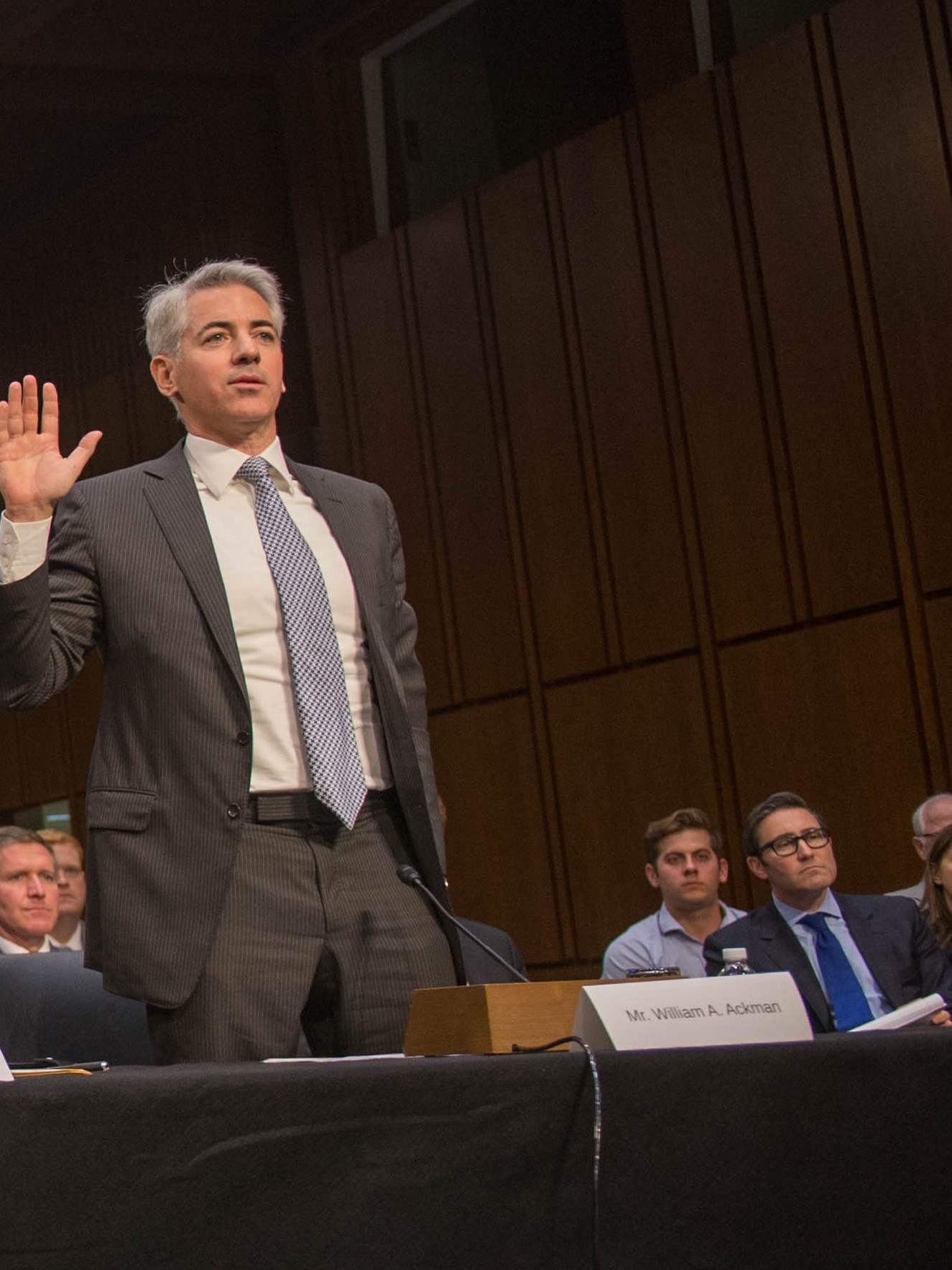
The story as usually told is that Ackman bought the stock, provided the debtor-in-possession financing, and took a board seat to steer the reorganisation. The middle of those three is not what happened, and what did happen is more interesting.
On 15 April 2009, the day before the filing, General Growth accepted a commitment from Pershing Square for $375 million of debtor-in-possession financing. The terms were what you would expect from a lender with no competition: LIBOR with a three per cent floor plus twelve per cent, a $15 million commitment fee, and warrants for 4.9 per cent of the fully diluted equity.3
Three weeks later it was gone. On 13 May the bankruptcy court approved a replacement $400 million facility led by UBS and funded by an entirely different group of lenders.5 The Pershing loan was never drawn. The $15 million fee had already been paid.
That is not a criticism, and it is not nothing either. Committing to lend at the moment nobody else would is what bought a seat at a table where the outcome was decided — and it was compensated at fifteen million dollars for a loan that never funded. A study that repeats “he provided the DIP financing” has described the intention and missed the transaction.
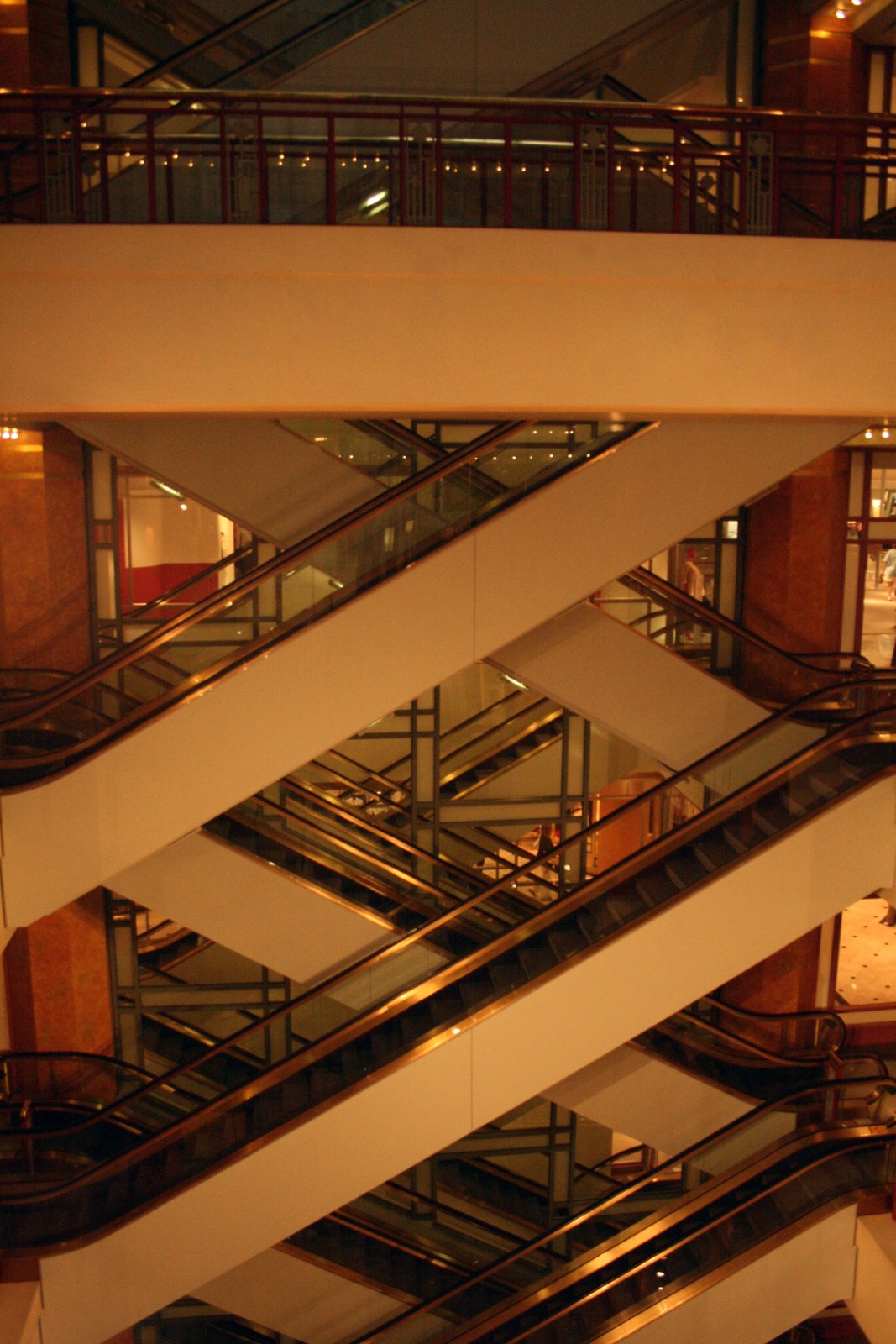
Solvent, current, and in bankruptcy anyway
The buildings kept working the entire time.
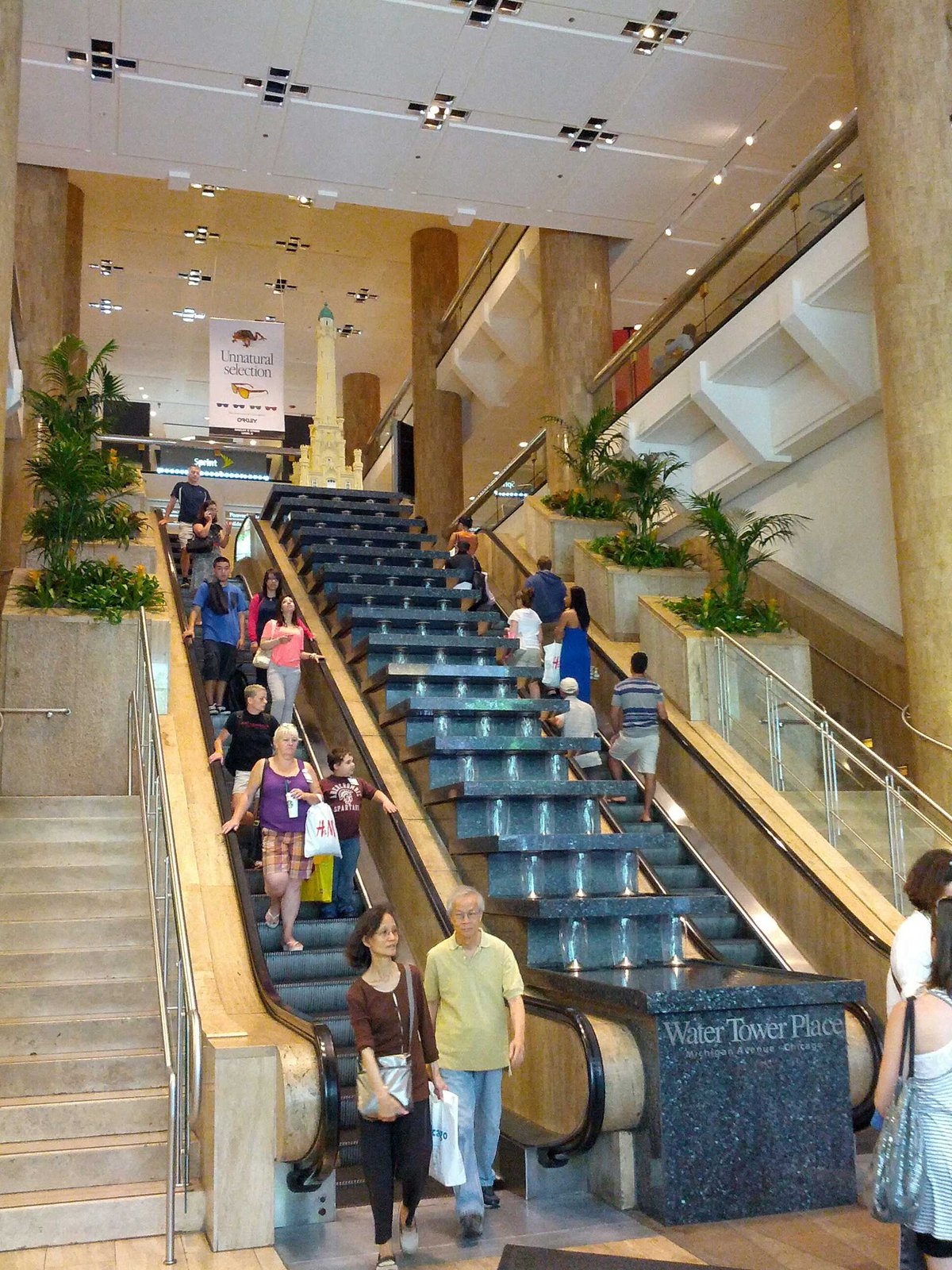
Escalators in a multi-level mall atrium, photographed in July 2007. Wikimedia's own categorisation places this at Water Tower Place; the photographer's caption does not name the location, so it is shown here as the building type rather than the building.Photo: Jeramey Jannene, CC BY 2.0, via Wikimedia Commons
The ruling that outlived the trade
Every one of General Growth’s malls was financed inside a bankruptcy-remote special purpose entity — a subsidiary structured, with independent managers and consent requirements, for the express purpose of ensuring that a parent’s failure could not drag the property into a bankruptcy. That structure is the assumption commercial mortgage securitisation is priced on. It is what lets a lender underwrite a single mall without underwriting the company that owns it.
General Growth put roughly 166 of those entities into Chapter 11 anyway, including ones that were solvent and fully current on their loans. Their lenders moved to dismiss, and on 11 August 2009 Judge Allan Gropper denied every motion.6 A subsidiary’s board, he held, may weigh the interests of the parent group in deciding whether to file, and the replacement of two independent managers days before the filing — which he described as“admittedly surreptitious” — was not bad faith.6
The lenders had bought separateness and discovered they had bought a presumption. Bankruptcy remote turned out not to mean bankruptcy proof, and law firms advising the securitisation market said so within weeks. The pricing of every subsequent deal in that market carries some of this ruling in it, which is a longer-lived consequence than any single investor’s return.
The record has a stain
The claim that old shareholders kept their shares is true, extraordinary for a bankruptcy this size, and incomplete. Each old share did become one new share plus about 0.0983 of a Howard Hughes share.13 But roughly 644 million new shares were sold to the investor group at $10.00 to $10.25, against 312 million shares outstanding before the filing.14,6 Setting those two sourced figures beside each other, legacy holders came out with something like a third of the combined company. Their shares survived. Their share of the company did not.
Simon Property Group spent months and retained four advisory firms trying to buy General Growth outright, raising its offer repeatedly and promising creditors would be paid in full. It withdrew on 7 May 2010 — beaten not on price but on a warrant package the court approved for the rival bidder. Its chairman said the board had “hastily decided in less than 24 hours to accept substantially less value”.11
And the thesis that prime assets endure has aged unevenly. Brookfield bought the whole company at $23.50 a share in 2018 and committed billions to redevelopment.16 Reporting since has described a portfolio where the strongest malls hold up and a long tail does not — properties sold or handed back to lenders, and at least one where the owner defaulted deliberately on a mall that was still 94 per cent occupied because its appraised value had halved. Occupancy survived at the top. It did not save the middle.
The sequence
Aug 2004
General Growth agrees to buy the Rouse Company for about $12.6 billion. Its own chief financial officer describes the financing plainly: the company is borrowing $7 billion, which will push its debt to $23 billion.8,9
$12.6B · debt to $23B
Q1 2007
The shares reach an intraday high of $67.43.2
$67.43
14 Oct 2008
The New York Times reports the company may be forced into a sale. An analyst: “The reality is, given this credit crunch, they’re up against the wall.”10
Q4 2008
The shares reach a low of $0.24 — about a third of one per cent of the peak eighteen months earlier.1
$0.24
Nov 2008
Pershing Square discloses a 7.5% stake at a cost basis of $9,261,789, plus swap exposure to a further 12.4% of the company.7
$9.26M disclosed
27 Feb 2009
The annual report lands: $27.3 billion of total liabilities against $29.6 billion of assets, 92.5% occupancy, and net operating income up 4.5% on the year. The malls are full. The balance sheet is not survivable.1
$27.3B of liabilities
16 Apr 2009
General Growth and some 360 subsidiaries file for Chapter 11 — the largest real estate bankruptcy in United States history. The company commits to a $375 million loan from Pershing Square and pays a $15 million fee for it.3,4
$15M fee paid
13 May 2009
The Pershing loan is abandoned. The court approves a replacement $400 million facility led by UBS and funded by a different group. Pershing keeps the fee for a loan nobody drew.5
$375M never drawn
11 Aug 2009
Judge Gropper denies the motions to dismiss the bankruptcy-remote subsidiaries from the case. Solvent, current, ring-fenced entities stay in a bankruptcy their lenders had structured specifically to keep them out of.6
16 Feb 2010
Simon Property Group goes public with an unsolicited bid it values above $10 billion, promising full creditor recovery.11
$10B+ bid
7 May 2010
Simon withdraws after the court approves warrants for the rival Brookfield-led group. Its chairman says the board “hastily decided in less than 24 hours to accept substantially less value”.11
21 Oct 2010
The plan is confirmed. Brookfield, Fairholme, Pershing Square, Blackstone and the Teacher Retirement System of Texas commit $6.8 billion of new equity.12
$6.8B committed
9 Nov 2010
General Growth emerges after nineteen months. Every old share becomes one new share plus about 0.0983 of a share in the Howard Hughes spin-off — but roughly 644 million new shares are sold to the investor group at $10.00 to $10.25.13,14
~644M new shares
10 Feb 2014
GGP buys Pershing Square’s remaining 27,624,282 shares at $20.12 — $555,800,553.84, to the cent.15
$555.8M
Mar 2018
Brookfield agrees to acquire the rest of GGP at $23.50 a share.16
$23.50/share
- Disclosed cost basis, Nov 20087$9.26 millionThe stock and swap leg only, from the SEC filing
- The commonly quoted amount invested~$60 millionAckman’s own figure, said to include bonds — never itemised anywhere
- The final GGP share buyback, Feb 201415$555.8 millionSourced to the cent
- The claimed total gain~$1.6 billionAckman to Bloomberg. No source states what it counts
Two of these are filings and two are a man’s own account of his own trade. The $9.26 million and the $555,800,553.84 are exact and primary.7,15 The $60 million and the $1.6 billion are not in any document: no source itemises the bond purchases, and none explains whether the gain is realised or marked, whether it includes the Howard Hughes stake, or whether it nets the fees. The most quoted figures here are the two nobody can check.
What transfers
The reel’s own summary is the right one and worth restating: liquidity crises are not solvency crises. An asset that produces cash is not worthless because the loan against it matures in a month when nobody is lending. It is worth exactly what it always was, to whoever can hold it long enough to refinance.
Three things make that usable rather than a slogan. Find the maturity schedule before you form a view on the equity — General Growth published its 2009 and 2010 maturities in the annual report that also showed 92.5 per cent occupancy, and both numbers were on the same page. Understand that the price of surviving a maturity wall is paid in ownership: the company survived, the shares survived, and the shareholders still ended up with about a third. And read the documents rather than the structure’s name — several sophisticated lenders had bought something called bankruptcy remote and found out in August 2009 what it actually guaranteed.
The last thing is a caution about the numbers this story is famous for. The $9.26 million and the $555.8 million are in SEC filings and exact to the cent. The $60 million and the $1.6 billion — the two figures the whole legend rests on — appear in no document, are itemised nowhere, and are the investor’s own account of his own outcome. That does not make them false. It makes them a claim, and a brief that treats a claim as a filing has stopped being a brief.
Common questions
- Why did General Growth Properties go bankrupt if its malls were full?
- Because occupancy does not repay a loan on its maturity date. At the end of 2008 the company was 92.5% leased with net operating income up 4.5% on the year, but it carried $27.3 billion of total liabilities with $3.31 billion maturing in 2009 and $6.43 billion in 2010 — into a market where commercial mortgage securitisation had stopped functioning. Much of that debt traced to the $12.6 billion Rouse Company acquisition in 2004, which its own CFO said involved borrowing $7 billion and pushing company debt to $23 billion.
- Did Bill Ackman provide General Growth’s bankruptcy financing?
- He committed to, and the loan was never drawn. On 15 April 2009 GGP accepted a $375 million debtor-in-possession commitment from Pershing Square and paid a $15 million commitment fee. Three weeks later, on 13 May, the bankruptcy court approved a replacement $400 million facility led by UBS and funded by a different lender group. Pershing Square kept the fee for a loan that never funded — which bought a seat at the table where the reorganisation was decided.
- Did General Growth shareholders really keep their shares?
- Yes, and that is genuinely extraordinary for a bankruptcy of this size — each old share became one new share plus about 0.0983 of a share in the Howard Hughes Corporation spin-off. But roughly 644 million new shares were sold to the Brookfield-led investor group at $10.00 to $10.25 a share, against 312 million shares outstanding before the filing. Legacy holders kept their shares and ended up with roughly a third of the combined company.
- What was the Gropper ruling and why does it matter?
- Each of GGP’s malls sat inside a bankruptcy-remote special purpose entity, structured with independent managers so that a parent’s failure could not pull the property into bankruptcy — the assumption commercial mortgage securitisation is priced on. GGP filed roughly 166 of them anyway, including solvent entities current on their debt. On 11 August 2009 Judge Allan Gropper denied every lender motion to dismiss, holding that a subsidiary’s board may weigh the parent group’s interests, and that replacing two independent managers days before the filing — which he called “admittedly surreptitious” — was not bad faith. Bankruptcy remote turned out not to mean bankruptcy proof.
- How much did Ackman actually make on General Growth?
- The exact figures are only partly documented. Pershing Square’s disclosed cost basis on its initial stock and swap position was $9,261,789 in November 2008, and GGP’s final buyback of its remaining 27,624,282 shares in February 2014 came to $555,800,553.84 at $20.12 a share — both from SEC filings. The widely quoted “$60 million into $1.6 billion” is Ackman’s own account, said to include bond purchases that are itemised nowhere, and no source explains whether the gain is realised or marked, or whether it includes the Howard Hughes stake.
Sources
- General Growth Properties, Inc. via SEC (Form 10-K, FY2008) — Annual report — $27.3 billion of total liabilities, 92.5% occupancy, net operating income up 4.5%, and comparable sales down 3.8% (2009-02-27)
- General Growth Properties, Inc. via SEC (Form 10-K, FY2007) — Annual report — the $67.43 intraday high and the occupancy trend before the crisis (2008-02-27)
- General Growth Properties, Inc. via SEC (Form 8-K, Item 1.03) — Chapter 11 filing, and the $375 million debtor-in-possession commitment from Pershing Square with its $15 million fee (2009-04-16)
- General Growth Properties, Inc. via SEC (Exhibit 99.1) — Press release on the filing — “our core business remains sound” (2009-04-16)
- General Growth Properties, Inc. via SEC (Form 8-K, Item 1.01) — The replacement $400 million debtor-in-possession facility, led by UBS AG — the Pershing Square loan is abandoned (2009-05-14)
- United States Bankruptcy Court, S.D.N.Y. (Judge Allan L. Gropper) — In re General Growth Properties, Inc., 409 B.R. 43 — the opinion denying the special-purpose-entity lenders’ motions to dismiss (2009-08-11)
- Pershing Square Capital Management, L.P. via SEC (Schedule 13D) — Pershing Square’s initial position in General Growth — 7.5% of the stock at a disclosed cost basis of $9,261,789, plus swaps (2008-11-25)
- Los Angeles Times (Associated Press) — Mall Innovator Rouse to Be Sold for $7.2 Billion — the CFO on borrowing $7 billion and pushing debt to $23 billion (2004-08-21)
- Las Vegas Sun — General Growth completes $12.6 billion merger with the Rouse Company (2004-11-16)
- The New York Times (Terry Pristin) — General Growth, Mall Owner, May Be Facing a Sale — “they’re up against the wall” (2008-10-14)
- Simon Property Group, Inc. (company release) — Simon Property Group makes $10 billion offer to acquire General Growth Properties (2010-02-16)
- General Growth Properties, Inc. via SEC (Exhibit 99.1) — Plan of reorganization confirmed — the $6.8 billion equity commitment from Brookfield, Fairholme, Pershing Square, Blackstone and the Teacher Retirement System of Texas (2010-10-21)
- General Growth Properties, Inc. via SEC (Exhibit 99.2) — Plan mechanics — each old share becomes one new share plus about 0.0983 of a Howard Hughes share (2010-10-27)
- General Growth Properties, Inc. via SEC (Form 8-K) — Emergence mechanics — roughly 644 million new shares issued to the investor group at $10.00 to $10.25 (2010-11-12)
- GGP Inc. via SEC (Form 8-K) — GGP repurchases Pershing Square’s remaining 27,624,282 shares at $20.12 — $555,800,553.84 (2014-02-10)
- GGP Inc. via SEC (Exhibit 99.1) — Brookfield to acquire the remainder of GGP at $23.50 a share (2018-03-26)