
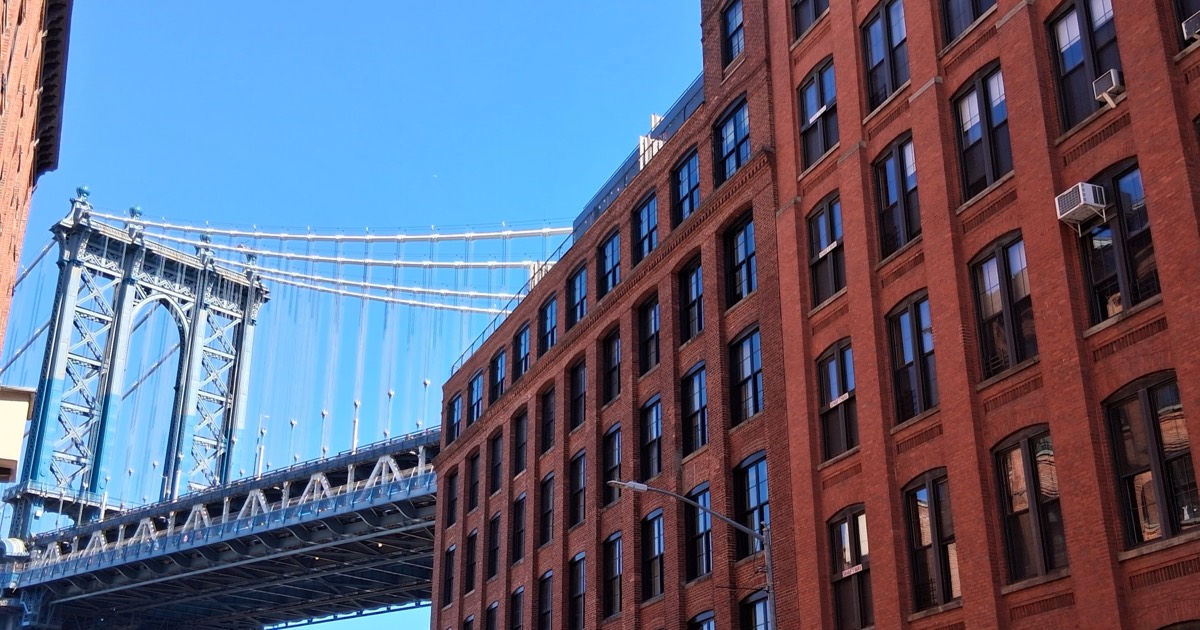
Case study Nº 13
Two Trees bought most of DUMBO for $12 million — and borrowed every dollar
One buyer, one seller, two million square feet at $6 a foot — then seventeen years of being blocked by the city. The public record shows a state lease that rescued the position, a 17% construction loan, a ten-year tax abatement and a decade of free rent to artists, with a source on every number.
Ben Fan, with Darryl WengJanuary 23, 202616 min readWatch the reel
Paid for 2M sq ft, c.1980
$12M
Paid nearby for 1.2M sq ft, 2013
$375M
Six dollars a square foot against roughly three hundred and twelve — the same kind of brick warehouse, on the same cobblestones, priced thirty-odd years apart by a different buyer.1,2,21 Walentas did not put up either number. The whole $12 million was borrowed, and for the first seventeen years the investment nearly destroyed him.
The short answer to how DUMBO happened: one buyer got the entire neighbourhood from one seller on borrowed money, was then blocked by the city for seventeen years, was rescued by a state agency’s rent cheque, and finally got the zoning changed under a different mayor — after which he converted the buildings one at a time, selling each finished project to fund the next. Everything the reels call a “placemaking playbook” sits on top of those four facts, and every one of them is in the public record.
What is not in the record is the total. No independent tally of the hold exists. Asked in 2006 how much he had made, Walentas said “three or four hundred million. I don’t know, really.”1 That is the most precise figure anyone has published, and it came from him.
| The deal at a glance | Number |
|---|---|
| Seller | Harry Helmsley1,7 |
| Price | $12 million for ~2 million sq ft — about $6 a foot1,6 |
| Purchase year (disputed) | 1979, 1980 or 1981 depending on the source1,3,6,28 |
| Buyer’s own cash at closing | None disclosed: $6M lent by the Lauders, ~$6M of debt assumed2 |
| Rent those buildings then earned | About $2 per square foot a year2 |
| Years from purchase to residential permission | 174 |
| The lease that carried him | NY State Labor Dept, 1986 — 10 years, $105 million3 |
| First conversion, 1 Main Street | $30M · 124 lofts · borrowed at 17%4,5 |
| Those lofts sold out in 1998 for | About $60 million3 |
| DUMBO portfolio today | 3M+ sq ft across 12 buildings22 |
| DUMBO pre-built office rent, Dec 2025 | Mid-$40s per sq ft (Two Trees’ own figure)22 |
| Founder’s net worth, Aug 2026 | $2 billion (Forbes estimate)25 |
Start with the seller
Harry Helmsley was the largest landlord in New York, and what he was holding between the Brooklyn and Manhattan Bridges was the residue of a dead industry. The blocks had been called Gairville, after Robert Gair, the man who invented the folding cardboard box and built a campus of poured-concrete factories to make them in.28 By the mid-1970s Gair was gone, the shoe and soap and coffee manufacturers were gone, and what was left were half-empty lofts collecting about two dollars a square foot a year.2
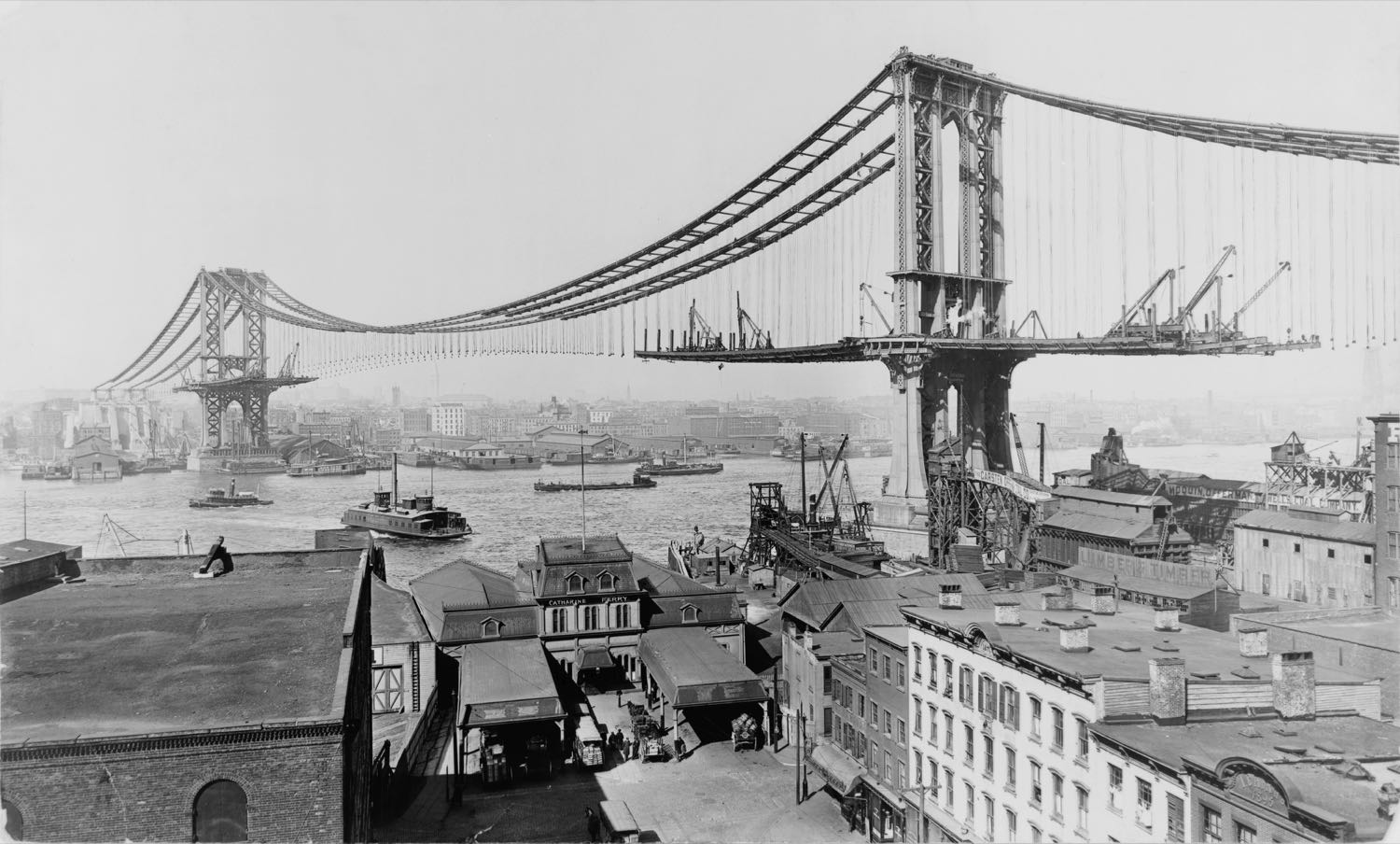
Six dollars a foot against two dollars of annual rent looks like a three-year payback, and it was not one. The buildings were half empty, the tenants were the last of a departing industry, and the taxes and upkeep on two million square feet of century-old concrete ran against whatever came in — for years afterwards Walentas could pay neither the taxes nor the debt service.1 The price was low because the only use the zoning permitted had stopped existing, and the use that would make the buildings valuable was illegal.
The buyer arrived in worse shape than the seller. In December 1977 Walentas’s partner J. Frederic Byers III, a W. R. Grace heir who had brought in every wealthy investor Two Trees had, died in a fall from his 14th-floor apartment on East 79th Street, leaving a note that mentioned business problems.2,4 Walentas paid Byers’s family $1.8 million for his stake, and found himself cash-poor and cut off from investors who now blamed him for the death.2
So the money came from one place. Jane Walentas had been an art director at Clinique; through her, Walentas got Ronald and Leonard Lauder to put $2 million into a Greenwich Village conversion in 1978. When no bank would touch Brooklyn, the Lauders lent him $6 million more. The agreed price was $6 a square foot including roughly $6 million of debt that came with the buildings.2 Leonard Lauder’s explanation is the whole underwriting: “Ronald and I were of the mind that you backed people, not institutions. David was good people.”2
Note what that structure means. The most-quoted acquisition in modern New York real estate — two million square feet for twelve million dollars — involved no equity from the buyer that any source discloses. It was a loan from a family and a mortgage assumed from a seller. Which is also why the next seventeen years were survivable: there was very little of his own capital to lose, and, as he later put it, the mortgage company “didn’t even want to foreclose.”1
What he actually bought
Roughly two million square feet across ten or eleven buildings, including the four Gair buildings, the largest on the waterfront.3,4 In 2006 the Times described it as most of a twelve-square-block neighbourhood, with nearly all of the remainder bought later.1 Site control on that scale is the one genuinely rare thing here, and Walentas was explicit about why it mattered: “You had the freedom to create a neighbourhood. In New York. And whatever you did with one building would add value to the others.”2
Even the name was an asset he acquired rather than invented. Walentas had been converting lofts in SoHo and NoHo, and asked an artist what came next. The answer — “Dumbo, Down Under the Manhattan Bridge Overpass” — had been coined by artists precisely to sound ugly enough to keep developers away.2,6 He adopted it and put it on the buildings.
Seventeen years of being wrong
The use that would make the buildings valuable was illegal.
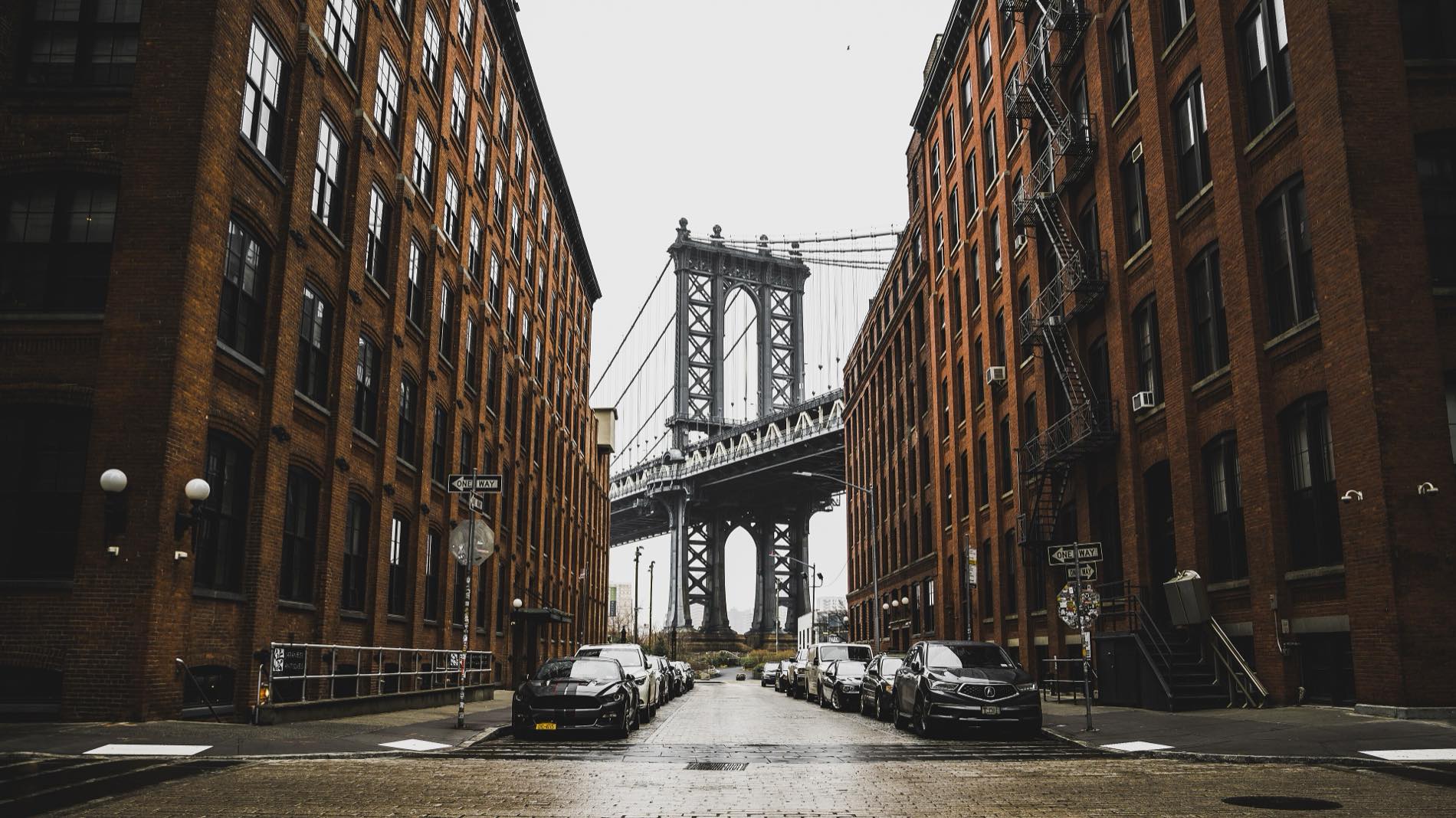
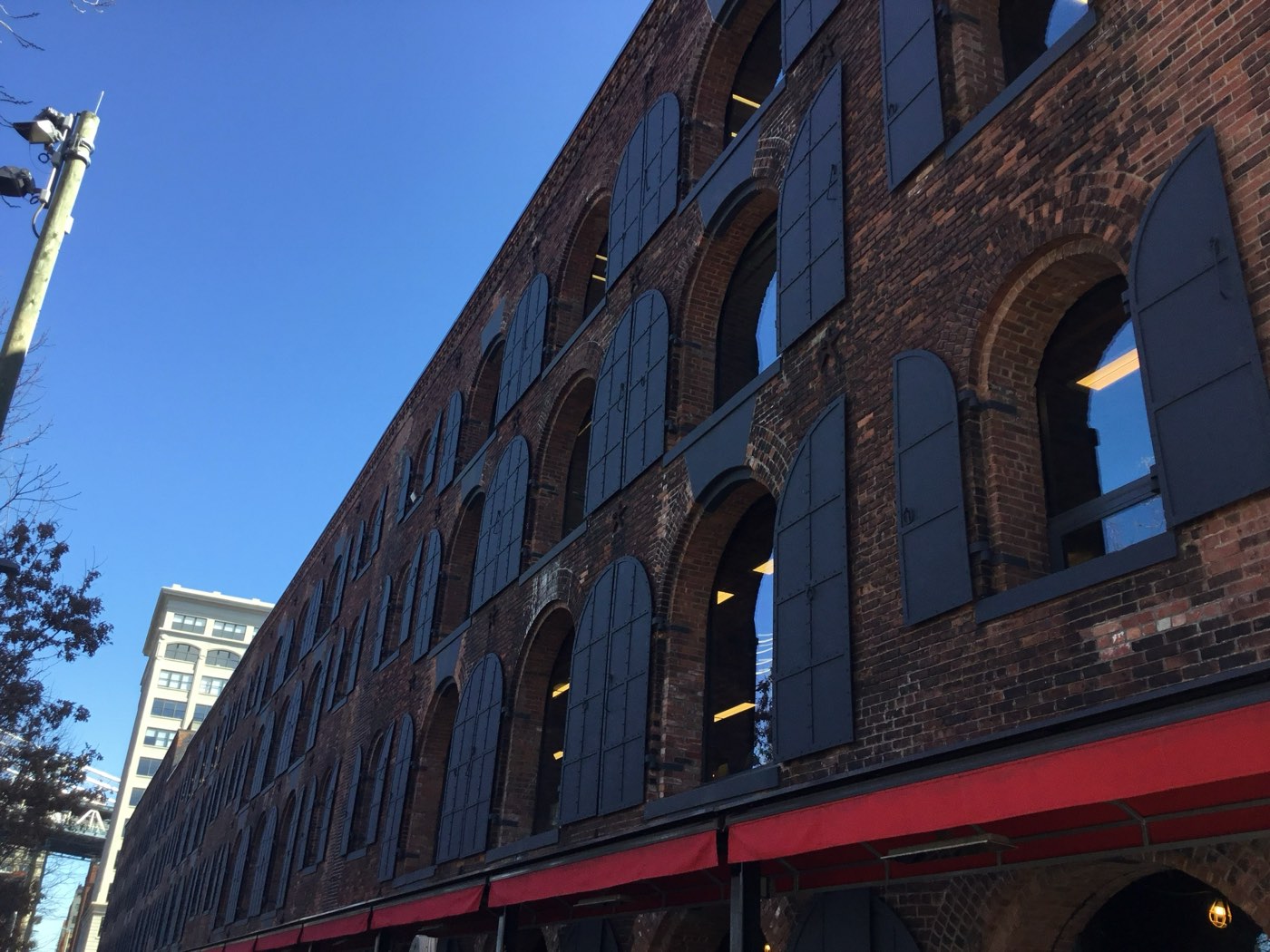
Washington Street, DUMBO, in April 2017 — the view to the Manhattan Bridge between converted warehouse blocks. For seventeen years after the purchase, the only use the zoning here permitted was the manufacturing that had already gone.Photo: Redd Angelo (Unsplash), CC0, via Wikimedia Commons
Seventeen years of being wrong
The plan failed twice before it worked. Walentas first saw DUMBO as a retail destination, then as a back-office campus for Wall Street firms expanding out of Manhattan.1 Lehman Brothers Kuhn Loeb agreed to move operations into the Clock Tower at 1 Main Street, and then walked away.3
The city was the larger problem. In 1982 he was designated by city and state as sole developer of the Empire Stores — the derelict Civil War-era coffee warehouses on the waterfront — and of several city-owned sites, with a package of tax breaks and subsidies attached.3,5 In March 1984 the designation was pulled, city officials concluding he lacked the financing.3 Walentas has always said the real reason was personal: Ed Koch’s deputy mayor Kenneth Lipper was a friend of Byers and a former Two Trees investor, and blocked him over the suicide. Lipper’s answer was that Walentas was simply unfit for the job.2 The Times reported him as “anathema at City Hall” during the Koch years.4
He called what followed his “Stalingrad phase.”3 For years he could not pay the taxes or service the debt.1 Every rezoning he proposed was voted down by the community board; the banks quit; his partners quit.7 City Limits, looking back in 2013, catalogued what the fight over the Brooklyn waterfront actually involved: investigations, lawsuits, charges of libel, and a steady haemorrhaging of jobs.9
The rescue is the part of the story the playbook version leaves out, and it is the most instructive part. By Walentas’s own telling, Governor Mario Cuomo’s office showed him the lever: publicly threaten not to renew the leases of his industrial tenants — who accounted for about 1,700 manufacturing jobs — and the state would find a way to deal. He made the threat. A deal was cut in which existing tenants could renew and the state moved its Department of Labor, 1,000 workers, out of the World Trade Center and into his building.2 That 1986 lease ran ten years at $105 million, then the largest ever signed in Brooklyn.3
Read that sequence again. A private landlord used the threatened elimination of industrial jobs as leverage, and the public sector responded by becoming his anchor tenant for a decade. The rent was still cheaper than the World Trade Center, so the state saved money too2 — but the survival of the DUMBO position was financed by a government lease, not by the market.
The rezoning, mechanism by mechanism
The Labor Department’s lease expired in 1997. In the same year, the city agreed to rezone.3 That timing is the hinge of the whole story: the building emptied exactly when it became legal to fill it with something worth twenty times more.
The reel compresses this into “lobbied to rezone the area from industrial to residential in 1998.” The record is a sequence of specific, named instruments, and the names matter because they are what an operator actually applies for. The city first rezoned two blocks around the Clock Tower in 1997.5 In 1998 a C6-2A district was mapped along Main Street to permit mixed-use conversion. In 1999 DUMBO received Brooklyn’s first Special Mixed Use District, M1-2/R8A — known as MX-2 — which allowed conversion and new construction between the two bridges. In December 2007 the Landmarks Preservation Commission designated the DUMBO Historic District, and in July 2009 the City Council adopted a further rezoning east of the Manhattan Bridge. City Planning counts those actions as having generated over 900 new homes with capacity for 900 more.8
The politics had changed as much as the paperwork. Walentas found a warmer reception under Rudolph Giuliani than he ever had under Koch, and the head of the city’s Economic Development Corporation said the quiet part out loud in 1998: “We have already learned the folly of trying to save manufacturing-only zoning in places where people would otherwise be willing to make a serious investment.”4 City Limits records the same turn less warmly — by 1997 Walentas had Republicans in City Hall and in Albany, and pushed most of his plan through.9
How the first conversion was actually financed
Permission is not capital. Even with the zoning in hand, no conventional bank would lend on the first residential conversion in a neighbourhood that had never had one. Walentas started the Clock Tower with $3 million of his own money and then borrowed $30.7 million from Emmes Capital at seventeen per cent annual interest.4
Seventeen per cent is the number to sit with. It is not a development loan rate; it is what you pay when the lender thinks it might end up owning the building. That single figure prices twenty years of scepticism more honestly than any quote about vision, and it is the reason speed mattered: after seventeen years of waiting for permission, the conversion took seven months.4
The public sector helped again, quietly. The 124 lofts came with a ten-year city tax abatement that held real estate taxes to $42–$220 a month, against $135–$710 without it — roughly a two-thirds reduction in the carrying cost of owning in DUMBO, applied at exactly the moment buyers had to be persuaded to move somewhere with no shops and no nightlife.5 Most units were priced between $220,000 and $980,000. Thirty contracts were signed in the first two weeks, and Jed Walentas — then the project manager, later chief executive — said prices would rise by as much as fifteen per cent on some units in response to demand.5 The building sold out that year for about $60 million. (The 1998 reporting counts 124 lofts; a 2002 account says 122.)3,5
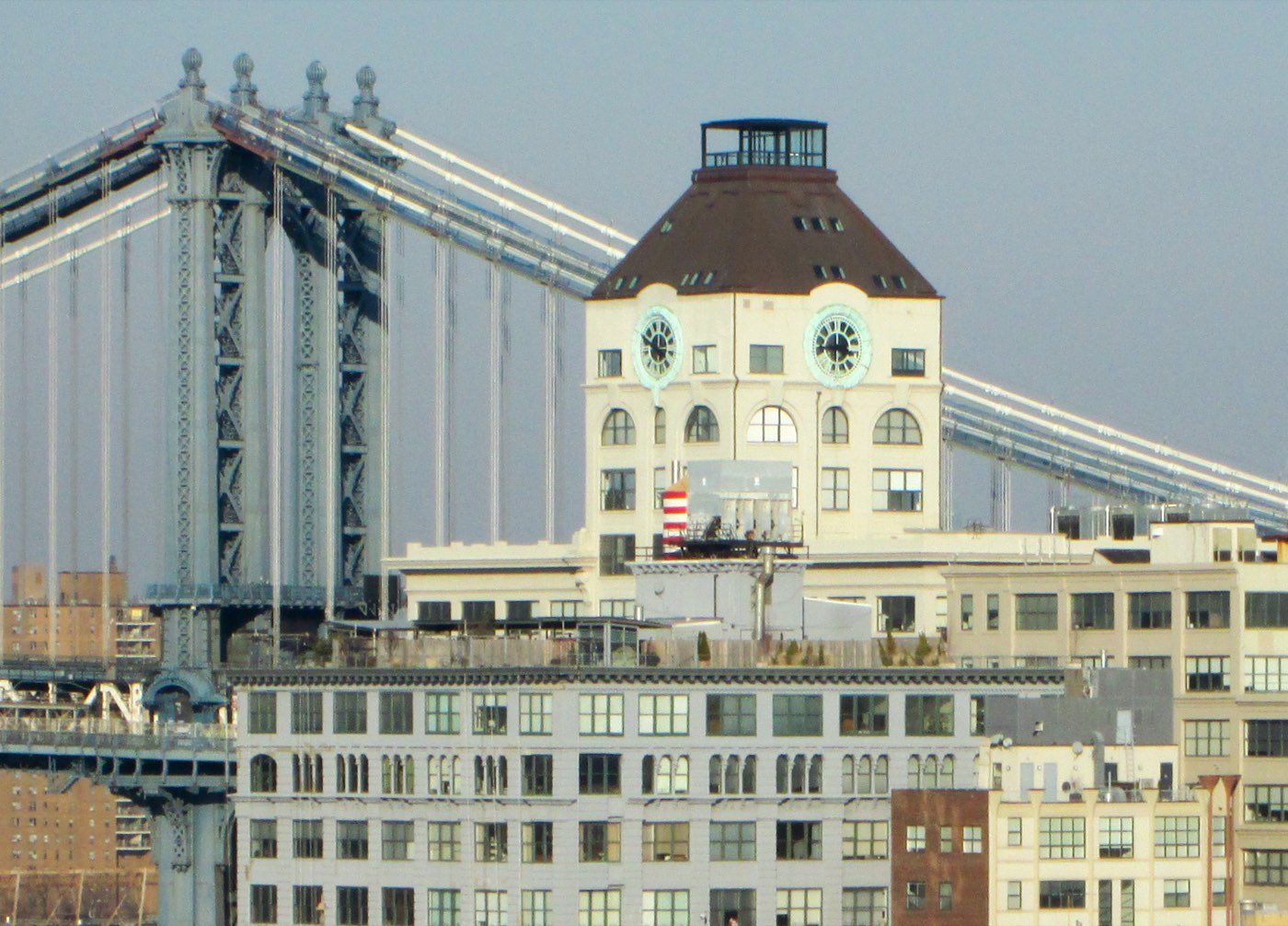
From there the model repeats without outside investors: convert one building, sell it, finance the next. The Lauders had sold out in the late 1980s — Leonard Lauder’s stated reason was that a New York real-estate position carried public-relations risk the family did not want — and Walentas bought out their successors from the mid-1990s.2 He also kept trading the position rather than only accumulating it: he redeveloped and sold about 700,000 square feet of the original parcel while buying roughly a million more square feet he had not owned.2
The loss leader, and what it cost
The most-copied part of the playbook is the retail. Walentas hand-picked ground-floor tenants and refused the ones who would have paid most. Asked about it in 2006: “Duane Reade would love to come in here, but we won’t have them. They’d pay whatever we ask, but we don’t need another place that sells Cokes and chips.”10 Two Trees turned away chain pharmacies and bank branches at what the Observer described as the cost of well-above-market rent.11
The subsidies were real and large. By 2002 he had given half a dozen arts groups a total of 100,000 square feet of free space, and fifteen shops were paying no rent for two years.3 St. Ann’s Warehouse paid nothing at all for its former spice factory; the Galapagos performance venue paid $6.82 a square foot for 10,000 square feet on Main Street at a time when DUMBO space was fetching upward of $24.11 Gleason’s Gym and Jacques Torres came in on free or reduced rent.28 He even paid the transit authority $90,000 in 1998 to reroute the B25 bus so it stopped in DUMBO — and, according to an MTA spokesman, stopped paying the annual fee in 2000, though the bus kept coming.3
Walentas never pretended this was philanthropy. His own formulation: “By enriching the mix downstairs, I’m increasing the value of what’s upstairs.”3 That is the entire economic argument for a loss leader, stated by the person paying for it. It only works if you own the upstairs — which is why site control comes first in the sequence and cheap rent comes second.
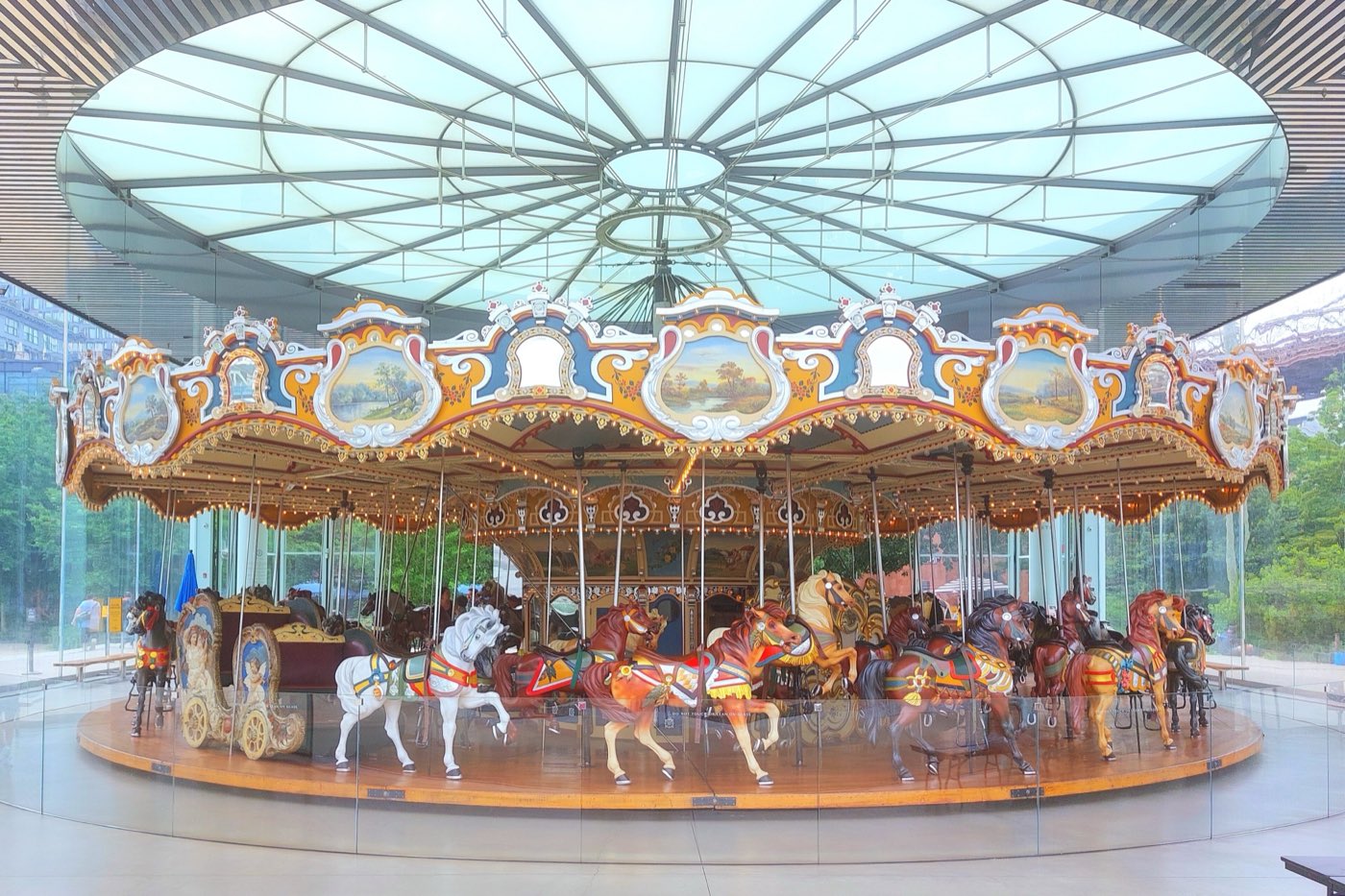
The carousel is the same logic at civic scale, and it is where the reel overstates the record. Jane and David Walentas bought the 1922 Philadelphia Toboggan Company carousel at an Ohio auction in 1984 for $385,000.13 Jane Walentas then spent between twenty-five and twenty-seven years restoring it, largely by hand.12,13 It opened to the public on 16 September 2011 inside a transparent acrylic-and-steel pavilion by Jean Nouvel that cost $9 million, given to Brooklyn Bridge Park along with a landscape renovation of the 4.5-acre Empire Fulton Ferry section and a guarantee of the ride’s upkeep for up to thirty years.12,14 The widely repeated “$15 million restoration” figure appears in no source this brief could verify; what is sourced is $385,000 of purchase and $9 million of pavilion, with the restoration cost never published.
The harvest
Once conversion was legal and the ground floors were interesting, the prices moved fast. By October 2002 Clock Tower lofts were reselling at up to $740 a square foot, according to Karen Heyman of Atco Residential Group; the newly converted Sweeney Building put 87 condos on the market with a third priced above $1 million, and sold twenty-seven of them over a single Columbus Day weekend.3 By 2010 Walentas said the firm “routinely” sold condos at $1,000 a foot and was asking $25 million for the 6,000-square-foot clock loft at the top of 1 Main Street.6
His own accounting of the returns, offered casually in 2006, is the only one on the record: three or four hundred million dollars over the whole period, of which “we made $200 million alone on one building last year. Converted it to condos.”1 By January 2014 Forbes put the Two Trees portfolio at 2.3 million square feet and estimated Walentas’s net worth, after debt, at $1.4 billion — the first billionaire to make his money almost entirely in Brooklyn.2
The cleanest external mark on the land came from a competitor. In October 2013 Kushner Companies, RFR Realty and Invesco Real Estate paid $375 million for 1.2 million square feet across six buildings the Jehovah’s Witnesses were selling in DUMBO — a $37.5 million deposit went down in July.21 That is roughly $312 a square foot for unrenovated space, against the $6 Walentas paid: about fifty times, on Forbes’s arithmetic.2 Walentas’s reaction was the sharpest thing he said about his own market: a new buyer prices the asset against everything else available in town, while he prices it against what it used to be, “and you get very different results.”2 He stopped buying in DUMBO. He had priced himself out.
The sequence
Dec 1977
Two Trees co-founder Jeff Byers dies by suicide, citing business problems. Walentas pays the family $1.8M for his stake and loses the investor network Byers had brought.2
1978
Ronald and Leonard Lauder put $2M into the Silk Building in Greenwich Village — Walentas’s biggest deal yet, and the relationship that pays for Brooklyn.2
c.1979–81
Buys about 2 million square feet of industrial DUMBO from Harry Helmsley at $6 a foot. The Lauders lend $6M; roughly $6M of debt comes with the buildings. Sources date the purchase 1979, 1980 and 1981.1,2,3
$12M for 2M sq ft
1982
Designated by city and state as sole developer of the Empire Stores and city-owned waterfront sites, with a package of tax breaks and subsidies attached.3,5
Mar 1984
De-designated: city officials conclude he lacks the financing. Lehman Brothers Kuhn Loeb had already walked away from its Clock Tower back-office lease.3
1984
The Walentases buy a 1922 Philadelphia Toboggan Company carousel at an Ohio auction and ship it to Brooklyn.12,13
$385,000
1986
The state moves its Labor Department into the Clock Tower — 1,000 workers on a ten-year lease, then the largest ever signed in Brooklyn. Walentas had spent $20M fitting the building out as offices.3,5
$105M contracted rent
1997
The city agrees to rezone two blocks around the Clock Tower for residential use — in the same year the Labor Department’s lease expires and it leaves.3,5
Aug 1998
The Clock Tower conversion: $30M, 124 lofts, funded by $3M of his own money and an Emmes loan at 17% interest. A ten-year city tax abatement cuts buyers’ taxes by roughly two thirds.4,5
$30.7M borrowed at 17%
Late 1998
The 124 lofts sell out. Seventeen years to win permission; seven months to convert the building.3,4
~$60M in condo sales
1998–99
A C6-2A district is mapped along Main Street; the next year DUMBO gets Brooklyn’s first Special Mixed Use District, M1-2/R8A (MX-2).8
Dec 2007
The Landmarks Preservation Commission designates the DUMBO Historic District, locking the neighbourhood’s look in place.8
Jun 2009
The City Council approves Two Trees’ Dock Street tower 41-10-1, overriding the local member — DUMBO’s first affordable housing and a 45,000 sq ft middle school in the deal.15,16
Sep 2011
Jane's Carousel opens in a $9M Jean Nouvel pavilion, given to Brooklyn Bridge Park along with a 4.5-acre landscape renovation.12,13,14
$9M pavilion, donated
Apr 2012
The Appellate Division affirms the dismissal of the neighbourhood group’s challenge to Dock Street. The tower proceeds.17
Oct 2012
Two Trees buys the Domino Sugar refinery site in Williamsburg — 11 acres — for $185M, $30M above its own opening bid.2
$185M out
Oct 2013
Kushner Companies, RFR and Invesco pay $375M for 1.2 million square feet of DUMBO — six buildings from the Jehovah’s Witnesses, at roughly fifty times what Walentas paid a block away.2,21
$375M paid nearby
Nov 2024
The Cultural Space Subsidy, which had housed artists at $1 per square foot a month since 2014, is not renewed. Tenants are quoted double or triple.20
May 2026
The last tower of the $2.5B Domino redevelopment rises at 280 Kent Avenue. River Ring, approved in 2021, is queued behind it.26
$2.5B project
The record has a stain
Someone was already living in those buildings. Artists had been moving into the vacant floors since the 1970s, sometimes illegally, and the acronym they invented was an attempt to keep exactly this from happening.28 By 2002 the sculptor Tom Otterness had been pushed out of his studio at 55 Washington Street after an internet company took the space at three times his rent; Elliott Arkin, eighteen years at 20 Jay Street and paying $1,500 a month for 2,000 square feet, expected to be gone when his lease ended.3
Jed Walentas has never denied the mechanism. In 2005, describing how many artists squatting in abandoned warehouses had to make way, he said plainly: “certainly we are proponents of gentrification. We’ve dramatically increased everyone’s property value, including ours. Through that process, what some people refer to as ‘character’ can get destroyed.”19
In November 2009, Two Trees told the artists and non-profits at 25 Washington Street to vacate so the building could become luxury rentals; the company’s answer was that the lease expiry dates had been in the documents all along. Doreen Gallo of the DUMBO Neighborhood Association put the counter-case: “he lures businesses in with incentives and then disposes of them when they’re no longer needed.”18
The industrial tenants fared no better than the artists, and were used more instrumentally. The 1,700 manufacturing jobs Walentas threatened to evict in the mid-1980s were the lever that produced the state lease; the last manufacturers had left by the time the neighbourhood was rezoned.1,2 City Limits’ verdict on the wider waterfront is that thousands of entry-level jobs were chased off it with help from political allies and well-paid lobbyists, and that there is no going back.9
The formal fights were lost by the neighbours. In June 2009 the City Council approved Two Trees’ seventeen-storey Dock Street tower by 41 votes to 10 with one abstention, overriding the objection of the local member, David Yassky, who argued it would permanently taint the view of the Brooklyn Bridge — a rare thing for the Council to do on a local land-use matter. The trade was a 45,000 square foot middle school and DUMBO’s first permanently affordable housing, twenty per cent of the units.15,16 Council members alleged during the debate that the School Construction Authority had no intention of building schools in the area and supported the project as a favour to the developer.16 The DUMBO Neighborhood Foundation sued; the Supreme Court dismissed the petition in October 2010 and the Appellate Division affirmed on 17 April 2012.17
And the subsidy that defined the brand has an end date. In 2014 Two Trees created a Cultural Space Subsidy giving an initial cohort of seventeen artists and non-profits studios at $1 per square foot a month — a rate one painter estimated saved her about $250,000 over a decade. In spring 2024, with the commercial market weak and a $108 million loan on 20 Jay Street coming due in 2028, nobody was renewed; those who wanted to stay were quoted $2 to $3 a foot by a broker, and the next cohort would pay $1.50. Two Trees’ director of external affairs answered: “we have supported hundreds of artists over the years through below-market rents, in good economic times and bad. And no good deed goes unpunished.”20 Both sentences are true. A subsidy that raises the value of the space around it is an investment, and investments get repriced.
The ledger, opened
Three money-back numbers, all sourced, all real — and stacking them would invent a figure nobody published.
The four sourced money-out lines, added
$67.5 million
The value of the public supportNever priced
- The buildings, from Helmsley, c.1979–811,2$12 million
- Buying out Byers's family, Dec 19772$1.8 million
- Fitting the Clock Tower out as offices, to 19863,5$20 million
- Converting the Clock Tower to lofts, 19984$33.7 million
Sourced, and not part of that total
Never published
A chart that stacked a rent roll, a sales total and a self-reported profit into one running line would be inventing a number nobody published — so the three sit outside the total, at their own scale, each labelled with what kind of number it actually is.
| Line | Amount | How it is counted |
|---|---|---|
| The buildings, from Helmsley, c.1979–81 | $12 million | sourced, and part of the total |
| Buying out Byers's family, Dec 1977 | $1.8 million | sourced, and part of the total |
| Fitting the Clock Tower out as offices, to 1986 | $20 million | sourced, and part of the total |
| Converting the Clock Tower to lofts, 1998 | $33.7 million | sourced, and part of the total |
| NY State Labor Department lease, 1986 | $105 million | sourced, but a different kind of number — not added to the total |
| Clock Tower condo sales, late 1998 | ~$60 million | sourced, but a different kind of number — not added to the total |
| "We made $200 million alone on one building" | $200 million | sourced, but a different kind of number — not added to the total |
| Twenty-odd years of rent across the portfolio | Never disclosed | never published |
| The cost of converting a dozen buildings one at a time | Never disclosed | never published |
| The value of the public support | Never priced | never published |
| The four sourced money-out lines, added | $67.5 million | the sourced total |
The ledger, opened
- The buildings, from Helmsley, c.1979–811,2$12 million
- Buying out Byers's family, Dec 19772$1.8 million
- Fitting the Clock Tower out as offices, to 19863,5$20 million
- Converting the Clock Tower to lofts, 19984$33.7 million
Sourced, and not part of that total
Never published
A chart that stacked a rent roll, a sales total and a self-reported profit into one running line would be inventing a number nobody published — so the three sit outside the total, at their own scale, each labelled with what kind of number it actually is.
What DUMBO is now, and the one building he never got
Two Trees holds more than three million square feet across twelve DUMBO buildings today.22 The tenants are the ones the strategy was designed to attract: in the fourth quarter of 2025 alone, Cushman & Wakefield logged the architects Bjarke Ingels Group renewing 50,000 square feet at 45 Main Street and Overtime renewing and expanding into 41,891 square feet at 20 Jay Street. Brooklyn’s average asking office rent that quarter was $53.02 a square foot borough-wide.23 Corcoran’s fourth-quarter report put Brooklyn new-development median prices at a record $1.4 million, crediting strong sales above $2 million in Williamsburg, DUMBO and Greenpoint.24
- DUMBO industrial space, mid-1970s2$2
- Galapagos, Main Street, 200211$6.82curated, below market
- DUMBO space generally, 200211$24upward of, market rate
- Two Trees' own pre-built office rent, Dec 202522mid-$40s
- Brooklyn borough-wide asking office rent, Q4 202523$53.02not DUMBO-specific
Not one continuous series — an industrial rent, a curated below-market deal, DUMBO's own market rate the same year, Two Trees' own pre-built figure and a borough-wide average sit on one scale because each is sourced and dated, not because all five measure identically. What survives the differences is the direction: DUMBO rent moved from single dollars to double digits in fifty years, and even the borough average it now sits inside is far above where this land started.
The Empire Stores never became his. He was designated in 1982, de-designated in 1984, was the sole respondent to the state’s request for proposals in 1997, and pitched a Nouvel-designed hotel and multiplex extending over the East River in 1998 — a plan the community fought and the state did not take.3,4 In 2013 Brooklyn Bridge Park Corporation ran another competition and Midtown Equities won it, opening about 380,000 square feet of offices and 60,000 square feet of shops in the restored warehouses.27 The single asset that started the whole fight is the one piece of DUMBO the man who assembled the neighbourhood does not own.
The sequel is running now
In October 2012 Two Trees paid $185 million for the Domino Sugar refinery and eleven surrounding acres in Williamsburg — $30 million above its own opening bid.2 The site was rezoned in 2014 and the redevelopment now runs to $2.5 billion: four mixed-use towers, the landmarked refinery converted into 460,000 square feet of offices, and public park and plaza across the eleven acres.22,26 Domino Park opened in 2018 and Domino Square in 2024. The final building, at 280 Kent Avenue, was rising in May 2026 — permits say 1,350 apartments, the approved land-use application 1,262 — of which 315 are affordable at an average of sixty per cent of area median income, plus 105 more built off-site.26
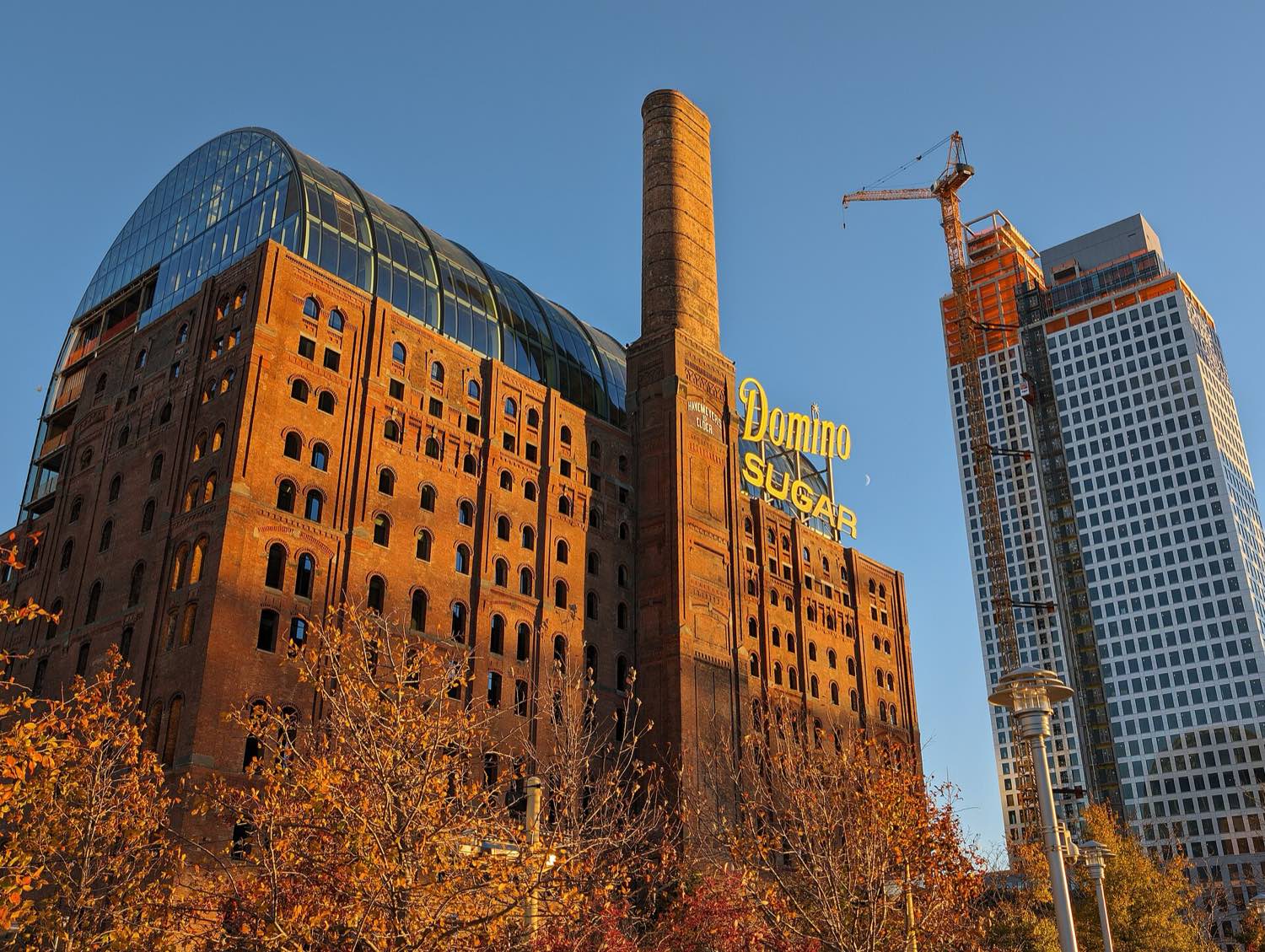
The differences from DUMBO are as instructive as the similarities. This time the rezoning came first and the affordable housing was negotiated into it up front; this time the company could self-finance; this time the public park was in the plan rather than offered as a concession after a fight. What carried over is the shape: buy an obsolete industrial parcel whole, spend on the public realm early, curate the ground floor, and convert the rest over a decade. River Ring, approved by the Council in 2021, is queued behind it.26
What transfers
Site control is the only part that cannot be bought later. Everything else in this story — the retail curation, the free rent, the carousel — depends on owning the upstairs that the downstairs makes valuable. A single storefront operator running the same playbook subsidises a neighbour’s asset. Ask who captures the spillover before you pay for it.
The binding constraint was legal, not financial. For seventeen years the buildings were worth $6 a foot because of a line in the zoning resolution, and they became worth hundreds because that line changed. Underwriting an entitlement play means underwriting a political timetable you do not control — and being able to survive it being wrong for a very long time, which here meant borrowed money, a patient lender and eventually a government tenant.
Cheap money in and cheap rent out are the same trade. Walentas bought with a family loan and an assumed mortgage, and gave away space for years. Both work only because the entry basis was low enough that time was affordable. Raise the basis — as the 2013 buyer next door did at fifty times the price — and the same playbook stops being available, because you can no longer afford to be wrong for a decade.
And a manufactured neighbourhood has a bill attached that arrives later. The artists whose presence made the lofts desirable, the manufacturers whose jobs were the bargaining chip, and the subsidised studios that closed in 2024 are all part of the same ledger as the condominium prices. A case study that reports only one side of it is a brochure.
Common questions
- Did David Walentas really buy DUMBO for $12 million?
- He bought about two million square feet of industrial buildings — most of the neighbourhood — from Harry Helmsley for $12 million, roughly $6 a square foot. The purchase year is genuinely disputed: the New York Times dated it 1979 in 2006 and 1981 in 1998 and 2002, and the DUMBO Improvement District says 1981. None of the money appears to have been his own: Ronald and Leonard Lauder lent him $6 million and about $6 million of debt came with the buildings.
- Why did it take so long to convert DUMBO to housing?
- The zoning did not allow it, and the city refused to change it for seventeen years. Walentas was designated developer of the Empire Stores and city-owned waterfront sites in 1982 and de-designated in March 1984, with the city citing insufficient financing. He was frozen out under Mayor Koch, survived on a ten-year, $105 million state Labor Department lease signed in 1986, and only got the rezoning in 1997 under Mayor Giuliani.
- How much did Two Trees make on DUMBO?
- Nobody has published a full accounting, including the company. The only figure on the record came from Walentas himself in 2006: three or four hundred million dollars, of which he said $200 million came from a single building converted the year before. Forbes estimated his net worth at $1.4 billion in 2014 and $2 billion in August 2026. Twenty years of rental income and the total conversion cost were never disclosed, so no independent total can be calculated.
- How much did Jane's Carousel cost?
- The record supports two numbers, not the $15 million restoration figure that circulates online. Jane and David Walentas bought the 1922 carousel at an Ohio auction in 1984 for $385,000, and the transparent pavilion Jean Nouvel designed for it cost $9 million. The restoration itself took between twenty-five and twenty-seven years and its cost has never been published. The carousel opened in Brooklyn Bridge Park on 16 September 2011 as a gift from the Walentases.
- What is Two Trees building now?
- The Domino Sugar refinery site in Williamsburg, bought for $185 million in October 2012 and rezoned in 2014. The $2.5 billion redevelopment covers four mixed-use towers, the landmarked refinery converted to 460,000 square feet of offices, and six acres of public space. The last building, 280 Kent Avenue, was under construction in May 2026 with about 1,262 apartments including 315 affordable ones. River Ring, approved in 2021, follows it.
Sources
- The New York Times (IHT) — Dumbo in New York — Properties (2006-06-13)
- Forbes — Brooklyn's Billionaire: How One Man Made A Fortune Rebuilding Dumbo (2014-01-22)
- The New York Times — Over the River, No Longer Fringe (2002-10-24)
- The New York Times — SoHo, TriBeCa And Now Dumbo? (1998-10-24)
- The New York Times — Residential Real Estate: A Neighborhood Called Dumbo Has High Hopes (1998-08-07)
- The New York Times — Square Feet — The 30-Minute Interview: David C. Walentas (2010-01-22)
- UVA Darden School of Business — Alumni Spotlight: David Walentas (undated)
- NYC Department of City Planning — DUMBO Rezoning — Approved (2009-07-29)
- City Limits — Forgotten History Behind New Brooklyn Waterfront Plan (2013-03-05)
- Brooklyn Paper — In land of Walentas, Mom & Pop are still king (2006-11-18)
- Observer — The Dumbo Closer (2009-10)
- Brooklyn Bridge Park (press release) — Jane's Carousel Opens at Newly Refurbished Portion of Brooklyn Bridge Park (2011-09)
- Brooklyn Paper — Take a spin on Jane's Carousel (2011-09-20)
- Architectural Record — Snapshot: Jane's Carousel Pavilion (undated)
- CityLand (CUNY/NYLS Center for New York City Law) — Council approves Two Trees project adjacent to bridge (2009-07-15)
- Gotham Gazette — Stated Meeting: Dumbo's Dock Street Project Approved (2009-06)
- NY Appellate Division, 2nd Dept (via Justia) — Matter of DUMBO Neighborhood Found., Inc. v City of New York (2012-04-17)
- HuffPost — DUMBO: Luxury conversion has DUMBO upset at the Walentases (2009-11-29)
- The Pennsylvania Gazette — The Rebirth of DUMBO (2005-03-01)
- Curbed — Can Commercial Real Estate Keep Propping Up Artists? (2024-11-25)
- The Real Deal — Meet the mystery exec who kicked off Kushner and RFR's $375M Dumbo buy (2013-10-10)
- Forbes — What Makes Brooklyn Commercial Real Estate Tick? (2025-12-01)
- Cushman & Wakefield — Brooklyn MarketBeat — Office Q4 2025 (2025-Q4)
- Corcoran — Brooklyn Real Estate Market Report: 4Q 2025 (2026-01)
- Forbes — Profile: David Walentas (2026-08)
- Brooklyn Paper / Brownstoner — Final building rising at Two Trees' Domino Sugar Refinery complex (2026-05-15)
- Midtown Equities (company page) — Empire Stores (undated)
- DUMBO Improvement District — Dumbo History — Timeline (undated)