
Case study Nº 02
Blackstone bought Hilton at the peak — then bought its own debt back at 54 cents
The $26 billion buyout closed weeks before the credit market shut, and seven months later the Financial Times reckoned the equity was worth almost nothing. The public record shows the April 2010 restructuring that saved it, the seven-part sell-down that followed, and exactly how much of the famous $14 billion an outside tally can confirm.
Ben Fan, with Darryl WengNovember 18, 202515 min readWatch the reel
Equity in, Oct 2007
$5.6B
Profit claimed, May 2018
$14B
Seven months after the deal closed, the Financial Times’ Lex column judged that equity “worth almost nothing.”3 Eleven years later Blackstone put the profit near $14 billion — its own account of its own deal, never independently audited.25 The turn between them happened in April 2010, in a debt restructuring, and $17.9 billion of sourced proceeds came back afterwards. The rail above follows that position as you read. Jump to the money ↓
On 3 July 2007, Blackstone agreed to buy Hilton Hotels Corporation for $47.50 a share, an all-cash deal valued at about $26 billion — a 40% premium to the previous day’s close and a 25% premium to the highest price the stock had touched in a year.1,2 It closed that October. Seven months after that, the Financial Times’ Lex column did the arithmetic and concluded that the $5.6 billion of equity Blackstone had injected was “worth almost nothing.”3
Eleven years later Blackstone sold its last 15.8 million shares and told the market it had made roughly $14 billion, more than tripling its money — its own account of its own deal, reported by Bloomberg the day of the sale, and never independently audited.23 This brief follows the money between those two sentences using Hilton’s own filings, because the turn did not happen in the hotels. It happened in April 2010, in a debt restructuring where the sponsor bought its own loans back at fifty-four cents on the dollar.
| The deal at a glance | Number |
|---|---|
| Announced 3 Jul 2007, closed 24 Oct 2007 | $47.50/share · ~$26 billion1,11 |
| Premium to the 2 Jul 2007 close of $33.87 | 40%2 |
| Cash to shareholders and award holders | ~$19.4 billion2 |
| Equity commitment (BREP VI + BCP V) | Up to $5.5 billion2 |
| Debt commitment, seven institutions | Up to $21 billion, no financing condition2 |
| Leverage at close | 78.5% debt · 12.4× debt/EBITDA5 |
| Goodwill booked Oct 2007, impaired across 2008 | $10.5 billion · ~$4.3 billion written off11 |
| Restructuring completed 8 Apr 2010 | $4.0B of debt removed · mezzanine bought at a 54% discount8,11 |
| IPO priced 11 Dec 2013 | $20.00/share · ~$2.35 billion raised11,14 |
| Final exit 18 May 2018 (Blackstone’s claim) | ~$14 billion profit, capital “more than tripled”23 |
The seller was not in trouble
Hilton was not a fading chain losing ground.
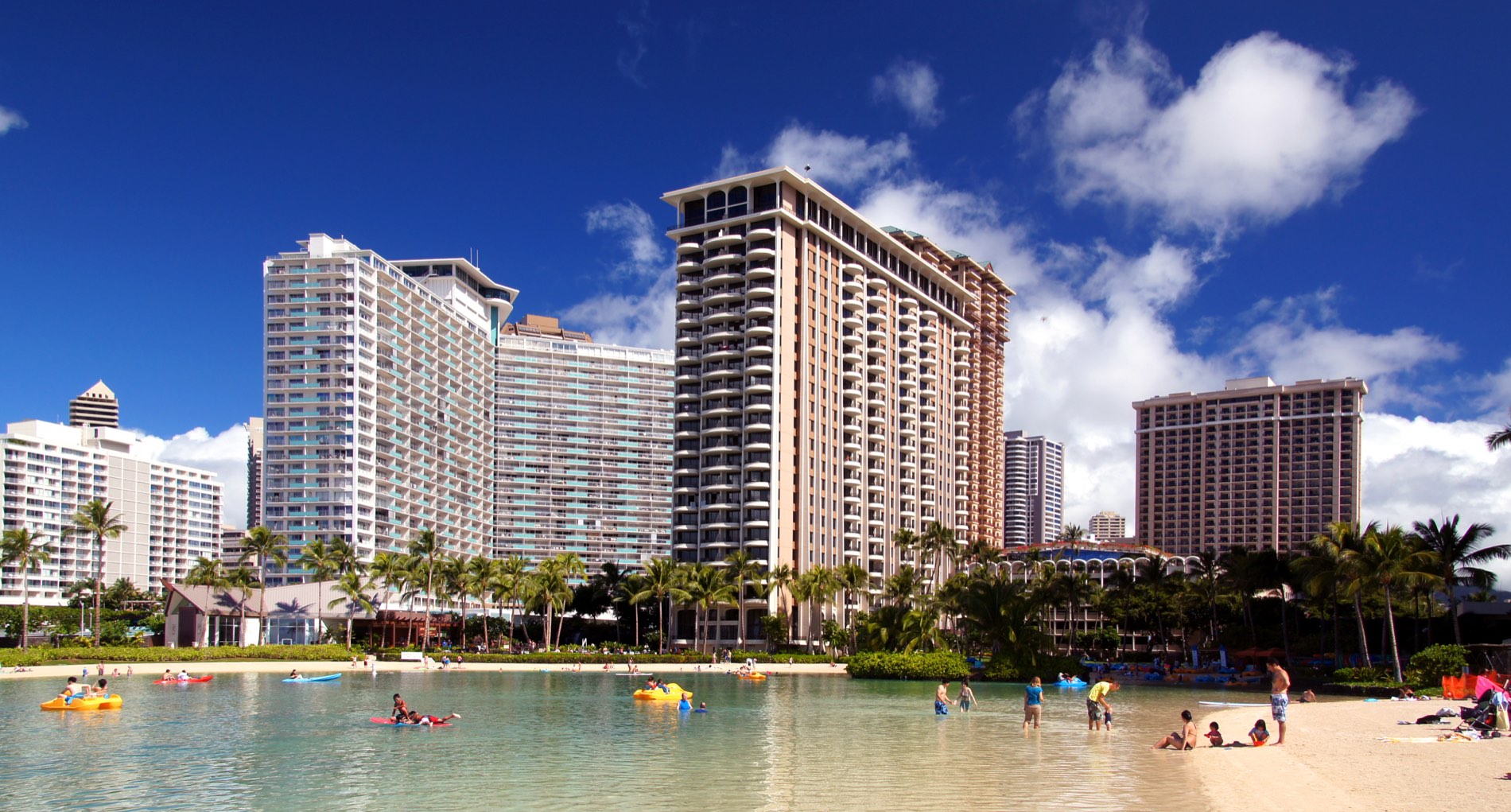
The Hilton Hawaiian Village on Waikiki Beach, November 2013 — the kind of asset that produced the problem. Hilton owned and leased a large share of its hotels, and owned real estate earns a lower multiple than fee income does.Bernard Spragg. NZ · Wikimedia Commons · CC0
The seller was not in trouble. It was in a discount.
Start with why Hilton sold, because the reels have this backwards.
Hilton was not a fading chain losing ground. Under Stephen Bollenbach, who had succeeded Barron Hilton as chief executive in 1996, its room count had grown by more than 350,000 between 1995 and 2007 — 238% growth, the fastest among the world’s ten largest hotel groups — and it had climbed from seventh-largest to fourth.5 Its problem was narrower and stranger: the stock had, for years, traded at a lower multiple of earnings than its peers, and the board could not close the gap.2 Hilton owned and leased a large share of its hotels, and owned real estate earns a lower multiple than fee income does.5 Just before the offer, Hilton traded at about 12.2 times, below most of the companies it competed with.5
The proxy statement records the negotiation almost minute by minute, and it is worth reading as a study in how a board sells a company without ever putting it up for sale. In August 2006 Bollenbach met Jonathan Gray of Blackstone, who floated the high $30s; the stock was in the mid $20s.2 At a September retreat management’s own valuation put Hilton’s standalone worth at roughly $42 a share.2 The board then considered whether to approach other buyers and decided not to, on the ground that putting the company up for sale risked “materially disrupting” it — distracting management, unsettling franchisees, operators and suppliers.2 Blackstone completed due diligence, could not reach the $40s, and in October 2006 was asked to destroy everything it had been shown.2
It came back in May 2007 at low $40s, then $45 — but only if Hilton gave up the right to shop the deal after signing, granted a right to match, and accepted a break fee of 2.75% of equity value.2 Bollenbach said $48. On 24 June, Gray offered $47.50, and the reason he gave for not going the last fifty cents is the most telling line in the document: the cost of the acquisition had risen significantly because credit market conditions had worsened.2 The board considered approaching other bidders a second time, concluded the probability of a materially better offer was low, and declined again.2
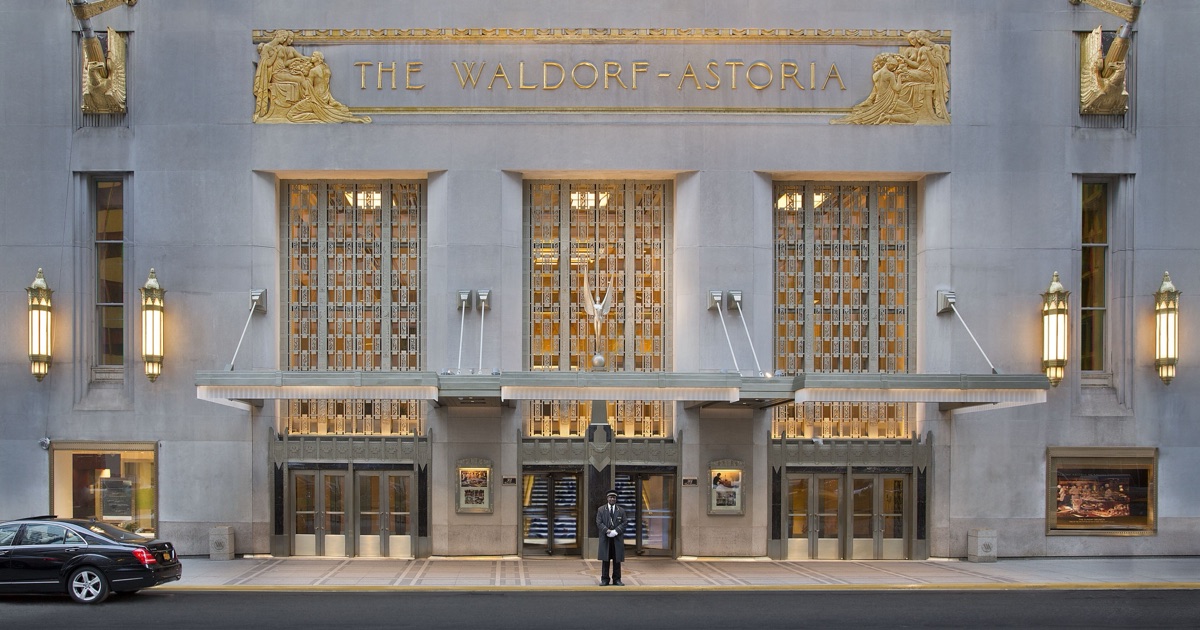
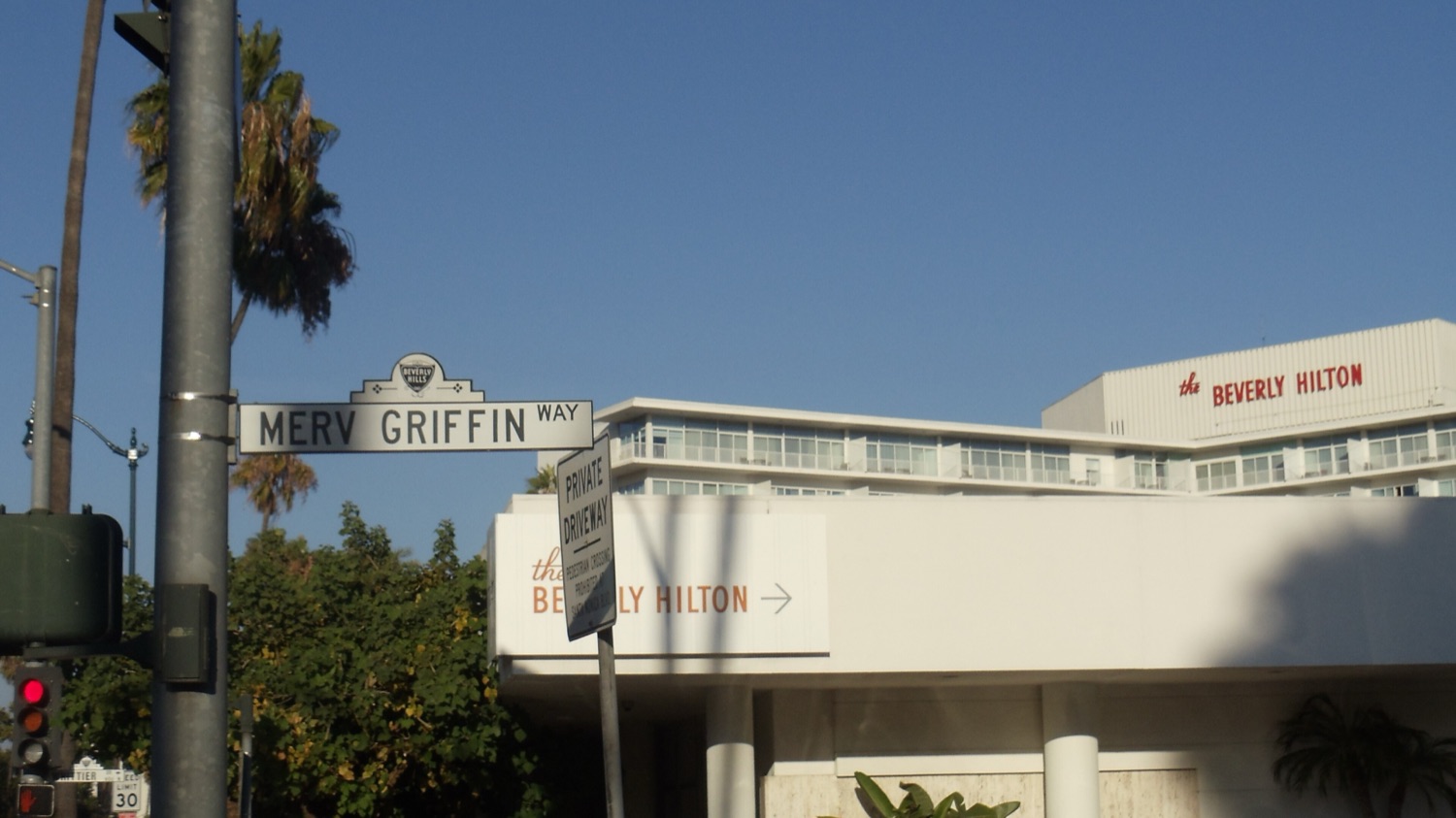
So the price that looks in hindsight like the definition of buying the top was, at the table, a 40% premium wrung out of a buyer who was already flinching at the credit markets, agreed by a board that never tested it against a second bid. Barron Hilton held 20,835,698 shares, 5.3% of the company, worth just under a billion dollars at the deal price.2 Shareholders voted at the Beverly Hilton on 18 September, and the merger closed on 24 October 2007.2,11
What the banks signed, and could not unsign
The financing is the part of this deal that has aged into a warning.
Blackstone’s equity commitment came from two funds — Blackstone Real Estate Partners VI and Blackstone Capital Partners V — for up to $5.5 billion in total.2 Blackstone’s own annual report later put the limited partner capital invested in 2007 at $3.7 billion across the real estate funds, including fee-earning co-investments, plus $1.5 billion from the corporate private equity fund.4 Contemporary accounts of the total equity vary — the FT used $5.6 billion, an Oxford case study $5.7 billion, and The Real Deal, relaying Bloomberg, $6.5 billion including co-investors — and the difference is mostly a question of who gets counted.3,5,25
- Merger proxy, Aug 20072$5.5 billionup to
- Financial Times, Feb 20083$5.6 billion
- Oxford case study, Apr 20145$5.7 billion
- Bloomberg via The Real Deal, May 201825$6.5 billionincl. co-investors
Which of these you accept decides the answer at the end: $17.9 billion of sourced proceeds is 2.79 times the lowest figure and 2.45 times the highest, before the $819 million added in 2010. The figures in this brief enter the equity at the Financial Times' $5.6 billion, because it is the contemporary one.
The debt was the rest. A commitment letter from Bear Stearns Commercial Mortgage, Bank of America, German American Capital Corporation (a Deutsche Bank affiliate), Goldman Sachs Mortgage Company and Morgan Stanley Mortgage Capital Holdings — later joined by Lehman Brothers Holdings and Merrill Lynch Mortgage Lending — provided the lesser of $21 billion or 80% of the total consideration.2 Seven institutions, and several of them would spend the following year fighting for their own survival.
How much of that debt the banks were still carrying when the market shut is one of the genuine gaps in this record, and worth saying plainly: no source found for this brief gives the figure. The nearest thing to a contemporary read is the FT’s, in February 2008 — that the bulk of the net debt sat in bank loans maturing at least three years out, and that the banks “continue to have some success at syndicating this.”3 “Some success” is a phrase doing a great deal of work.
And the merger agreement, in the proxy’s own words, contained neither a financing condition nor a “market MAC” condition.2 That is the sentence that decided the next three years. A financing condition lets a buyer walk if the money does not show up; a market MAC lets it walk if markets collapse. Blackstone had neither escape, and neither did its banks. There was a reverse break fee — Blackstone would owe Hilton $660 million if it failed to close, against $560 million Hilton would owe if it walked to a better offer.2 That, and only that, was the price of abandoning the deal, and nobody paid it.
The result was leverage of 78.5% debt to 21.5% equity, at about 12.4 times EBITDA — roughly twice the average multiple of buyouts that year. For comparison, the TXU buyout closed months earlier at similar leverage but 6.6 times earnings.5 The loans were also “cov-lite”: written with minimal covenants, the promises a borrower makes about keeping its finances inside agreed limits.5 That looked reckless in 2007. It turned out to be the reason nobody could seize the company in 2009.
Seven months later, the equity was gone
On 3 February 2008, before Lehman, before the worst of it, the FT’s Lex column ran the numbers. Hilton carried about $20 billion of net debt at around 5.7%, roughly $1.14 billion of annual interest against internal projections of $2 billion of EBITDA for the year. The column judged the financing robust enough to survive most downturns — and then noted that the enterprise value of listed hotel companies had fallen about a fifth since the buyout, which applied to Hilton meant the $5.6 billion of equity was now worth almost nothing. Credit default swap protection on Hilton’s debt had more than doubled to 735 basis points since October.3
The accounting caught up in stages. Purchase accounting had booked $10.5 billion of goodwill in 2007 — the premium paid over the fair value of the identifiable assets. During 2008 Hilton wrote off approximately $4.3 billion of it.11 Blackstone marked its own equity stake down by about 70%.5,24 A Bloomberg line quoted in a later Oxford case study caught how it looked from outside: Hilton was “once seen as a black mark on Blackstone’s record in real estate.”5
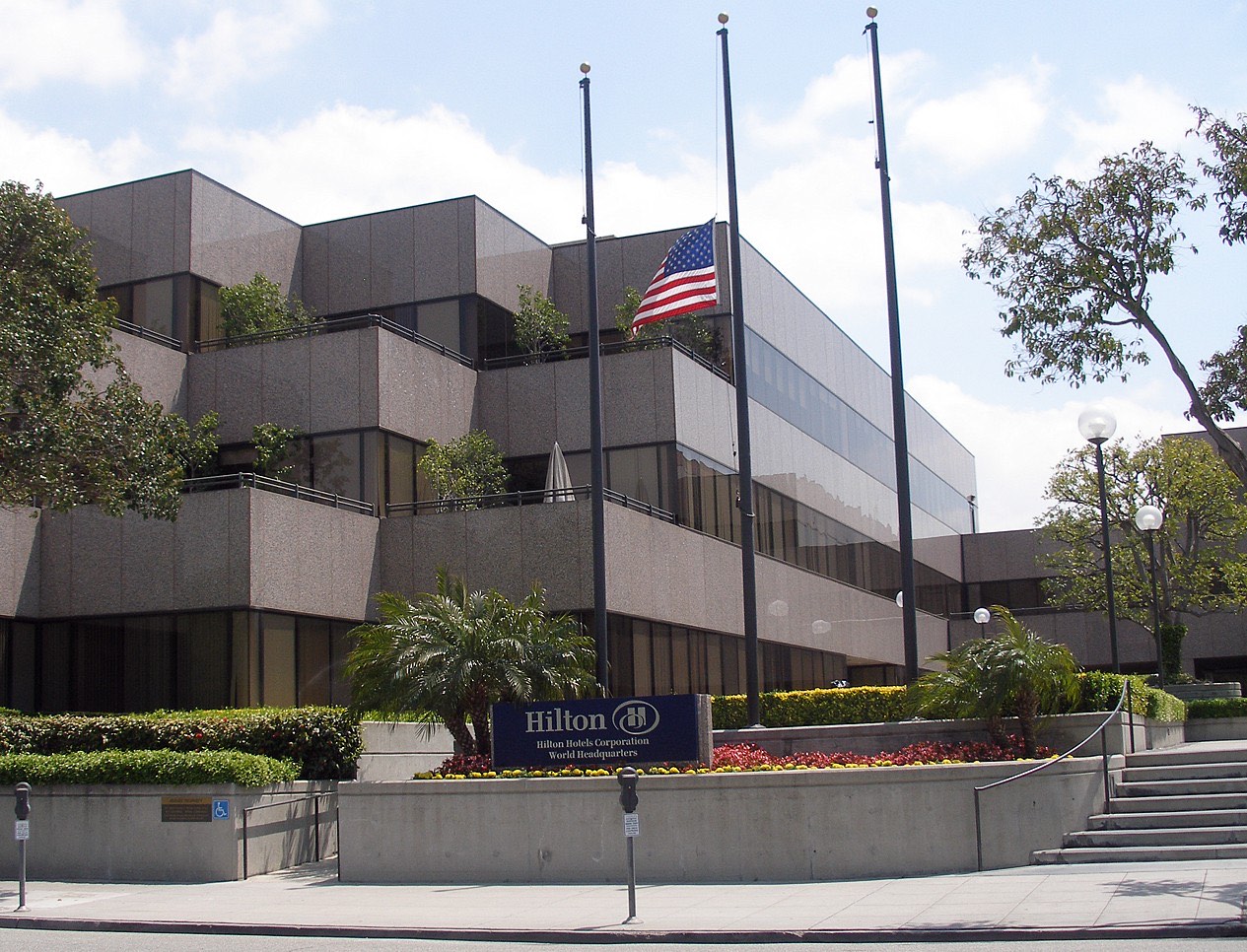
Inside the company, the response was cost. On 4 February 2009 Hilton announced it was moving its global headquarters out of Beverly Hills to Fairfax County, Virginia, investing at least $17 million and promising more than 300 permanent jobs there within three years; Virginia beat Maryland and the District of Columbia for it with a $1 million grant from the Governor’s Opportunity Fund and $2.5 million from a state incentive programme.6 Christopher Nassetta, who had arrived as chief executive in December 2007 from Host Hotels, said Virginia would “allow us to significantly reduce our costs.”6,11
Nine days later the other half of that sentence was reported: more than 1,000 jobs going worldwide as part of a $250 million cost-cutting programme, with McKinsey engaged to find between $200 million and $250 million, and staff at the Watford, Singapore and Dubai offices bracing.7 Hilton then employed about 135,000 people.6 That is the part of a rescue that does not appear in a return multiple.
The mechanical heart
Blackstone did not persuade lenders to forgive anything.
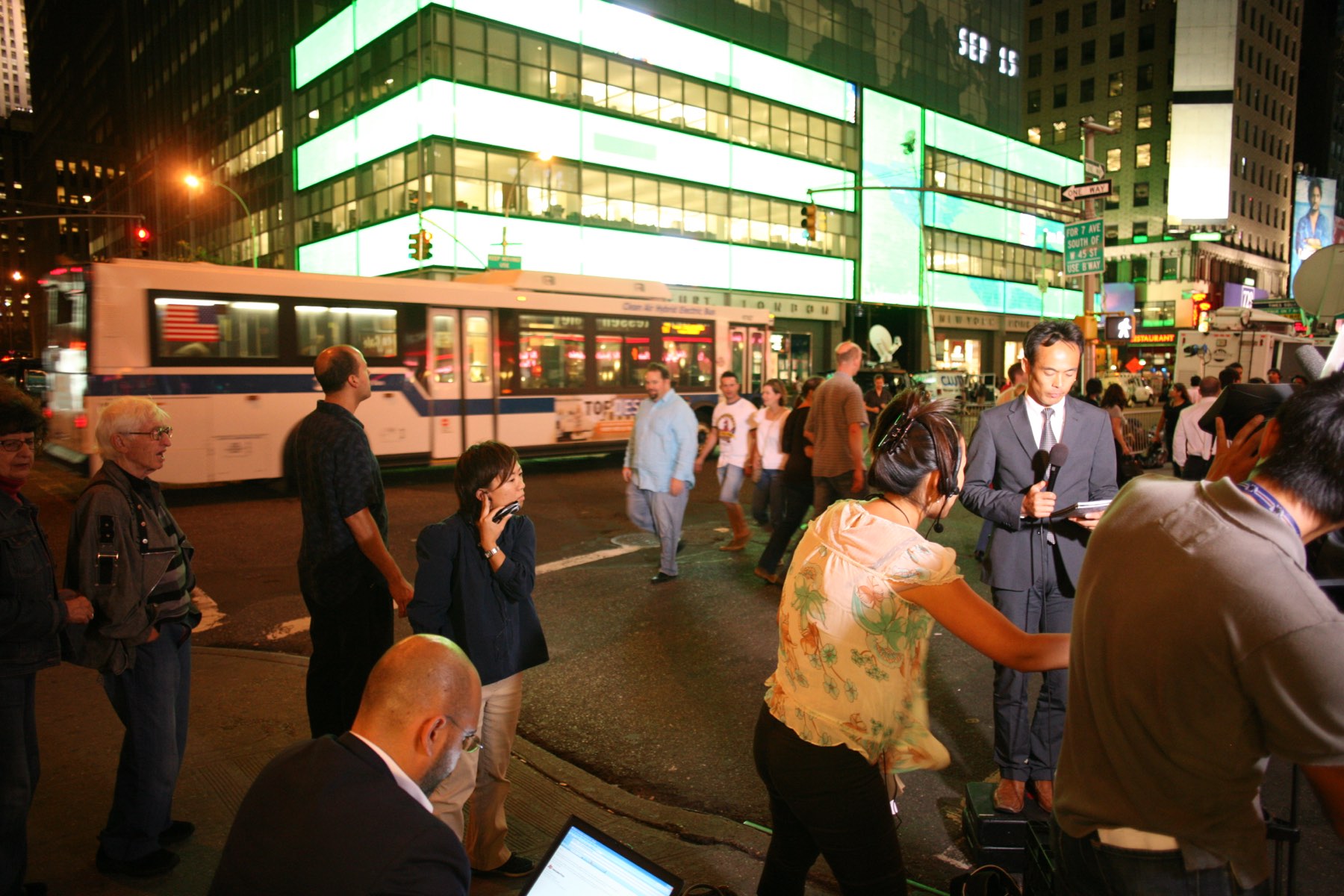
Lehman Brothers' headquarters on Seventh Avenue in New York on 15 September 2008, the day the firm filed for bankruptcy. Lehman Brothers Holdings was one of the seven institutions that had committed the debt for the Hilton buyout fourteen months earlier.Robert Scoble · Wikimedia Commons · CC BY 2.0
The mechanical heart: buying your own debt at 54 cents
Now the part that actually saved the deal, which the reels compress into a sentence about convincing lenders.
When a company’s loans trade below face value, the lender who holds them is telling you they expect to be paid less than they are owed. That creates an opportunity for whoever controls the borrower: buy the loans at the market’s discount, and the discount becomes the borrower’s gain. On 8 April 2010 Hilton announced it had completed a restructuring of substantially all of its existing debt, extending maturity to November 2015 and cutting total debt by nearly $4 billion, “effected through the purchase and retirement of $1.8 billion of debt and the conversion of $2.1 billion of junior mezzanine debt to preferred equity.”8 Bloomberg reported the debt now stood at about $16 billion.9 Private Equity International put the same figures under the headline “Blackstone slices $4bn off Hilton debt.”10
Hilton’s own IPO prospectus sets out what those two clauses actually were, and the detail matters more than the press release does.11
| Component of the Debt Restructuring | Amount |
|---|---|
| Overall reduction in indebtedness | $4.0 billion11 |
| Principal reduction on the senior mortgage loan | $76 million, from restricted cash11 |
| Secured mezzanine debt repurchased | $1.8 billion of face value11 |
| Cash paid for it | $819 million — a 54% discount to par11 |
| Where that $819 million came from | An $819 million equity contribution from the parent11 |
| Two most-junior mezzanine tranches extinguished by the parent | $2.0 billion principal + $87 million deferred interest11 |
| Interest spread reset | From LIBOR +80–525bp to LIBOR +175–425bp11 |
| Accounting gain recognised in 2010 | $789 million11 |
Read the second and third rows together. Blackstone did not persuade lenders to forgive anything. It wrote a fresh cheque for $819 million, handed it to Hilton, and Hilton immediately spent it buying $1.8 billion of its own mezzanine loans from lenders willing to take fifty-four cents rather than wait.11 The difference — $981 million of face value — was extinguished without a cent being paid for it. The company booked a $789 million gain on the transaction — the excess of what the debt was carried at over what it cost to reacquire, less fees.11
One thing worth flagging, because the two accounts differ. Hilton’s press release called the second half a “conversion of $2.1 billion of junior mezzanine debt to preferred equity.”8 Its later filing describes the same event as the extinguishment, by our Parent of the two most-junior tranches, with an aggregate principal amount of $2.0 billion plus $87 million of deferred interest.11 The economics land in the same place; the filing is the more precise of the two, and it is the one used here.
What the restructuring bought was time — five and a half years of it, to November 2015 — and that is what the equity had run out of. It was not a rescue in the sense of new business. It was a purchase of runway, paid for with the sponsor’s own money, at a moment when putting more money into Hilton looked to most observers like the worst idea available.
Growing on other people’s money
The operating turn ran alongside the financial one, and it had a single organising idea: stop buying hotels, start signing them.
A hotel company can grow two ways. It can buy or build buildings, which consumes capital and adds real estate to the balance sheet, or it can put its brand on buildings other people own — franchising them, or managing them under contract — which consumes almost nothing and earns a fee on the room revenue. Hilton had a large share of its earnings in the first kind. It spent the crisis moving toward the second.
In its 8 April 2010 announcement the company claimed it had added 302 new hotels during 2009, the second most in its ninety-one-year history; had become the leading hotel company in the United States by open and operating rooms, citing Smith Travel Research; had more rooms under construction outside the United States than within it for the first time ever; and held a pipeline of more than 900 hotels in 57 countries.8 Those are the company’s own statements about its own performance, made in the same release that announced the debt deal, and they should be read as such.
The independently checkable version is the unit count, which appears in dated company documents across the hold. At announcement in July 2007: more than 2,800 hotels, 480,000 rooms, 76 countries.1 February 2009: 3,200 hotels, 545,000 rooms, 77 countries, about 135,000 team members.6 April 2010: more than 3,500 hotels in 81 countries.8 By 30 September 2013: 4,039 hotel and resort properties, 665,522 rooms, 90 countries, plus 41 timeshare properties.11 A company that was supposed to be drowning added roughly 1,200 hotels while it drowned.
And it added them without paying for them. An Oxford case study found that between 30 June 2007 and 30 September 2013, Hilton’s management and franchise segment grew 40% in rooms, which represented 98% of the company’s overall room growth, with virtually no capital investment by Hilton.5 Nassetta’s own summary was blunter: “Our category-killer brands are attracting capital from all over the world, and it is their capital we are growing with, not ours.”5
The owned hotels tell the opposite story, and the same study is honest about it: Hilton put about $1.8 billion into its owned portfolio after December 2007, and the adjusted EBITDA of the owned and leased segment in 2012 was still below its 2008 level.5 The buildings did not recover. The flag did.
By late 2013 the balance sheet had been rebuilt enough to refinance the whole legacy stack. On 25 October 2013 Hilton repaid $13.4 billion of senior mortgage and secured mezzanine loans in one move, using a $7.6 billion term loan, $1.5 billion of 5.625% senior notes due 2021, a $3.5 billion mortgage-backed loan secured on 23 US hotels, a $525 million loan against the Waldorf Astoria New York, extra timeshare borrowings and $650 million raised by selling Hilton HHonors points for cash.11 Total debt stood at about $15.0 billion.11 The company was now financeable on ordinary corporate terms. That is what made the next step possible.
The sequence
Aug–Sep 2006
Blackstone opens at the high $30s a share while the stock sits in the mid $20s. Hilton’s own internal valuation says $42. The board decides not to seek other buyers — the first of two such decisions — and never runs a sale process.2
3 Jul 2007
Merger agreed at $47.50 a share — a 40% premium, and 25% above the 52-week high. Blackstone commits up to $5.5B of equity; seven banks commit up to $21B of debt with no financing condition.1,2
$19.4B to shareholders
24 Oct 2007
The merger closes. Purchase accounting books $10.5 billion of goodwill.11
3 Feb 2008
Seven months in, the FT’s Lex column reckons the $5.6 billion of equity is worth almost nothing. Credit default swaps on Hilton debt have more than doubled to 735 basis points.3
2008
Across the year Hilton writes off about $4.3 billion of the goodwill it booked twelve months earlier.11
$4.3B impaired
4 Feb 2009
The head office leaves Beverly Hills for Fairfax County, Virginia — at least $17 million invested, 300 promised jobs, $3.5 million of state incentives.6
13 Feb 2009
More than 1,000 jobs go worldwide in a $250 million cost programme, with McKinsey engaged to find the savings.7
8 Apr 2010
The restructuring. Debt falls from about $20B to about $16B; the sponsor puts in $819M of new equity and Hilton spends it buying $1.8B of its own mezzanine debt back at 54 cents on the dollar.8,9,11
$819M in, $4.0B of debt out
22 Dec 2010
Hilton settles Starwood’s corporate-espionage suit — $150 million of expense including $75 million cash, an independent monitor and a two-year ban on launching a lifestyle brand.11,12,13
$150M of expense
11 Dec 2013
IPO priced at $20.00, raising about $2.35 billion; trading opens the next day. Blackstone’s funds sell not one share.11,14
$0 to Blackstone
Jun 2014–May 2015
Three secondary offerings of 90 million shares each, at $22.50, $25.00 and $29.85. Blackstone stops being a majority owner.15,16,17
$6.85B out
24 Oct 2016
HNA Tourism Group agrees to buy 247.5 million shares — about 25% — at $26.25, roughly $6.5 billion, including the spin-off shares attached to them. It closes in March 2017.18,26
~$6.5B out
3 Jan 2017
Park Hotels & Resorts and Hilton Grand Vacations are spun off to shareholders, and a 1-for-3 reverse split takes effect at 5:01pm the same evening.20
Jun–Sep 2017
Two more sales, at $65.82 and $69.20 post-split. Blackstone falls from 15.3% to 5.4%.21,22
$2.0B out
18 May 2018
The last 15.8 million shares go for about $1.3 billion. Blackstone puts the eleven-year profit at roughly $14 billion.23,24
~$1.3B out
The record has a stain
In April 2009 Starwood Hotels sued Hilton in federal court in Manhattan, alleging that Hilton’s senior management had “personally induced and used Starwood employees to serve as corporate spies” and had exploited internal Starwood documents to develop its new lifestyle brand, Denizen.12 The litigation began after Hilton itself told Starwood, in February 2009, that it had found confidential Starwood information at Hilton and in the homes of Hilton employees, then handed back thousands of documents and computer files.12 Starwood alleged Nassetta had been told of the theft months earlier, and that an internal whistleblower had written to him in November 2008.12 CoStar reported that Nassetta and at least 44 other Hilton executives were accused of condoning it, and that Hilton staff were accused of “scrubbing” Starwood labelling from the documents.13
The case settled on 22 December 2010 in a thirteen-page filing. Hilton denied the allegations. It agreed to return all Starwood documents, to submit to an independent monitor, and, until 1 January 2013, neither to develop or acquire any lifestyle or branded-boutique hotel product occupying Denizen’s market space nor to hire any Starwood employee into or above its luxury and lifestyle brands group.12,13 Some terms were kept confidential, and the Justice Department’s grand jury investigation was still open when the settlement was filed.12
Hilton’s accounts put numbers on it. The 2010 results carried $150 million of legal settlement expense, including a $75 million cash payment.11 Separately, in connection with the settlement Hilton guaranteed any shortfall under certain service contracts that Blackstone affiliates had entered into with the plaintiff — initial maximum exposure $75 million, reduced to about $45 million by March 2014 as the counterparties paid.15 A brand that had just launched, Denizen, was extinguished before it opened a hotel.
Two other items belong in the same column. The 1,000-plus jobs cut in 2009 were real people in Beverly Hills, Watford, Singapore and Dubai, and the head office that arrived in Virginia was smaller than the one that left California.6,7 And when Hilton listed in 2013 it disclosed that the Internal Revenue Service was auditing the returns covering 2006 and the ten months to the merger, with proposed adjustments that would produce about $695 million of federal tax owed before interest, penalties and state taxes. Hilton said it disagreed on every assertion and intended to contest them.11
The exit took four and a half years, not a day
The exit came in eight pieces over just under four years, and every one of them is on file.
| Sale | Shares, price and proceeds |
|---|---|
| 11 Dec 2013 — IPO | Blackstone sells nothing11 |
| 24 Jun 2014 — secondary (76.4% → 67.3%) | 90,000,000 at $22.50 · $1.974B15 |
| 3 Nov 2014 — secondary (65.8% → 56.7%) | 90,000,000 at $25.00 · $2.205B16 |
| 11 May 2015 — secondary, majority ends | 90,000,000 at $29.85 · $2.674B17 |
| 9 Nov 2016 — secondary (45.8% → 40.3%) | 55,000,000 at $23.50 · $1.285B19 |
| 24 Oct 2016 agreed, closed Mar 2017 — private sale to HNA | 247,500,000 at $26.25 · ~$6.5B18,26 |
| 7 Jun 2017 — secondary (15.3% → 10.3%) | 15,000,000 at $65.82 · $0.987B21 |
| 28 Sep 2017 — secondary (10.2% → 5.4%) | 14,610,000 at $69.20 · $1.010B22 |
| 18 May 2018 — the last block | 15,800,000 · ~$1.3B23,24 |
Two structural events sit inside that table and explain why the prices jump. On 3 January 2017 Hilton spun off its owned real estate as Park Hotels & Resorts and its timeshare business as Hilton Grand Vacations, distributing one Park share for every five Hilton shares and one HGV share for every ten; that same evening a 1-for-3 reverse stock split converted every three Hilton shares into one.20,21 A $23.50 share in November 2016 and a $65.82 share in June 2017 are therefore not comparable quantities. The company had been split into three and the remaining shares consolidated.
How the money came back
Two cheques in, an IPO that returned nothing, and eight sales over four and a half years.
Sponsor’s capital position
+$11.5B
2.79× the $6.42B cheque returned
Jun 2017–May 2018 · The last three sales +$3.297B
Step one: put more money into a position you have written off
By April 2010 Blackstone had marked its own stake down by about 70%, and the Financial Times had already judged the equity worth almost nothing.3,5 It wrote another cheque anyway — $819 million, contributed to Hilton, which spent it the same day buying $1.8 billion of its own secured mezzanine debt at fifty-four cents on the dollar.11
Watch the position get worse here before it gets better. That is not a detour in this deal; it is the deal. The lenders’ discount was available to anybody, and only the party that controlled the borrower could turn it into a permanent reduction of the borrower’s debt.
Step two: create a market, and sell nothing into it
Hilton returned to the New York Stock Exchange on 12 December 2013, pricing 117,640,624 shares at $20.00 the evening before — about $2.35 billion, the biggest hotel IPO on record and the second-largest American flotation of 2013 behind Plains GP Holdings.11,14 It valued Hilton’s equity at roughly $19.7 billion.14
Here is the detail almost every retelling drops. Blackstone sold nothing. The prospectus says it in the first paragraph on its cover: no private equity or real estate fund or co-investment vehicle sponsored or managed by Blackstone was selling shares in the offering or receiving cash in lieu of selling.11 Hilton itself sold 64,102,564 new shares and used the roughly $1,238 million of net proceeds to repay about $1,250 million of its term loan.11 An IPO is not an exit. It is the creation of a market in which an exit becomes possible.
Step three: sell into it, for four and a half years
Jun 2017–May 2018, The last three sales, +$3.297B. Position +$11.5B.
The ledger, opened
Add up only what is on file, and the arithmetic is close to the claim without confirming it.
The ledger, stepped
7 of 7 events
| When | Event | Amount | Position after |
|---|---|---|---|
| Oct 2007 | Equity invested | −$5.6B | −$5.6B |
| Apr 2010 | Restructuring equity | −$819M | −$6.4B |
| Dec 2013 | IPO: nothing sold | $0 | −$6.4B |
| Jun 2014–May 2015 | Three secondaries | +$6.853B | +$434M |
| Nov 2016 | Secondary at $23.50 | +$1.285B | +$1.7B |
| Mar 2017 | Private sale to HNA | +$6.5B | +$8.2B |
| Jun 2017–May 2018 | The last three sales | +$3.297B | +$11.5B |
Jun 2017–May 2018, The last three sales, +$3.297B.
- Hard-sourced position, at exit
- +$11.5B
Roughly $17.9 billion of visible proceeds against something between $6.4 billion and $7.3 billion of equity in — 2.79 times the money on the lower equity figure, 2.45 on the higher, on the cash that can be counted. Blackstone says more than three times, and about $14 billion of profit.23 Both can be true, and the gap between them is not a contradiction: it is the Park Hotels and Hilton Grand Vacations shares that Blackstone received in the January 2017 spin-offs on the roughly 151 million Hilton shares it had not sold to HNA, and then disposed of separately. No public source adds those disposals up.
Several other things resist addition, and saying so is part of the answer. The June and November 2014 offerings each carried an over-allotment option of 13.5 million further shares, and Blackstone’s holding fell by about 14 million shares between the two beyond the 90 million sold — proceeds the filings do not state as a figure.15,16 Hilton repurchased 1,500,000 shares on 7 June 2017, 986,175 on 28 September 2017 and 1.25 million on 18 May 2018 directly from Blackstone at the offering prices, adding a couple of hundred million more.21,22,24 Eleven years of management fees, transaction fees and advisory income to Blackstone entities were never published in one place. And the $6.5 billion HNA line is a blended price for stakes in three companies, not a Hilton-only number.18
So the honest verdict has three parts. The deal made an enormous amount of money — that much the filings establish beyond argument. Whether it was the most profitable private equity transaction ever done, as Blackstone and the trade press describe it, is a claim that rests on Blackstone’s own accounting of a private position, and no outsider has audited it.23,26 And the naive read — bought at the top of the cycle, therefore a disaster — was correct for about three years and wrong forever afterward, because the entry price stopped mattering the moment the capital structure was rebuilt underneath it.
What transfers
A deal with no financing condition is a deal you cannot walk away from. Blackstone and its seven banks signed a merger agreement in July 2007 with neither a financing out nor a market MAC, and by the time the world changed, the only exit was a $660 million reverse break fee.2 Every negotiating point that looks like lawyer’s detail during a boom is the whole deal during a bust. Read the conditions before the price.
The lender’s discount is the borrower’s gain, and only the owner can collect it. When Hilton’s mezzanine loans traded at fifty-four cents, that price was available to anybody — but only the party that controlled the borrower could turn it into a permanent reduction of the borrower’s debt. That is the single mechanic that turned this deal around, and it required the sponsor to put fresh money into a position it had already written down by 70%.5,11 Distressed debt is cheapest exactly when writing the cheque feels most absurd.
Growth that consumes no capital survives a downturn that growth requiring capital does not. Hilton added roughly 1,200 hotels between 2007 and 2013, 98% of the room growth coming through management and franchise agreements funded by other people, while the hotels Hilton owned were still earning less in 2012 than in 2008 despite $1.8 billion of investment.5 When you read a growth story, always ask whose balance sheet paid for it.
An IPO is a liquidity event, not an exit. Blackstone sold zero shares in December 2013 and took four and a half years and eight separate transactions to get out, at prices ranging from $22.50 to $83.30 across a reverse split and a three-way corporate break-up.11,15,24 The listing created the market; the market did the paying. Judge a hold by the whole sequence of sales, never by the day the ticker appears.
Common questions
- How much did Blackstone pay for Hilton, and how much did it make?
- Blackstone agreed on 3 July 2007 to buy Hilton Hotels Corporation for $47.50 a share in cash, valuing the company at about $26 billion, and closed on 24 October 2007. Roughly $19.4 billion went to shareholders and equity-award holders. Blackstone says the eleven-year investment produced about $14 billion of profit and more than tripled its capital — the firm’s own figure, reported by Bloomberg when it sold its last shares in May 2018, and never independently audited. Adding only the share sales disclosed in Hilton’s filings gives about $17.9 billion of proceeds against roughly $6.4–7.3 billion of equity invested.
- What was the 2010 Hilton debt restructuring?
- Completed in April 2010, it removed $4.0 billion of Hilton’s debt and pushed maturity out to November 2015. Its central move was that Blackstone contributed $819 million of new equity to Hilton, which Hilton used to repurchase $1.8 billion of its own secured mezzanine debt — a 54% discount to face value. The parent also extinguished the two most-junior mezzanine tranches, $2.0 billion of principal plus $87 million of deferred interest, and interest spreads were reset. Hilton booked a $789 million accounting gain on the transaction.
- Why did Hilton’s board agree to sell in 2007?
- The merger proxy says Hilton’s stock had traded for years at a lower earnings multiple than its peers, largely because so much of its profit came from hotels it owned and leased rather than from fees, and the board could not close that gap. Management’s own September 2006 valuation put standalone value near $42 a share when the stock was in the mid $20s. The board twice considered approaching other buyers and twice declined, judging that a sale process risked disrupting the business — so the $47.50 price was never tested against a competing bid.
- Did Blackstone sell Hilton shares in the 2013 IPO?
- No. The IPO prospectus states on its cover that no Blackstone-sponsored private equity fund, real estate fund or co-investment vehicle sold shares or received cash in lieu. Hilton itself sold 64,102,564 new shares at $20.00 and used the proceeds to repay term loan debt. Blackstone’s exit came afterwards, in eight transactions between June 2014 and May 2018, including a roughly $6.5 billion private sale of about 25% to HNA Tourism Group.
- What was the Hilton–Starwood corporate espionage case?
- Starwood sued Hilton in 2009, alleging Hilton’s senior management used former Starwood executives to obtain confidential documents and build its Denizen lifestyle brand from them. The case settled on 22 December 2010; Hilton denied the allegations, returned the documents, accepted an independent monitor, and agreed not to launch a competing lifestyle brand or hire Starwood staff into its luxury and lifestyle group until 1 January 2013. Hilton’s accounts record $150 million of legal settlement expense in 2010 including a $75 million cash payment, plus a guarantee with initial maximum exposure of a further $75 million. A federal grand jury investigation was still open when the settlement was filed.
Sources
- Hilton Hotels Corporation via SEC (company release) — Hilton Hotels Corporation to be Acquired by Blackstone Investment Funds (2007-07-03)
- Hilton Hotels Corporation via SEC (merger proxy, DEFM14A) — Notice of Special Meeting of Stockholders and Proxy Statement — background, financing and termination fees (2007-08-08)
- Financial Times (Lex) — Revisiting Hilton's LBO (2008-02-03)
- The Blackstone Group L.P. via SEC (Form 10-K, FY2009) — Annual Report — limited partner capital invested by BCP V and the BREP funds (2010-02-26)
- Saïd Business School, University of Oxford (Ludovic Phalippou) — Hilton Hotels: Real Estate Private Equity (2014-04-05)
- Virginia Economic Development Partnership — Governor Kaine Announces Hilton Hotels Corporation to Move Headquarters to Fairfax County (2009-02-04)
- Breaking Travel News — Hilton plans jobs cuts in US$250m cost cuts (2009-02-13)
- Hilton Worldwide via Blackstone (company release) — Hilton Worldwide Completes Restructuring of Existing Debt (2010-04-08)
- Bloomberg — Blackstone's Hilton Cuts Debt by $3.9 Billion, Extends Due Date (2010-04-09)
- Private Equity International — Blackstone slices $4bn off Hilton debt (2010-04-12)
- Hilton Worldwide Holdings Inc. via SEC (IPO prospectus, 424B4) — Initial public offering of 117,640,624 shares — Debt Restructuring, goodwill, refinancing and legal notes (2013-12-13)
- The Washington Post — Hilton, Starwood settle corporate espionage lawsuit on trade secrets (2010-12-22)
- CoStar — Hilton, Starwood Settle Espionage Case (2010-12-23)
- Reuters via Business Standard — Hilton Worldwide raises over $2.3 bn in biggest-ever hotel IPO (2013-12-12)
- Hilton Worldwide Holdings Inc. via SEC (424B4) — Secondary offering of 90,000,000 shares at $22.50 (2014-06-24)
- Hilton Worldwide Holdings Inc. via SEC (424B4) — Secondary offering of 90,000,000 shares at $25.00 (2014-11-03)
- Hilton Worldwide Holdings Inc. via SEC (424B2) — Secondary offering of 90,000,000 shares at $29.85 (2015-05-11)
- Hilton Worldwide Holdings Inc. via SEC (Form 8-K) — Blackstone agrees to sell 247,500,000 shares to HNA Tourism Group at $26.25 per share (2016-10-24)
- Hilton Worldwide Holdings Inc. via SEC (424B2) — Secondary offering of 55,000,000 shares at $23.50 (2016-11-09)
- Hilton Worldwide Holdings Inc. via SEC (Form 8-K) — Spin-offs of Park Hotels & Resorts and Hilton Grand Vacations; 1-for-3 reverse stock split (2017-01-04)
- Hilton Worldwide Holdings Inc. via SEC (424B2) — Secondary offering of 15,000,000 shares at $65.82, plus a 1,500,000-share repurchase (2017-06-07)
- Hilton Worldwide Holdings Inc. via SEC (424B2) — Secondary offering of 14,610,000 shares at $69.20, plus a 986,175-share repurchase (2017-09-28)
- Bloomberg — Blackstone Exits Hilton, Earning $14 Billion After 11 Years (2018-05-18)
- Financial Times — Blackstone exits Hilton after 11 years (2018-05-18)
- The Real Deal — Blackstone's overall profit from Hilton deal? A whopping $14B (2018-05-18)
- Bisnow — Blackstone Agrees To Sell Remaining Shares Of Hilton (2018-05-18)
- Hotel Business — Checking Out: Blackstone Sells Off Remaining Hilton Shares (2018-05-18)