
Case study Nº 11
One company bought downtown Detroit — and the public is funding the last act
Bedrock says it has committed $7.5 billion across 140+ properties since 2011. The public record shows what that bought, the $618 million of future taxes that helped pay for it, and the two numbers that moved in opposite directions — with a source on every figure.
Ben Fan, with Darryl WengJanuary 7, 202614 min readWatch the reel
Bedrock has committed
$7.5B
Detroit poverty rate, 2024
34.5%
The first figure is the company’s own, published on its own site and never independently audited.8 The second is the Census, and it is the highest of any American city above 500,000 people.23 Both went up together. What follows is the method that produced them.
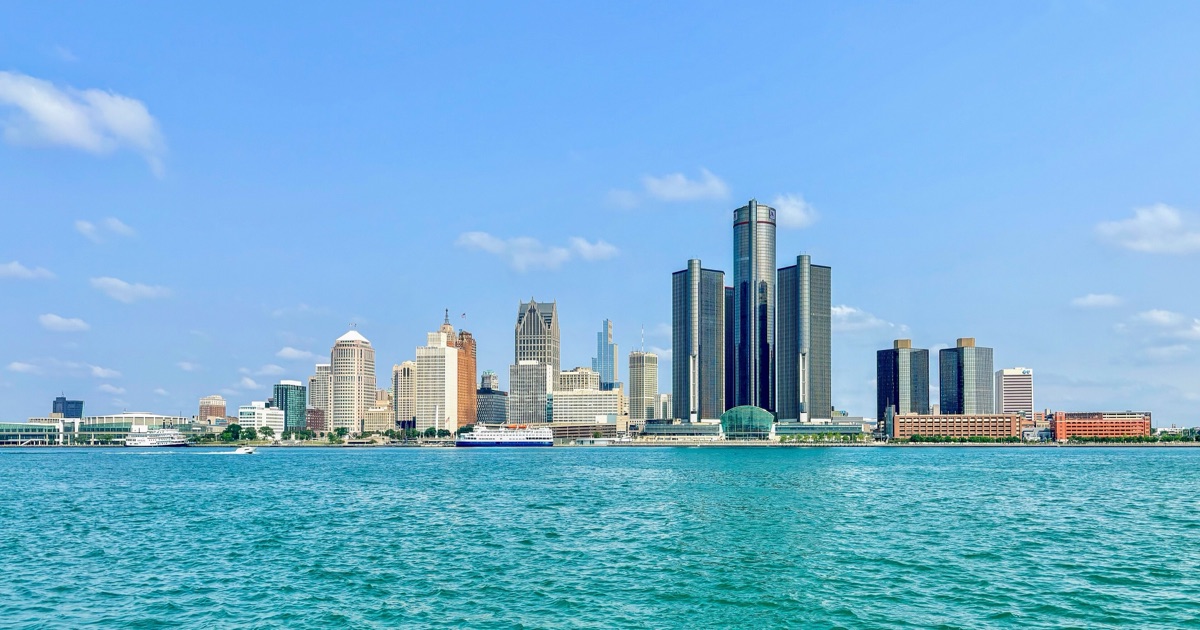
Detroit’s downtown did not recover the way a market recovers. One company bought it. Bedrock, founded by Dan Gilbert in 2011, says it has invested and committed more than $7.5 billion across over 140 properties totalling more than 21 million square feet in Detroit and Cleveland.8 That is the company’s own figure, published on its own site; no independent audit of it exists.
What the public record does show, in detail, is the method: move your own payroll in before the demand exists, buy the core while it is cheap, spend ten times the purchase price repairing it, and finance the last and largest third from taxes that have not been collected yet. Each of those steps is documented and dated. So is the part the reels leave out — across the same years, Detroit’s poverty rate rose to 34.5%, the highest of any American city above 500,000 people.23
| The strategy at a glance | Number |
|---|---|
| Bedrock founded | 20118 |
| Portfolio today (company claim) | $7.5B committed · 140+ properties · 21M+ sq ft8 |
| First National Building, bought 2011 | $8.1 million4 |
| Book Tower complex, bought Aug 2015 | ~$30 million6 |
| Book Tower restoration | ~$300 million7 |
| State tax capture approved, 22 May 2018 | $618 million over ~30 years9 |
| Hudson's site cost, and its city tax break | $1.4 billion · $60 million abated11 |
| Renaissance Center plan, still to be funded | $1.6 billion · ~$350M public14 |
| Detroit poverty rate, 2024 | 34.5%, up from 31.9%23 |
The experiment that already failed
A single magnificent building does not create demand for a district.
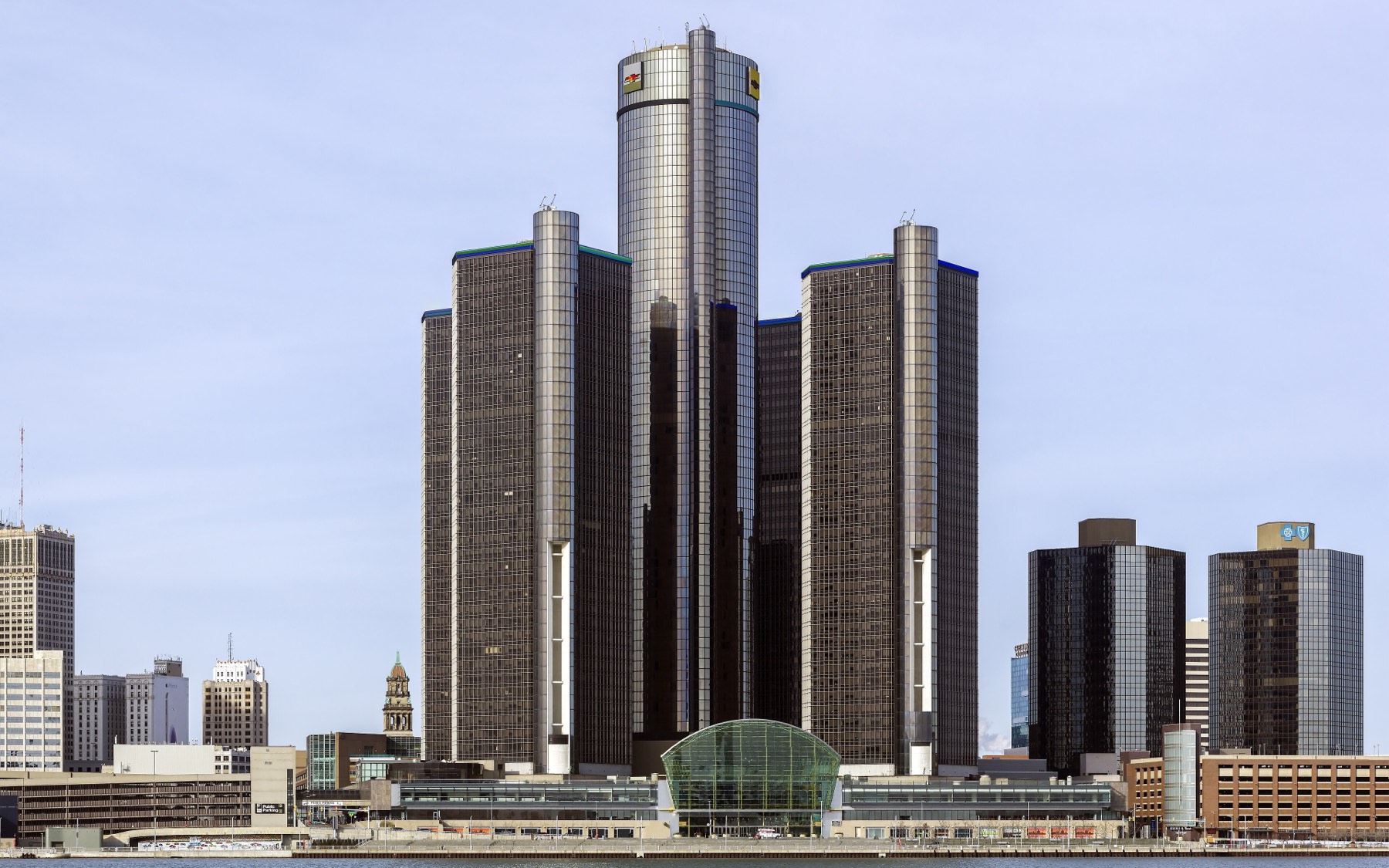
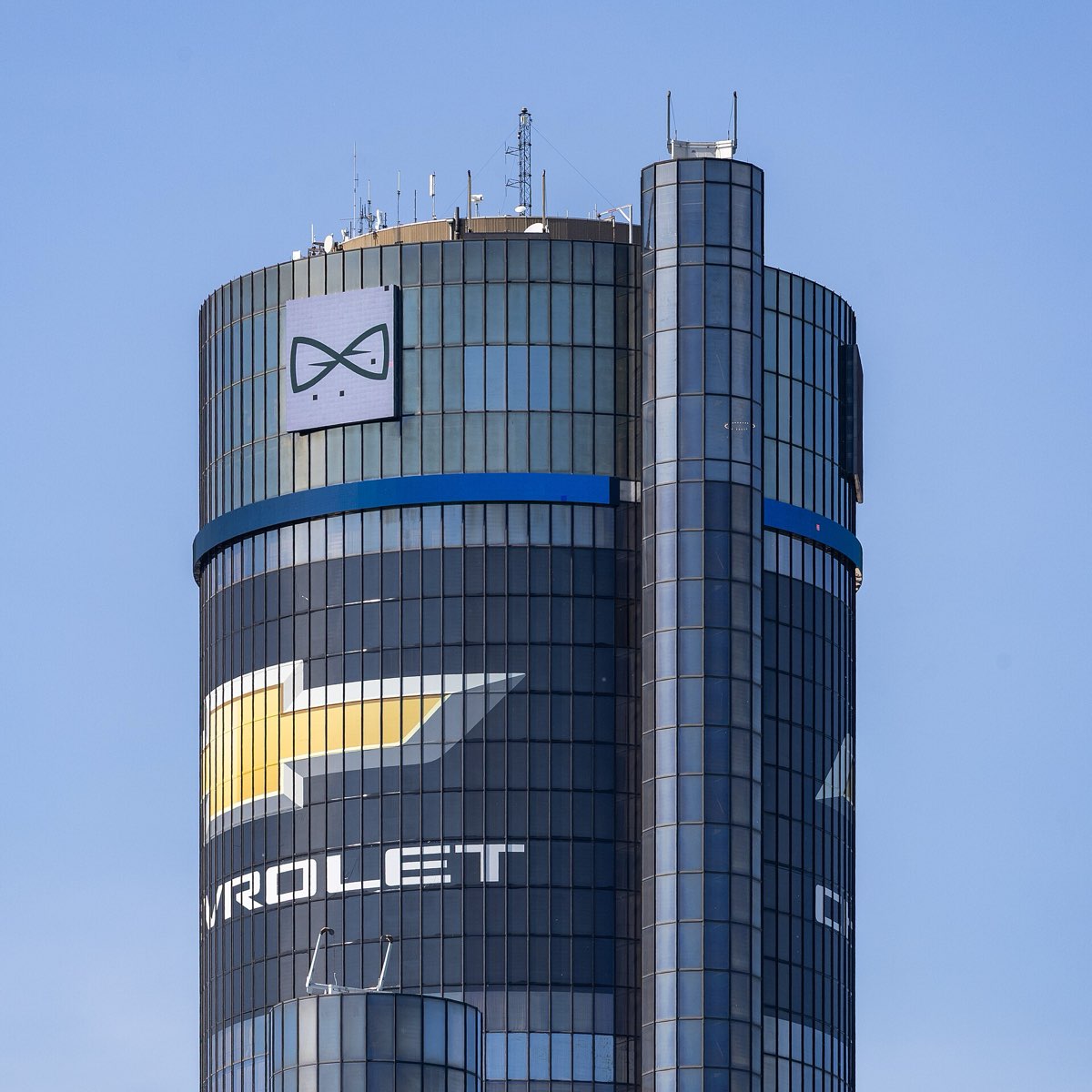
The Renaissance Center from the Detroit River, December 2014. Built for $350 million and dedicated in April 1977, it was about 30% leased before it was finished; General Motors bought the office towers in 1996 for $73 million and then spent about $500 million on them.Crisco 1492 · Wikimedia Commons · public domain
Start with the experiment that already failed
Detroit had tried the trophy-building version of this fifty years earlier, and the results are the reason the second attempt looks the way it does.
The Renaissance Center was built for $350 million and dedicated in April 1977 — four thirty-nine-storey office towers around a seventy-three-storey hotel, funded by a coalition Henry Ford II convened, with more than forty companies putting money in.1,2 It did not work. Before the complex was even finished, about 30% of it had been leased, and management conceded that its primary market was tenants already downtown.1 The complex lost $9 million in the first quarter of 1980 alone.2 In 1996 General Motors bought the office towers for $73 million — roughly a fifth of what they cost to build — and then spent about $500 million fixing what it had bought.1
Read that sequence carefully, because it contains the whole thesis. A single magnificent building does not create demand for a district. It relocates the demand that already exists, empties the older buildings around it, and leaves the city with the same tenants in newer walls. That is the trap the next attempt had to avoid — and, as you will see, did not entirely.
Be your own anchor tenant
Gilbert’s first move was not a purchase. It was a payroll.
In August 2010, Quicken Loans and five sister companies moved 1,700 people from the suburbs into leased space on Campus Martius. Fourteen months later the company announced 2,500 more heading downtown — 1,500 into Chase Tower, 1,000 into the Madison Theatre Building, 1,000 into the First National Building — taking its downtown headcount past 4,000.3
Notice which buildings those were. Bedrock had bought Chase Tower and the First National in 2011, in the same stretch of months.4,8 The company was not waiting for tenants to appear in the towers it was acquiring. It was the tenant. When a landlord can move thousands of its own employees into its own vacant floors, the vacancy problem that stops everyone else from buying simply does not apply to it.
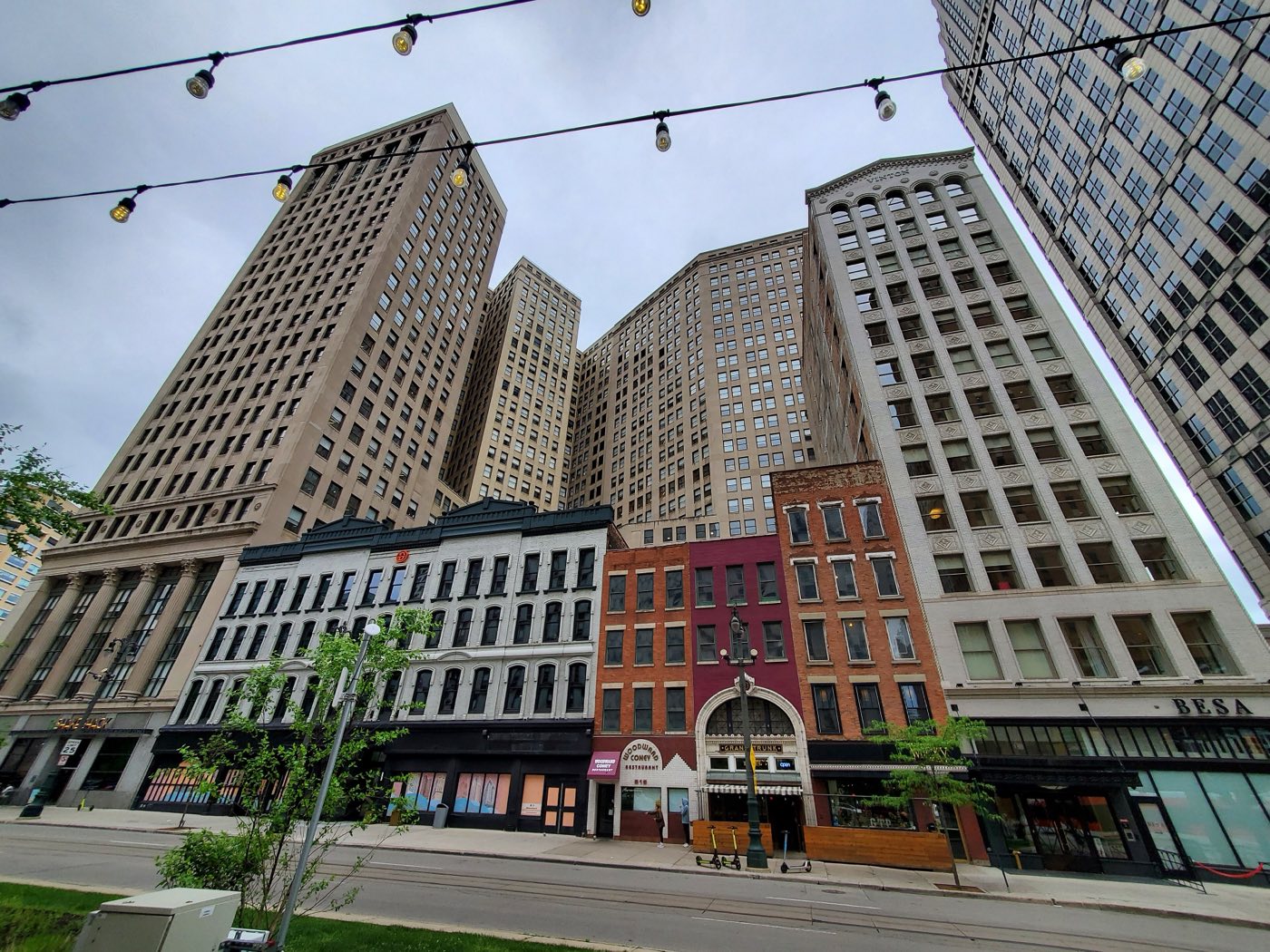
And the entry prices were extraordinary. The First National Building — twenty-five storeys, an Albert Kahn design — cost $8.1 million in 2011.4 Four years later Bedrock paid about $30 million for the Book Tower complex, three connected buildings that had stood empty since 2009; at that point the firm reported controlling around 80 downtown buildings, more than 13 million square feet, on investments above $1.7 billion.6
All of this ran straight through the worst of it. In July 2013 Detroit filed the largest municipal bankruptcy in American history, carrying an estimated $18–20 billion of debt.5 The buying did not pause. That is the part of the playbook that cannot be copied by anyone whose capital has a redemption date.
The buildings cost more than the buildings cost
Here is where the story stops being about clever buying.
Bedrock paid roughly $30 million for the Book Tower complex and then spent about $300 million restoring it, reopening in 2023 with restaurant, retail, office, hotel and residential floors inside the 1926 tower.6,7 That is ten times the purchase price, spent on a building that had been dark for six years. The state’s own preservation record puts the figure at about $300 million; the source reel put it near $400 million, and the record does not support that.
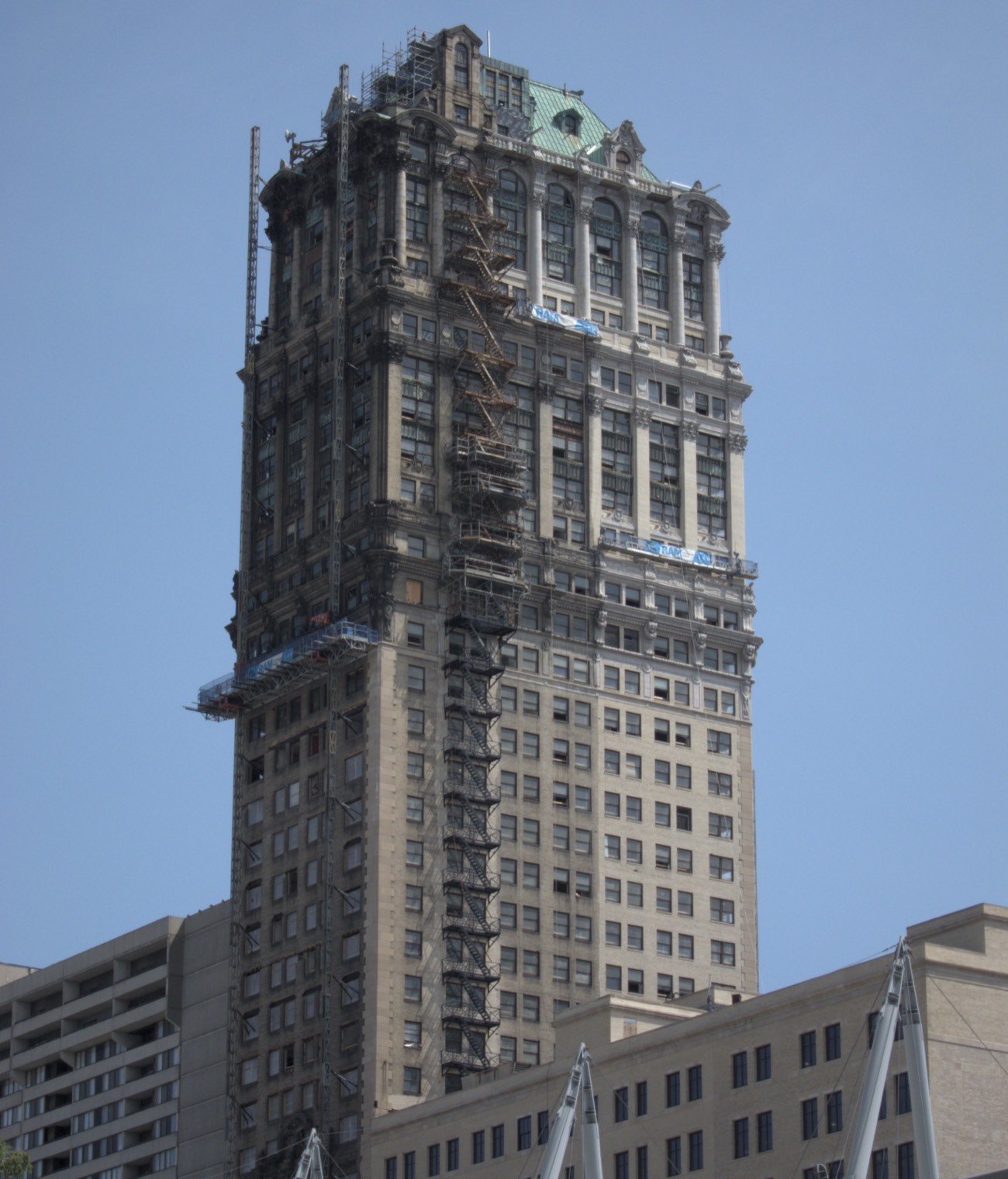
This ratio is the reason nobody else did this. Distressed skyscrapers in a shrinking city are cheap precisely because the repair bill dwarfs the sticker, and the repair has to be paid before a single dollar of rent arrives. Which raises the obvious question: where does three hundred million dollars for one restoration come from?
The last third comes from taxes not yet collected
Awarded, sought, and never priced at all. The public money in this story does not arrive as one number.
Public money awarded, where the record puts a figure on it
$678 million
Bedrock's own returnsNever published
- State tax capture, four projects, 22 May 20189$618 million
- Detroit property tax abatement, Hudson's site, Jun 202211$60 million
Sourced, and not part of that total
Never published
- Federal Opportunity Zone relief, three downtown tracts, Apr 201810No dollar figure exists
- A single published tally of every public dollarNobody sums them
- Bedrock's own returnsNever published
Two awarded items with figures, two sought and not granted, and three lines the record does not carry at all. The $7.5 billion, the 140 properties and the 21 million square feet are Bedrock’s own numbers about Bedrock.
| Line | Amount | How it is counted |
|---|---|---|
| State tax capture, four projects, 22 May 2018 | $618 million | sourced, and part of the total |
| Federal Opportunity Zone relief, three downtown tracts, Apr 2018 | No dollar figure exists | never published |
| Detroit property tax abatement, Hudson's site, Jun 2022 | $60 million | sourced, and part of the total |
| Sought from the state for the Renaissance Center, Jan 2025 | ~$250 million | sourced, but a different kind of number — not added to the total |
| Sought from Detroit's downtown development authority | ~$100 million | sourced, but a different kind of number — not added to the total |
| A single published tally of every public dollar | Nobody sums them | never published |
| Bedrock's own returns | Never published | never published |
| Public money awarded, where the record puts a figure on it | $678 million | the sourced total |
The last third comes from taxes not yet collected
Part of it came from the public — legally, publicly, and by a law written for the purpose.
In May 2018 the Michigan Strategic Fund approved $618 million of support for four Bedrock projects together worth $2.15 billion: the Hudson’s site, Monroe Blocks, the Book Building and Tower, and an expansion of One Campus Martius.9 The mechanism was tax increment financing — the developer keeps a share of the new taxes its own project generates, instead of those taxes going to the state and city, for up to thirty years. It was the first use of Michigan’s transformational brownfield law, and Bedrock’s announcement projected 22,000 jobs and $2.5 billion of new state revenue over the same period.9 Those were forecasts made by the party receiving the money.
Weeks earlier, something quieter had happened. Three downtown census tracts were designated federal Opportunity Zones, a 2017 programme meant to route investment into poor neighbourhoods. ProPublica reported in October 2019 that Treasury revised its eligible-tract list in late February 2018 to add a downtown Detroit tract that had been excluded for being too wealthy — its median family income sat at one and a half times the eligibility threshold — and that a Gilbert lobbyist, Jared Fleisher, was the only non-city official named on Detroit’s recommendation map.10 Treasury said its opportunity zone officials had no knowledge of the matter; the White House declined to answer questions; Fleisher said Gilbert’s companies joined a wide range of stakeholders and exercised no inappropriate influence.10
Then the city added its own layer. In June 2022, with the Hudson’s project’s cost at $1.4 billion, Bedrock asked Detroit for a $60 million, ten-year property tax break, which the council granted the following month.11
Hold the name in mind, because it recurs. Fleisher — the lobbyist named on Detroit’s opportunity zone recommendation map, and the government affairs executive who argued the Renaissance Center case publicly in 2025 — joined Bedrock as president on 1 August 2025 and became its chief executive at the start of 2026.14,17 In this playbook, government relations is not a support function. It is the succession plan.
- State tax capture, four projects, 22 May 20189$618 million
- Detroit property tax abatement, Hudson's site, Jun 202211$60 million
Sourced, and not part of that total
Never published
- Federal Opportunity Zone relief, three downtown tracts, Apr 201810No dollar figure exists
- A single published tally of every public dollarNobody sums them
- Bedrock's own returnsNever published
Two awarded items with figures, two sought and not granted, and three lines the record does not carry at all. The $7.5 billion, the 140 properties and the 21 million square feet are Bedrock’s own numbers about Bedrock.
The sequence
Aug 2010–Oct 2011
Quicken Loans moves 1,700 staff into leased downtown space, then 2,500 more into three buildings Gilbert has just bought. Downtown headcount passes 4,000.3
2011
Bedrock is founded. The First National Building, 25 storeys, costs $8.1 million.4,8
$8.1M for a skyscraper
18 Jul 2013
Detroit files the largest municipal bankruptcy in US history, on $18–20 billion of debt. The buying continues through it.5
Aug 2015
Buys the Book Tower complex — vacant since 2009 — for about $30 million. Bedrock is then 80 buildings and $1.7 billion in.6
~$30M in
22 May 2018
Michigan approves $618 million of tax capture for four Bedrock projects worth $2.15 billion — the first use of the transformational brownfield law.9
$618M of future taxes
Apr 2018
Three downtown census tracts become federal Opportunity Zones; one had been ruled too wealthy to qualify weeks earlier.10
Jun 2022
Detroit adds a $60 million property tax abatement for the Hudson’s site as its cost reaches $1.4 billion.11
$60M abatement
2023
Book Tower reopens after a roughly $300 million restoration — ten times what the buildings cost.7
~$300M spent
Jul 2025
City Modern completes: 450 homes across eight acres of Brush Park, 54 of them affordable and age-restricted.15,16
12 Jan 2026
GM opens its global headquarters inside Hudson’s — vacating the Renaissance Center half a mile away.18
Jul 2026
Michigan doubles the transformational brownfield cap to $3.2 billion, unblocking the $1.6 billion RenCen plan.19
Cap $1.6B → $3.2B
What actually got built
Three of the four projects in that 2018 package exist.
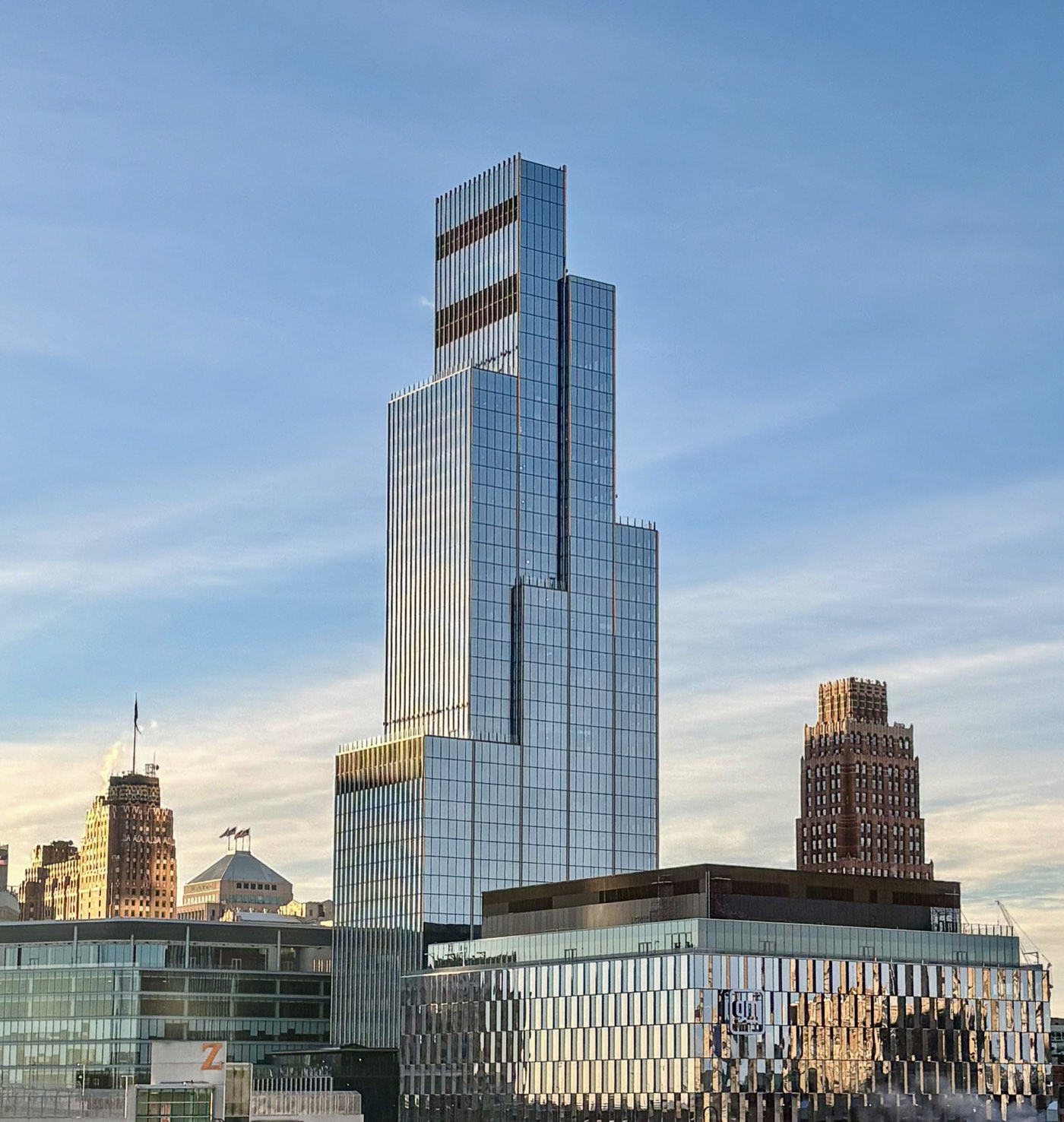
Hudson's Detroit on 1 January 2026, the General Motors sign already up on the block building at the tower's foot. GM opened its global headquarters there eleven days later.TheWxResearcher · Wikimedia Commons · CC0
What actually got built
Three of the four projects in that 2018 package exist. City Modern finished in July 2025 — 450 homes across twenty new buildings plus three rehabilitated mansions, on eight acres of Brush Park at the seam between downtown and Midtown, with 31,000 square feet of retail.15 Fifty-four of the apartments are affordable — one building, opened in 2019, restricted to residents aged 55 and over earning 30% to 60% of the area median income.16 In a city with the poverty rate quoted above, twelve percent of a single development, age-restricted, is worth stating plainly rather than rounding into “mixed income”.
Hudson’s Detroit is the flagship, and its cost ran away from it: by June 2022 the project stood at $1.4 billion, which is the number on the table when Bedrock asked the city for its tax break.11 In April 2024 General Motors said it would move its global headquarters into the twelve-storey block building,12 and on 12 January 2026 it opened there.18
The fourth project, Monroe Blocks, never happened as sold. Eight years after it entered the incentive package as a mixed-use development, the site is being finished as something else entirely: Cosm, a 70,000-square-foot venue built around an 87-foot LED dome that seats about 1,500, opening on 10 September 2026.21 A subsidy approved for a portfolio is not a subsidy approved for a building, and the portfolio is free to change its mind.
The record has a stain
In July 2017 Bedrock put an advertisement on the windows of a downtown building reading “See Detroit Like We Do”, over a photograph of an almost entirely white crowd, in a city that is majority Black. Gilbert called it “tone deaf, in poor taste” and said Bedrock had “screwed up badly”.20 It was an advertisement, not a deal — and it is in this brief because for one week the company said out loud what its critics had been arguing about who the district was being built for.
The sharper finding is arithmetic. BridgeDetroit reported in April 2024 that the Hudson’s incentives had been justified to the city with a projection of 2,000 new jobs and $71 million in new city tax revenue over ten years — and that roughly 850 of the arriving GM employees were moving from the Renaissance Center, about half a mile away, cutting the projected ten-year tax take by around 43%.13 Greg LeRoy of Good Jobs First put it flatly: office space does not create jobs, “especially when it’s office space in a market with high vacancy rates, and tenants that move from three blocks away”.13 A spokesman for Mayor Duggan called the findings premature and unverified.13
Which returns us, precisely, to 1977.
The building the last move emptied
GM left the Renaissance Center for Hudson’s, and the Renaissance Center is now the problem.
The plan Bedrock and GM published would spend $1.6 billion demolishing the complex’s concrete podium and two of its five towers, converting the central hotel tower to rooms and apartments, and opening the site to the riverfront. As set out in January 2025, Bedrock would put in about $1 billion and GM $250 million, with roughly $250 million sought from the state and $100 million from Detroit’s downtown development authority.14
It stalled on a ceiling. Michigan’s transformational brownfield programme had a $1.6 billion statewide cap and had very nearly spent it — a good deal of it on earlier Bedrock work — so the legislature had to raise the cap before this project could be considered at all.14 That took more than a year of open argument. Fleisher’s case was that “the RenCen cannot survive in its current form”. House speaker Matt Hall answered that he did not agree with using tax dollars to do it. Donna Givens Davidson of the Eastside Community Network put the objection at its sharpest: the riverfront is now seen as having a higher, better use to produce profit, but taxpayers are expected to fund the transformation.14
The ceiling moved in July 2026. Michigan doubled the programme’s aggregate cap from $1.6 billion to $3.2 billion, doubled the annual limit from $80 million to $160 million, and set a $300 million ceiling per project.19 That unblocks the route; it is not the same thing as the money being awarded, and as of this writing the project-specific approvals had not been completed.
The ledger, opened
Put the sourced public money in one column and the sourced outcomes in the other, and the shape of the thing appears.
| Public support, and what followed | Amount or figure |
|---|---|
| 22 May 2018 — state tax capture, four projects | $618M over ~30 years9 |
| Apr 2018 — three downtown Opportunity Zone tracts | Federal capital-gains relief10 |
| Jun 2022 — Detroit abatement, Hudson's site | $60M over 10 years11 |
| Jan 2025 — RenCen public share sought | ~$250M state + $100M DDA14 |
| Jul 2026 — statewide cap raised to allow it | $1.6B → $3.2B19 |
| Detroit population, 2022→2023 | +1,852, first gain since 195722 |
| Detroit poverty rate, 2023→2024 | 31.9% → 34.5%23 |
| Downtown office vacancy, Q3 2025 | 21.3%24 |
| Bedrock's own returns | Never published |
Several things in that table cannot be added together honestly, and saying so is part of the answer. Bedrock is private: no rent roll, no fund economics, no return figure has ever been published, so whether this strategy made money for its investors is simply not on the record. There is no single published tally of every public dollar directed to the company across state capture, city abatements, federal zone relief and authority contributions — each is documented separately, and no source sums them. The $7.5 billion, 140 properties and 21 million square feet are Bedrock’s own numbers about Bedrock.8 And the exact day Michigan’s 2026 cap increase was signed is reported inconsistently — passage and signature both fall in July 2026, which is as precise as the record supports.
What is verifiable is the pair of numbers moving in opposite directions. Detroit gained residents in the year to July 2023 for the first time since 1957 — 1,852 of them.22 Over roughly the same stretch, its poverty rate went from 31.9% to 34.5%, the highest of any large American city.23 Downtown office vacancy sat at 21.3% in the third quarter of 2025, in the district the whole strategy was built around.24
So the honest verdict has two halves that do not cancel. The portfolio strategy worked on the portfolio: a downtown that had emptied is dense, tenanted and building again, and one company holding almost all of it is why the coordination was possible at all. And a concentrated downtown strategy produced concentrated downtown results, which is what its critics said it would do from the beginning.
What transfers
Control lets you coordinate; fragmentation is what actually kills districts. Ordinary landlords cannot agree on a leasing strategy, a retail mix or a street. One owner of 21 million square feet can run all three as a single plan, which is a real advantage and has nothing to do with being right about the market.
Manufactured demand beats forecast demand. Gilbert did not underwrite a recovery; he moved 4,000 of his own employees into the buildings he was buying and created the foot traffic the retail then priced off. When you read a plan whose first phase depends on tenants arriving, ask who exactly is contractually obliged to arrive.
The purchase price is the small number. Eight million dollars for a skyscraper and thirty for the Book complex are the headlines; three hundred million for one restoration is the deal. Distressed assets are cheap because the repair is expensive and comes first — always underwrite the second cheque, not the first.
Relocation is not creation, and someone eventually pays for the building you emptied. The 1977 Renaissance Center leased mostly from downtown tenants and failed; the 2026 headquarters move filled Hudson’s largely with people who already worked half a mile away, cut the promised tax gain by roughly two fifths, and left a $1.6 billion hole on the riverfront now seeking public money to fill. When a district’s wins arrive by transfer, count the losses at the other end of the transfer before calling it growth.
Common questions
- How much has Bedrock invested in Detroit?
- Bedrock states it has invested and committed more than $7.5 billion across over 140 properties totalling more than 21 million square feet in Detroit and Cleveland since 2011. That figure comes from the company itself and has not been independently audited. Dated outside reporting shows the scale of the claim growing over time: about $1.7 billion across 80 buildings in 2015, and roughly $3 billion across about 100 properties in 2019.
- How much public money went into Bedrock’s Detroit projects?
- The largest single item is $618 million of state tax capture approved in May 2018 for four projects worth $2.15 billion — the first use of Michigan’s transformational brownfield law, which lets a developer keep a share of the new taxes its project generates for up to 30 years. Detroit added a $60 million, ten-year property tax abatement for the Hudson’s site in 2022. Three downtown census tracts were designated federal Opportunity Zones in 2018. No published source adds all of these together.
- Why is the Renaissance Center being partly demolished?
- General Motors moved its global headquarters out of the complex to Hudson’s Detroit, opening there on 12 January 2026, which left the RenCen largely empty. The Bedrock and GM plan would spend $1.6 billion demolishing the concrete podium and two of the five towers, converting the central hotel tower to rooms and apartments, and opening the site to the riverfront. It stalled until Michigan doubled its transformational brownfield cap to $3.2 billion in July 2026.
- Did downtown Detroit’s revival help the rest of the city?
- The record cuts both ways. Detroit gained residents in the year to July 2023 for the first time since 1957. Over roughly the same period its poverty rate rose from 31.9% to 34.5% — the highest of any US city above 500,000 people — and downtown office vacancy stood at 21.3% in the third quarter of 2025. A 2024 analysis of the Hudson’s incentives found that about 850 of the 2,000 promised jobs were GM employees relocating from half a mile away.
- How much did the Book Tower restoration cost?
- About $300 million, according to Michigan’s own historic preservation record, against a purchase price of roughly $30 million for the three-building complex in 2015 — around ten times what the buildings cost. It had been vacant since 2009 and reopened in 2023 with restaurant, retail, office, hotel and residential floors. Figures near $400 million that circulate online are not supported by the record.
Sources
- Historic Detroit (reference archive) — Renaissance Center (GM RenCen) (undated)
- Hour Detroit — GM Renaissance Center Celebrates 35 Years (2012-03-27)
- Quicken Loans via PR Newswire (company release) — Quicken Loans Begins Move of 2,500 Additional Team Members to Heart of Downtown Detroit (2011-10-10)
- The Detroit News — Gilbert's First National Building soars in value (2016-01-07)
- NPR — Detroit Files Nation's Largest-Ever Municipal Bankruptcy (2013-07-19)
- Fortune — Dan Gilbert just bought one of Detroit's most storied skyscrapers (2015-08-28)
- Michigan Economic Development Corporation — Book Tower — Governor's Awards for Historic Preservation (2025)
- Bedrock (company claim) — Our Story — invested and committed, properties, square feet (undated)
- Bedrock via PR Newswire (company release) — Bedrock's $2.15 Billion Transformational Development Projects Clear Final Hurdle with Michigan Strategic Fund Approval of MIthrive Financing (2018-05-22)
- ProPublica — How a Tax Break to Help the Poor Went to NBA Owner Dan Gilbert (2019-10-24)
- The Detroit News — Bedrock seeks $60 million, 10-year property tax break for Hudson's site as costs balloon (2022-06-09)
- General Motors (company release) — General Motors names Hudson's Detroit as its new global headquarters (2024-04-15)
- BridgeDetroit — 'Net loser': Gilbert's Hudson building unlikely to meet promised job, tax revenue when GM workers move in (2024-04-22)
- Bridge Michigan — Renaissance Center looks to future. Should taxpayers help pay the bill? (2025-01-22)
- The Detroit News — City Modern arrives: Bedrock completes mixed-use project in Brush Park (2025-07-24)
- Bedrock via PR Newswire (company release) — The Flats at 124 Alfred opens at City Modern — 54 affordable apartments for residents 55 and older (2019-04-16)
- Bedrock (company release) — Bedrock Announces CEO Succession Plan (2025-08-01)
- General Motors (company release) — General Motors' new home in Detroit (2026-01-12)
- Plante Moran — Michigan expands real estate incentives for commercial and housing development (2026-07-10)
- Michigan Public — Mostly-white "See Detroit Like We Do" ad draws backlash and apologies (2017-07-24)
- The Detroit News — Cosm Detroit sets opening date, will show NFL games, movies (2026-07-30)
- City of Detroit — Detroit grows in population for the first time in decades (2024-05-16)
- The Detroit News — Detroit's poverty rate rises to highest number since 2017 amid city's comeback (2025-09-11)
- Newmark — Detroit Office Market Report, Q3 2025 — CBD vacancy (2025-Q3)