

Case study Nº 07
Nobody awarded it. The minutes explain why nobody had to.
Aries Lofts — 315 affordable units rising on a remediated salvage yard in Whitehall, Ohio — is the 4% LIHTC machine run once, on the record: $60 million of county-conduit bonds, $46.9 million of federal credits sold at 88 cents on the dollar, a Freddie Mac loan priced two years before it funds, and a $152.3 million financing headline on a $108 million building. The state housing agency never approved it, because the bond issuer’s own minutes say the deal was structured so it wouldn’t have to.
Ben Fan, with Darryl WengDecember 22, 202516 min readWatch the reel
Ten years of federal credits, per the application
$46.9M
What investors paid for them
$41.3M
This is the trade at the center of every 4% LIHTC deal, in Aries Lofts’ own application numbers: $46,884,228 of federal tax credits, claimable a tenth a year for ten years, sold to investors for $41,258,121 of equity today — 88 cents on the credit dollar.3 That equity is why a 315-unit building whose rents cannot service a market loan gets built anyway.1 Around the trade sits the machine this study opens up: tax-exempt bonds issued by a county conduit, a permanent loan committed two years before it funds, five layers of public money — and no state award anywhere, because the 4% credit is designed not to need one.2,12 Jump to the stack ↓
The reel this brief grew from is an explainer, and its scorecard is clean: the $152.3 million, the 315 units, the $60 million of tax-exempt construction financing, the $41.6 million of 4% credit equity with Merchants as syndicator, the $42.7 million Freddie Mac forward loan, the 2027 delivery — all verify, most against Merchants Capital’s own announcement — and its formula recital matches the statute itself.1,9,12 What the record adds is precision the announcement never volunteers. The $152.3 million is financing, not cost: the project costs $108 million by the Dispatch’s accounting and $98.8 million by its own application, because the construction loan and the permanent loan that retires it both count toward the headline.3,9 And “you get 4%” has only been literally true since December 2020, when Congress put a floor under a formula that had produced less than 4% every month since January 1988.12,13
The deeper finding is about what does not exist. The queue that produced this study asked for the state’s award file. There is none — and the reason is written into the record by the bond issuer itself, in language this study’s last chapters walk through: the 4% machine is built so that no one ever has to say yes.2
| The deal at a glance | Number |
|---|---|
| The project | Aries Lofts, 3515 E. Main St., Whitehall, Ohio — 315 units in two four-story buildings, delivering 20271,9 |
| Who lives there | 66 units at 50% of area median income, 183 at 60%, 66 at 70% — rents $981 to $1,5851,9 |
| The developer | LDG Development, Louisville — top-five nationally by affordable starts, 28,000+ units23,27 |
| The financing, announced | $152.3M: $60M construction + $41.6M LIHTC equity + $42.7M Freddie forward + $8M bridge1,11 |
| The cost, reported | $108M at groundbreaking — $98.8M ($313,536/unit) in the application3,9 |
| The credits | $46.9M over ten years, sold at $0.88 per credit dollar for $41.3M of equity3 |
| The bonds | Columbus-Franklin County Finance Authority capital-lease bonds, capped at $55M then $60M — privately placed2 |
| The state award | None — the deal was structured, in the issuer’s own words, to “avoid OHFA board approval”2 |
| The local layers | ≈$5.66M state brownfield grant · $1.35M county Magnet Fund · a 15-year Whitehall tax exemption, passed 4–32,5,7 |
| Why 4% means 30% | Ten years of 4% credits discount to ~30% of qualified basis — the statute’s own design12,13 |
| Who buys the credits | Banks, ~80% of the $28.9B 2024 equity market, driven by the Community Reinvestment Act20 |
| The leash | Credits over 10 years, recapture risk for 15, rent restrictions for 30 — to about 205712 |
| The context | Columbus has 25 affordable units per 100 extremely-low-income renters — fewer than San Francisco28 |
A machine with no gatekeeper
The Low-Income Housing Tax Credit comes in two strengths, and the difference is not really the percentage — it is who says yes. The 9% credit is competitive: it draws from each state’s fixed annual allocation, and a state agency scores applications and picks winners. The 4% credit is automatic: finance enough of the building with tax-exempt private activity bonds and the credits attach as of right, drawing from no allocation at all.12,13 The Congressional Research Service’s plain words: developers “do not have to compete for an award… they are automatically awarded 4% tax credits.”13 The machine’s whole point is that no one has to say yes.
Two rules give the machine its shape. The first is the bond test: for deals like this one, at least 50 per cent of the building-and-land basis must be financed with volume-cap bonds — a cliff, not a slope, and the single reason a $60 million construction loan sits inside a $98.8 million project.12,17 (For bonds issued after 2025 the threshold halves to 25 per cent — the same building will soon unlock the same credits with half the bonds.12,18) The second is the floor. The “4%” was designed as a present-value target — ten years of credits worth 30 per cent of qualified basis, against the 9%’s 70 — and Treasury’s monthly formula chased it below 4% for thirty-two straight years, sitting at 3.07% when Congress fixed a 4% minimum in the year-end bill signed 27 December 2020.12,13,14,15 The floor was a 30 per cent raise for every bond-financed deal since; the formula underneath still reads 3.45%.13,14,16

The scarce resource in the 4% economy is not approval but bond capacity: states ration private-activity-bond volume under a federal per-capita cap, multifamily issuance hit a record $21.67 billion in 2023, and thirty-five states plus Washington were at or above capacity by September 2025.18 The buyers on the other side are overwhelmingly banks — roughly 80 per cent of the $28.9 billion of LIHTC equity closed in 2024 — because the Community Reinvestment Act counts these investments toward the obligations bank regulators score.20 An investor paying 88 cents for a dollar of credits is buying a ten-year annuity of tax reduction; a bank is also buying regulatory standing. That is the demand side of the machine — the syndicator on this deal alone produced $7 billion of affordable financing in 202530 — and it is why the price of a credit dollar, $1.05 before the 2017 corporate tax cut and about 85 cents in mid-2025, moves with tax policy rather than with rents.19
One project, four sizes
Aries Lofts has been four different sizes in its own record, and none of the four is wrong — they measure different things, at different moments, for different audiences. The drift is the reason this room keeps a rule about headline numbers.
- The application, 20243$98.8MTotal development costs, self-reported to OHFA: $98,763,802, or $313,536 per unit — the only sources-and-uses accounting in the public record.
- The issuer’s estimate, May 20242>$101MCFFA’s board, at inducement: “Total estimated cost is more than $101 million. Hard costs are estimated to be over $66 million.”
- At groundbreaking, Dec 20259$108MThe Columbus Dispatch’s project cost — the figure the financing announcement exceeds “because it includes a combination of permanent and construction loans.”
- The financing, Nov 20251$152.3MNot a cost. A construction loan that will be retired, the permanent loan that retires it, a bridge, and the equity — sequential instruments summed into one headline.
The reel, like every trade retelling, carried the fourth number — the only one in a press release. The building’s actual price sits a third below it. Whenever a deal’s size is quoted, ask whether the figure is a cost or a sum of financings — and whether any instrument in the sum exists to pay off another.1,9
What the machine builds
The machine’s whole point is that no one has to say yes.
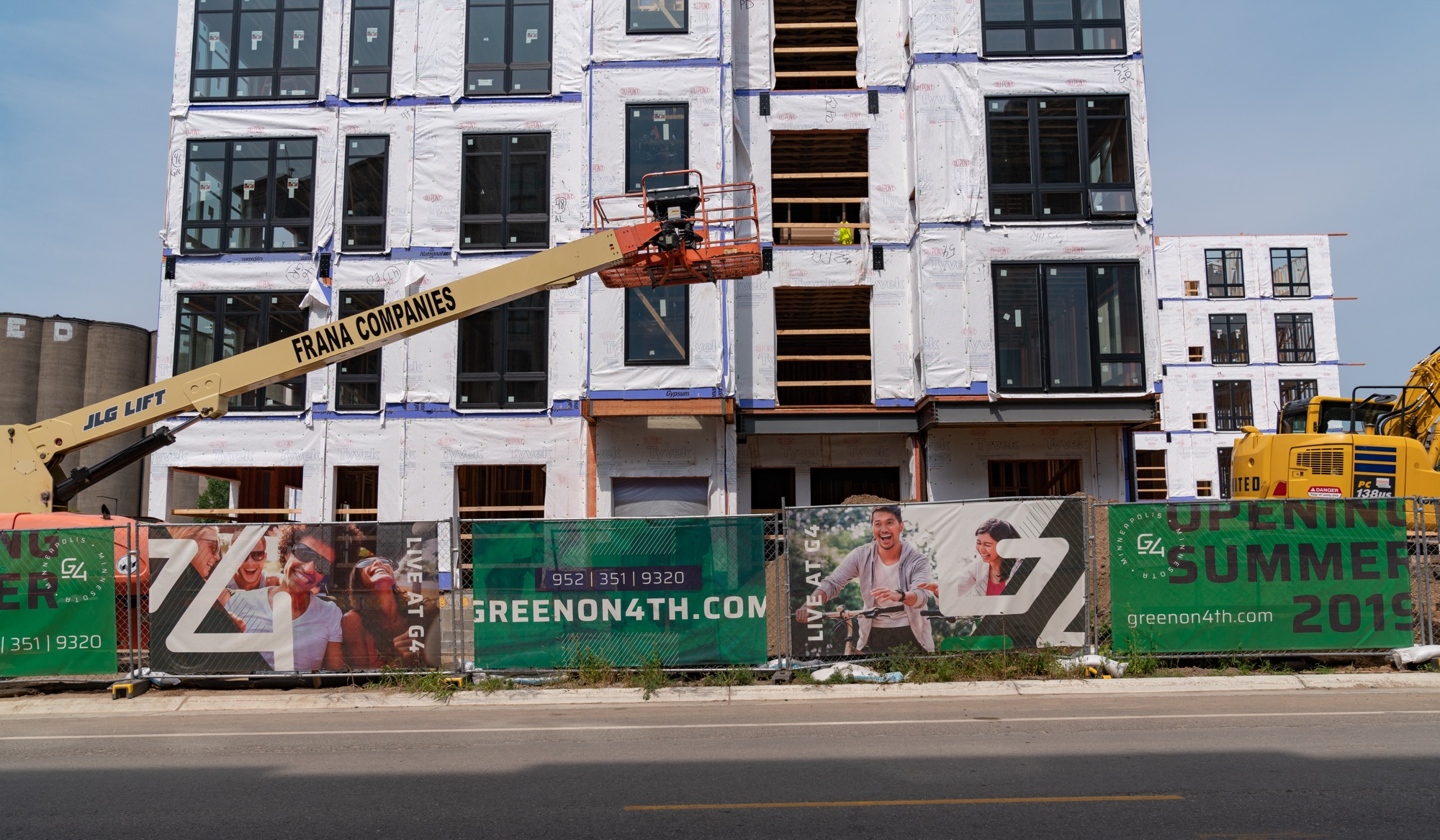
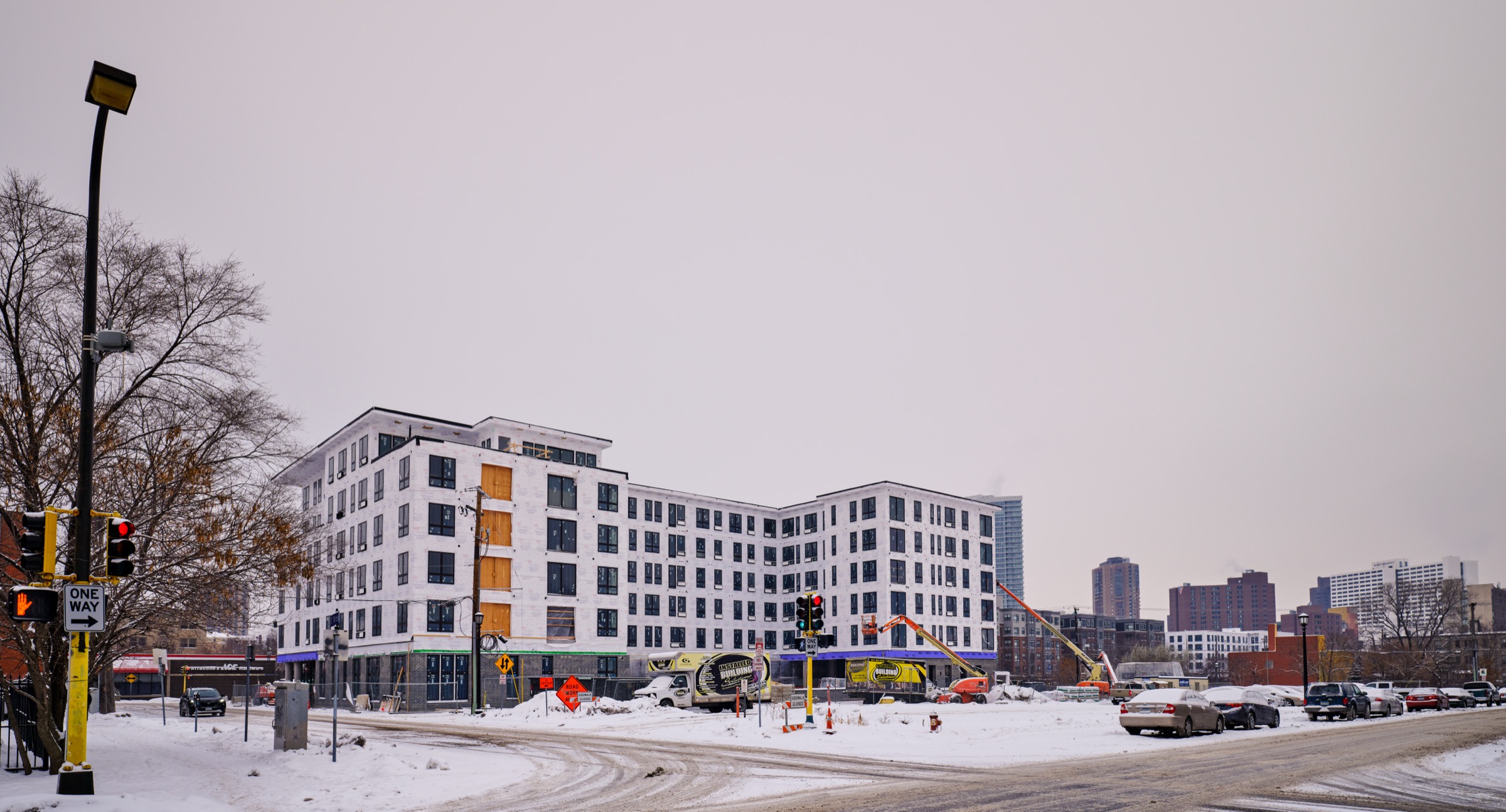
A mixed-use apartment block under construction in Minneapolis, December 2019 — the Midwest wood-frame typology, shown here as illustration; Aries Lofts' own buildings will not top out until 2026. The 4% program produces this building at national scale precisely because it is automatic: bonds plus credits, no award, no discretion.Photo: Tony Webster, CC BY 2.0, via Wikimedia Commons
The financing, opened
Merchants Capital's $152.3 million, taken apart: four instruments that sum to the headline exactly — two of which exist to retire each other — beside the costs the package exceeds, the public layers outside it, and the one line no document prices.
The package, announced 21 Nov 2025
$152.3 million
The 15-year Whitehall tax exemptionUnpriced
- Tax-exempt construction loan — CFFA capital-lease bonds1,2$60 million
- 4% LIHTC equity — Merchants Capital, syndicator1,3$41.6 million
- Freddie Mac Forward TEL — funds at stabilization1,29$42.7 million
- Equity bridge loan — Merchants Bank1$8 million
Sourced, and not part of that total
Never published
- The 15-year Whitehall tax exemptionUnpriced
The four stacked lines are the announcement's own arithmetic: 60 + 41.6 + 42.7 + 8 = 152.3, to the decimal. The hatched asides are the honest context: the application's $98.8 million of development cost, the $46.9 million of ten-year credits the equity purchased, and the two public grants that sit outside the package. The unpriced line is the 15-year tax exemption no source values. Construction loan and permanent loan both count toward the headline while one exists to pay off the other — which is why the financing is a third larger than the building.
| Line | Amount | How it is counted |
|---|---|---|
| Tax-exempt construction loan — CFFA capital-lease bonds | $60 million | sourced, and part of the total |
| 4% LIHTC equity — Merchants Capital, syndicator | $41.6 million | sourced, and part of the total |
| Freddie Mac Forward TEL — funds at stabilization | $42.7 million | sourced, and part of the total |
| Equity bridge loan — Merchants Bank | $8 million | sourced, and part of the total |
| Total development cost, per the application | $98.8 million | sourced, but a different kind of number — not added to the total |
| Federal credits over ten years | $46.9 million | sourced, but a different kind of number — not added to the total |
| Ohio brownfield remediation grant | ≈$5.66 million | sourced, but a different kind of number — not added to the total |
| Franklin County Magnet Fund grant | $1.35 million | sourced, but a different kind of number — not added to the total |
| The 15-year Whitehall tax exemption | Unpriced | never published |
| The package, announced 21 Nov 2025 | $152.3 million | the sourced total |
The financing, opened
The stack’s foundation is the $60 million tax-exempt construction loan, and its paper trail runs through a body most explainers never mention: the Columbus-Franklin County Finance Authority, a local conduit issuer. CFFA’s board approved up to $55 million of capital-lease revenue bonds in May 2024 and raised the cap to $60 million that July; the bonds were placed privately with a lender the developer arranged, which is why the municipal-bond disclosure system holds nothing on this deal.2
The bonds are not cheap money for their own sake. They are the key that turns the credits on: at least half the building-and-land basis financed with volume-cap bonds, and the 4% credit attaches to the whole qualified basis.12,17 A cliff test built the stack.
- Tax-exempt construction loan — CFFA capital-lease bonds1,2$60 million
- 4% LIHTC equity — Merchants Capital, syndicator1,3$41.6 million
- Freddie Mac Forward TEL — funds at stabilization1,29$42.7 million
- Equity bridge loan — Merchants Bank1$8 million
Sourced, and not part of that total
Never published
- The 15-year Whitehall tax exemptionUnpriced
The four stacked lines are the announcement's own arithmetic: 60 + 41.6 + 42.7 + 8 = 152.3, to the decimal. The hatched asides are the honest context: the application's $98.8 million of development cost, the $46.9 million of ten-year credits the equity purchased, and the two public grants that sit outside the package. The unpriced line is the 15-year tax exemption no source values. Construction loan and permanent loan both count toward the headline while one exists to pay off the other — which is why the financing is a third larger than the building.
The developer who sues the cities that say no
LDG Development is what the 4% machine produces at operator scale: a Louisville firm, founded in 1994 by Chris Dischinger and Mark Lechner under the motto “Everyone Deserves a Quality Place to Live,” now past 28,000 units and a top-five national affordable developer by construction starts.23,27 Its distinguishing record is not construction scandal — none surfaced in this study’s research — but litigation posture: when Louisville’s council rejected its Prospect Cove senior project in 2017 over what Dischinger called “a case of NIMBY,” LDG sued under the Fair Housing Act and, eight years later, walked away with a settlement of over $6 million and changes to the city’s land-development code that curb council overrides of unanimous planning approvals.24,25 Its own counsel calls it among the first cases nationally where a city paid to resolve such a claim — the winning side’s characterization, and quoted here as that.26
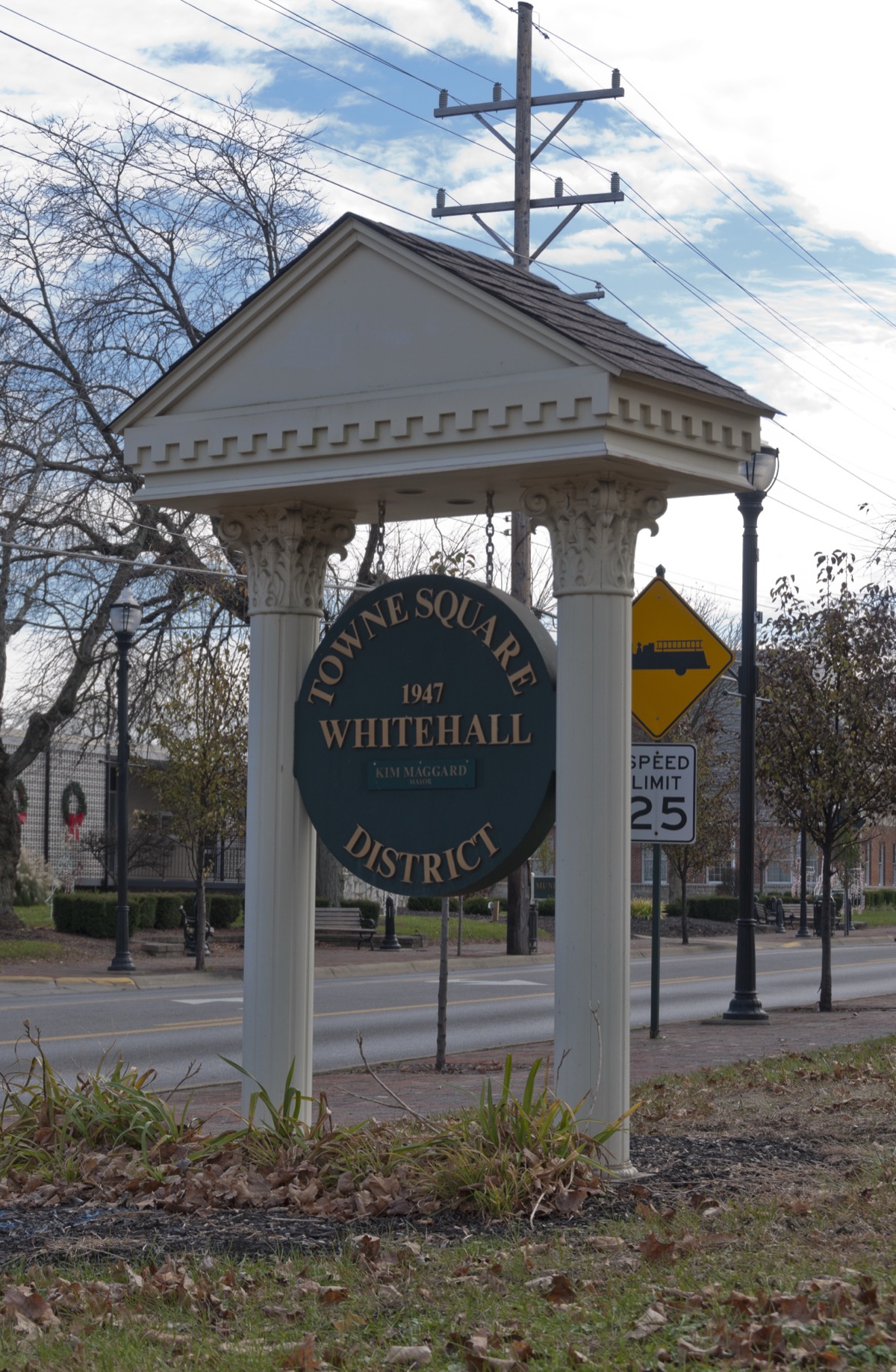
In Whitehall the pattern inverted: no opponents at the hearing, a unanimous rezoning, and a mayor welcoming “housing affordability for all families” onto a remediated salvage yard.5,10 The friction, such as it was, came on the money — the 4–3 tax-exemption vote, and the county commissioner voting for the grant while warning about out-of-town developers collecting local dollars.5,8 Columbus needs what the machine builds by any measure the record offers: the region has twenty-five affordable and available units per hundred extremely-low-income renter households — a thinner cushion than San Francisco or New York.28
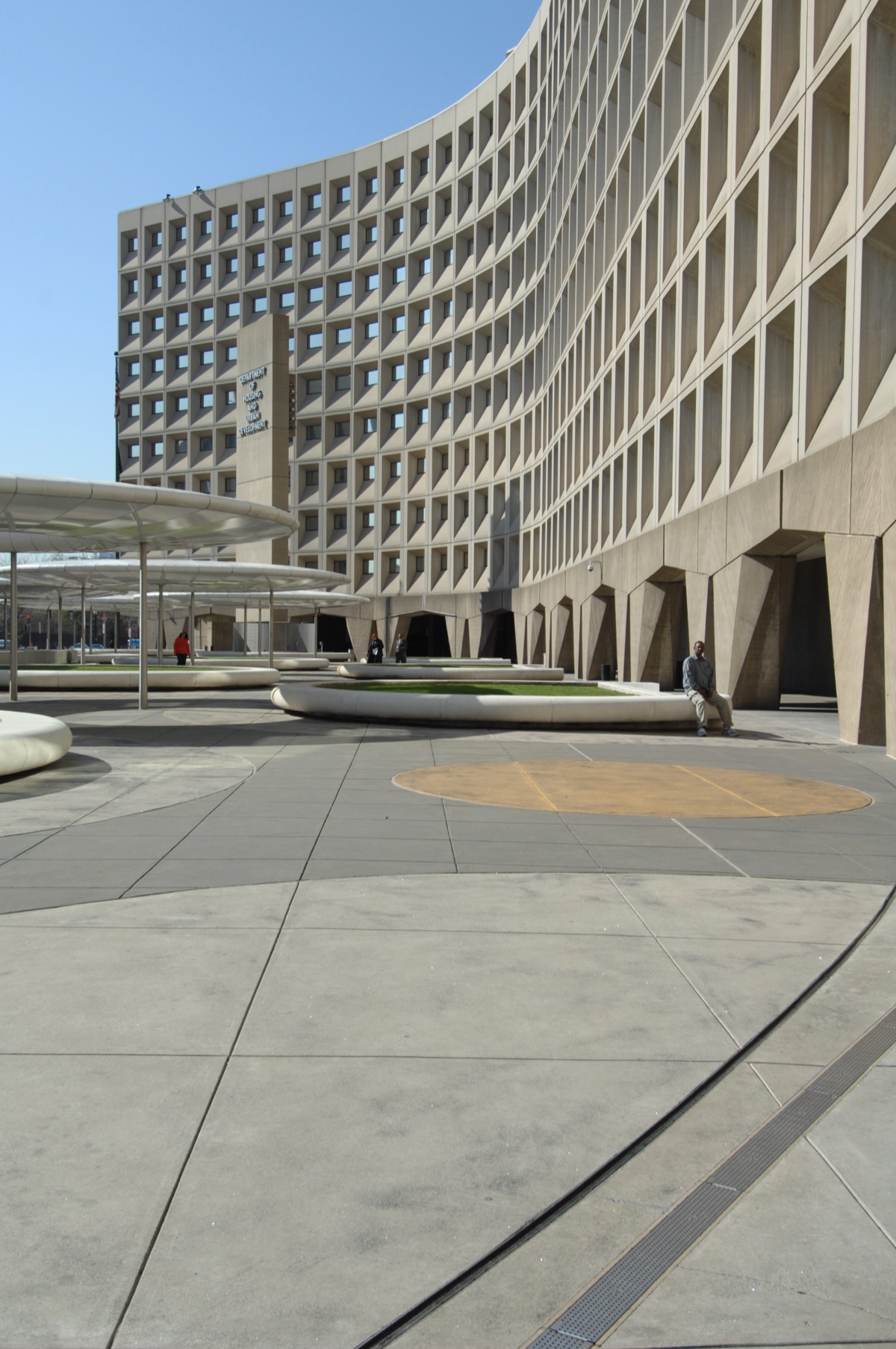
The program’s stain belongs beside its output, briefly. GAO found median per-unit development costs ranging from $126,000 in Texas to $326,000 in California — Aries Lofts’ $313,536 sits near the top of that national span — with syndication fees that allocating agencies “did not capture” and cost-certification gaps the report calls a known fraud risk; five years later a follow-up found federal oversight still “minimal,” the recommended cost-data collection still unbuilt.21,22 The machine that needs no gatekeeper also has, in GAO’s accounting, almost no auditor.
The sequence
27 Dec 2020
The floor. Congress fixes the “4%” credit at an actual 4% for bond-financed deals — the formula rate had been below 4% every month since January 1988 and sat at 3.07% when the fix passed. A 30% raise for every future 4% deal, Aries Lofts included, in one appropriations rider.12,13,14
3.07% → 4%
Aug 2021
The Wirthman family approaches Whitehall about its 15-acre salvage yard at 3515 E. Main Street. LDG Development — Louisville-based, founded 1994, “Everyone Deserves a Quality Place to Live” — buys the site for $2.1 million.6,10,23
$2.1M
Summer 2022
The Ohio Department of Development awards site-remediation money. Whitehall’s page says $5.05 million; the finance authority’s minutes and the application both say $5.6625 million. The record keeps both.2,3,6
≈$5.66M
19 Dec 2023
Whitehall votes. The 15-year CRA tax exemption passes 4–3, without its emergency clause, the ordinance’s own sponsor voting no. The rezoning passes unanimously — amended to require LDG to come back with a traffic study. At the public hearing: “There were no opponents.”5
May–Aug 2024
The bond record forms, at the county conduit rather than the state. CFFA approves up to $55 million of capital-lease revenue bonds in May, raises the cap to $60 million in July, and passes the inducement in August — minutes noting LDG realized it could “avoid OHFA board approval by using us as the issuer.” The bonds will be privately placed.2
$55M → $60M
2024
The application, self-reported to OHFA: total development costs of $98,763,802 — $313,536 per unit — an eligible basis of $90.2 million, ten-year credits of $46,884,228, and equity of $41,258,121 at 88 cents per credit dollar. The syndicator named at this stage is Key Community Development Corporation; by closing it is Merchants. No source explains the change.3,4
$98.8M TDC
14 Oct 2025
Franklin County adds $1.35 million from its Magnet Fund. Commissioner Kevin Boyce, voting yes anyway: “when outside developers come into town and take these grant dollars, I just want us to be very careful.”7,8
$1.35M
6 Nov 2025
Groundbreaking on the remediated salvage yard — two four-story buildings, 315 units: 66 at 50% of area median income, 183 at 60%, 66 at 70%. Rents will run $981 to $1,585.1,9
21 Nov 2025
Merchants Capital announces “$152.3 million in total financing”: a $60 million tax-exempt construction loan, $41.6 million of 4% LIHTC equity, a $42.7 million Freddie Mac Forward TEL permanent loan, and an $8 million equity bridge. The four pieces sum to the headline exactly.1
$152.3M
1 Dec 2025
The Columbus Dispatch prints the number the announcement does not: the project costs $108 million — the financing figure “exceeds the $108 million project cost because it includes a combination of permanent and construction loans.”9
$108M
22 Dec 2025
The reel airs, with the announcement’s framing intact: $152.3 million as the deal’s size. Every number in it is real; the one it lacks is the building’s cost.1,9
31 Dec 2025
The bond test halves. For bonds issued after this date, the One Big Beautiful Bill Act’s 25% test replaces the 50% test that shaped Aries Lofts’ stack — the same building will soon need half as much bond financing to unlock full credits.12,18
50% → 25%
2027
Delivery: first units leasing in summer, completion late in the year. The credits then flow for ten years, the compliance leash runs fifteen, and the extended-use commitment holds rents restricted until about 2057.6,9,12
What transfers
The first lesson is the correction: a financing announcement is not a price. Aries Lofts is a $98.8-to-$108 million building wearing a $152.3 million headline, because a construction loan and the permanent loan that retires it both count. The reel repeated the headline; so did every trade outlet, because all of them were reprinting one press release. The test that catches it costs one question — do any of these instruments exist to pay off the others?
The second is that “the 4% credit” is three claims folded into one word. The rate is a statutory floor, five years old, over a formula still producing 3.45%. The subsidy is a present-value target — ten years of credits worth roughly 30 per cent of qualified basis. And the access is automatic: clear the bond test and no board scores you. Each is checkable; the reel’s version — “you get 4%… into 30% present value” — compresses all three correctly and explains none of them. That compression is what this room exists to unpack.
The third is where the record of an automatic program lives. There is no OHFA award file because there was no award — the issuer’s minutes say the structure was chosen partly so there would not be. What exists instead is granular and municipal: a conduit authority’s bond caps, a 4–3 council vote on a tax abatement, a county grant resolution with a wary commissioner in the minutes, a self-reported application under an agency disclaimer. The public accountability of the 4% machine is real, but it is scattered across bodies nobody watches — and the one number no document states is what the fifteen-year tax exemption costs the town that granted it.
And the last is the trade at the center: $46.9 million of future federal tax relief, sold for $41.3 million of present equity, so that 315 families pay $981 instead of market rent. Whether that is an efficient subsidy is the program’s permanent debate — GAO’s cost findings and the syndication spread are the case against; Columbus’s twenty-five-units-per-hundred arithmetic is the case for building by whatever machine runs. The 4% machine’s answer is neither efficiency nor generosity. It is that it does not wait for anyone’s permission — and in a country short of homes, being automatic may be the most consequential design decision in the entire tax code.
Common questions
- What is the 4% LIHTC, in one paragraph?
- A federal subsidy that turns future tax relief into present construction equity. A project financed at least half with tax-exempt private activity bonds earns credits equal to 4% of its qualified basis every year for ten years — about 30% of the building’s cost in present value. Developers sell those credits to investors, overwhelmingly banks motivated by the Community Reinvestment Act, for cash equity today; Aries Lofts sold $46.9 million of credits for $41.3 million at 88 cents per credit dollar. The equity replaces debt the restricted rents could never service, which is what makes the building financeable at $981-a-month rents.
- Why is there no state award for Aries Lofts?
- Because the 4% credit is automatic. Unlike the competitive 9% credit, which a state agency scores and allocates, 4% credits attach as of right once the bond test is met — and the bonds themselves can come from any conduit issuer. The Columbus-Franklin County Finance Authority’s own board minutes record that LDG realized a straight LIHTC deal taking no OHFA funds could “avoid OHFA board approval by using us as the issuer.” The only OHFA document in the record is a proposal summary the developer wrote itself, hosted under an agency disclaimer. The bonds are privately placed, so the municipal disclosure system is empty too.
- Is Aries Lofts really a $152.3 million project?
- No — that is its financing, not its cost. The $152.3 million sums a $60 million construction loan, the $42.7 million permanent loan that will retire it, an $8 million bridge, and $41.6 million of credit equity. The building itself costs $108 million per the Columbus Dispatch at groundbreaking, and $98.8 million — $313,536 per unit — in the developer’s own 2024 application. The Dispatch stated the reconciliation plainly: the financing figure exceeds the project cost because it counts both construction and permanent loans. The reel, like every trade outlet, carried the headline; all of them were repeating one press release.
- Who pays for the affordability, and for how long?
- Layers, mostly public. Federal taxpayers forgo $46.9 million over ten years through the credits. Ohio paid roughly $5.66 million to remediate the salvage-yard site. Franklin County granted $1.35 million. Whitehall gave a 15-year property-tax exemption whose value no document states — passed 4–3, the closest thing to a contested approval in the whole deal. In exchange, all 315 units are rent-restricted across a band averaging exactly 60% of area median income, with recapture risk for 15 years and an extended-use commitment holding restrictions for about 30 — until roughly 2057.
- What did the reel get right, and what did it miss?
- Its numbers all verify: the stack, the units, the syndicator, the formula, the 10-year credit period and 15-year compliance leash. It compressed three things worth uncompressing: the $152.3 million is financing on a $108 million building; “you get 4%” is a statutory floor enacted in December 2020 over a formula that has produced less than 4% every month since January 1988; and the 15-year leash is half the story, since the extended-use agreement restricts rents for 30 years. It also, understandably, skipped the machine’s strangest feature — that no state board ever approved the deal, by design.
Sources
- Merchants Capital (press release) — Merchants Capital secures $152M in total financing for 315-unit affordable housing development — the stack: $42.7M Freddie Mac Forward TEL, $60M tax-exempt construction loan, $8M equity bridge, $41.6M of 4% LIHTC equity, plus the 15-year Whitehall PILOT and the public partners (2025-11-21)
- Columbus-Franklin County Finance Authority (2024 board meeting minutes) — The bond record — Resolution 2024-11 approving up to $55 million of capital lease revenue bonds (May), 2024-34 raising it to $60 million (July), the $5.6625 million brownfield passthrough (June), and the August inducement minutes stating LDG could “avoid OHFA board approval by using us as the issuer” (2024)
- Ohio Housing Finance Agency (Wirthman Yard 4% LIHTC proposal summary) — The application, self-reported by the developer — total development costs $98,763,802 ($313,536 per unit), eligible basis $90.16 million, ten-year credits $46,884,228, equity $41,258,121 at $0.88 per credit dollar, and Key Community Development Corporation as the syndicator then named (2024)
- Ohio Housing Finance Agency (2024 proposal summaries index) — The page that hosts the summary, with the agency’s own disclaimer: the summaries “were completed and submitted by their respective applicant. OHFA does not take responsibility for any information contained within” (2024)
- City of Whitehall (council meeting minutes) — The votes of 19 December 2023 — Ordinance 099-2023, the CRA tax exemption, adopted 4–3 without its emergency clause, the sponsor voting no; Ordinance 100-2023, the rezoning, adopted unanimously as amended, contingent on a traffic study; “There were no opponents” (2023-12-19)
- City of Whitehall (Aries Lofts project page) — The city’s own timeline — the Wirthman family’s 2021 approach, the remediation award it states as $5.05 million, the December 2023 council votes, the November 2025 groundbreaking, and a unit count of 316 that every closing document gives as 315 (undated)
- Franklin County Board of Commissioners (Resolution 0760-25) — The county’s $1,350,000 Magnet Fund grant to Rita June Foundation, Inc. and LDG Multifamily, LLC for the 315-unit project at 3515 E. Main St., adopted 14 October 2025 (2025-10-14)
- ABC6/WSYX Columbus — Franklin County commissioners approve $1.35 million for Aries Lofts — Commissioner Kevin Boyce, on the record: “when outside developers come into town and take these grant dollars, I just want us to be very careful” (2025-10-14)
- The Columbus Dispatch (Emma Wozniak) — Construction begins on Aries Lofts — the $108 million project cost the financing figure exceeds “because it includes a combination of permanent and construction loans,” rents of $981 to $1,585, and the 6 November 2025 groundbreaking (2025-12-01)
- Columbus Underground (Brent Warren) — Housing planned for Green Line-adjacent industrial site — LDG’s $2.1 million purchase of the Wirthman Brothers salvage yard, the 2022 state cleanup grant, and Whitehall Mayor Michael T. Bivens on “housing affordability for all families” (2025-05-30)
- Multi-Housing News (Dees Stribling) — LDG Development secures $152M for Columbus-area affordable project — the trade retelling of the Merchants release, and LDG’s 25,000-unit, nine-state footprint (2025-11-24)
- 26 U.S.C. §42 (Legal Information Institute, Cornell Law School) — The statute itself — the credit formula, the 10-year credit period, the 15-year compliance period, the 30-year extended-use commitment, the 4% floor for buildings placed in service after 31 December 2020, the 50% bond test and its new 25% variant, and the 30%/70% present-value design (undated)
- Congressional Research Service (RS22389, Mark P. Keightley) — An Introduction to the Low-Income Housing Tax Credit — the formula rate “below 4% every month since January 1988,” the July 2025 formula rates of 3.45% and 8.06%, the competitive-versus-automatic distinction, the worked $1 million example, and the OBBBA changes taking effect in 2026 (2025-07-11)
- Novogradac (Journal of Tax Credits, Jim Campbell) — “Fixing” the 4% LIHTC rate pays significant dividends — the rate was 3.07% shortly before the fix; going to 4.00% was a 30% increase in credits and equity (2021-10)
- Novogradac (Notes from Novogradac, Peter Lawrence) — The year-end bill that fixed the floor — the 4% minimum enacted in the appropriations package of 21 December 2020, effective for bond-financed properties from 2021 (2020-12-21)
- Novogradac (tax credit percentages) — The shadow rate the floor overrides — Treasury’s formula produced 3.43% to 3.45% through 2024, published monthly by revenue ruling, with the 4% floor note (2024)
- Novogradac (Journal of Tax Credits, Kroger and Chung) — The 50% test as a cliff — at least half of aggregate basis financed by volume-cap bonds buys credits on 100% of qualified basis, and the denominator excludes financing, syndication and reserve costs (2021-10)
- Novogradac (Notes from Novogradac, Peter Lawrence) — PAB use continues to grow — the OBBBA cut of the bond test from 50% to 25% for bonds issued after 2025, record $21.67 billion of multifamily issuance in 2023, and 35 states plus D.C. at or above bond-cap capacity (2025-09-24)
- Novogradac (Journal of Tax Credits, Michael J. Novogradac) — The road ahead for equity markets — average bid prices of roughly 85 cents per credit dollar as of June 2025, down from $1.05 before the 2017 tax cut, in a ~$25 billion annual LIHTC equity market (2025-08)
- CohnReznick (2024 LIHTC equity market volume survey) — Who buys the credits — $28.9 billion of equity closed in 2024, with bank investors, driven by the Community Reinvestment Act, accounting for approximately 80% of it (undated)
- U.S. Government Accountability Office (GAO-18-637) — LIHTC development costs — median per-unit costs from $126,000 in Texas to $326,000 in California, syndication fees allocating agencies “did not capture,” and cost-certification gaps the report calls a known fraud risk (2018-09-18)
- U.S. Government Accountability Office (GAO-24-107064) — Five years later — federal oversight of the credit remains minimal, and the recommendation that someone collect cost data remains unimplemented (2023-12-14)
- LDG Development (corporate site) — The developer — founded 1994 by Chris Dischinger and Mark Lechner, 28,000+ units across six states, under the mission statement “Everyone Deserves a Quality Place to Live” (undated)
- WDRB Louisville (Marcus Green) — Developers sue Louisville Metro Council over rebuffed low-income apartments — the 2017 Prospect Cove denial, and Dischinger on the record: “We just feel like this is a case of NIMBY” (2017-11-27)
- WAVE3 Louisville — Louisville ends LDG lawsuit with multi-million dollar payout — the Fair Housing Act settlement of over $6 million, August 2025, plus land-development-code changes curbing council overrides (2025-09-25)
- Dinsmore & Shohl (LDG’s counsel) — The firm’s own account of the settlement — “among the first nationally where a city paid to resolve such a claim,” a characterization from the winning side’s lawyers (2025-12-31)
- Affordable Housing Finance (Donna Kimura) — AHF 50: construction starts slow — LDG Development among the top five affordable housing developers in the country for 2025 starts (2026-05-18)
- Coalition on Homelessness and Housing in Ohio (COHHIO) — The 2025 gap report — Ohio short 264,083 affordable units for extremely-low-income renters; Columbus has 25 affordable and available units per 100 such households, fewer than San Francisco or New York (2025-03-13)
- Freddie Mac Multifamily (news release) — A forward commitment in the wild — the comparable Arizona deal: permanent tax-exempt loan financing committed before construction, “to be funded after 36 months once construction is completed,” with the certainty-of-execution rationale in Freddie’s own words (2026-05-28)
- Merchants Capital (press release) — Merchants at 35 — $7 billion of annual production, $30 billion under management, top-five agency affordable lender rankings: the scale of the machine that financed Aries Lofts (2026-03-23)