
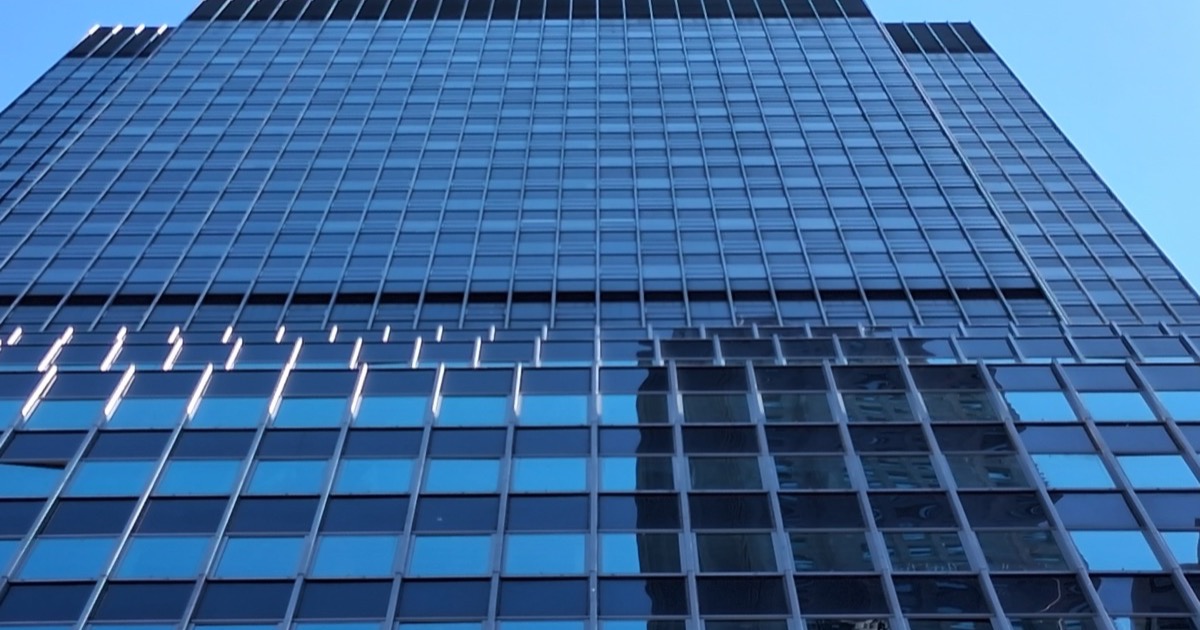
Case study Nº 06
The law arrived two years late and claimed the building anyway.
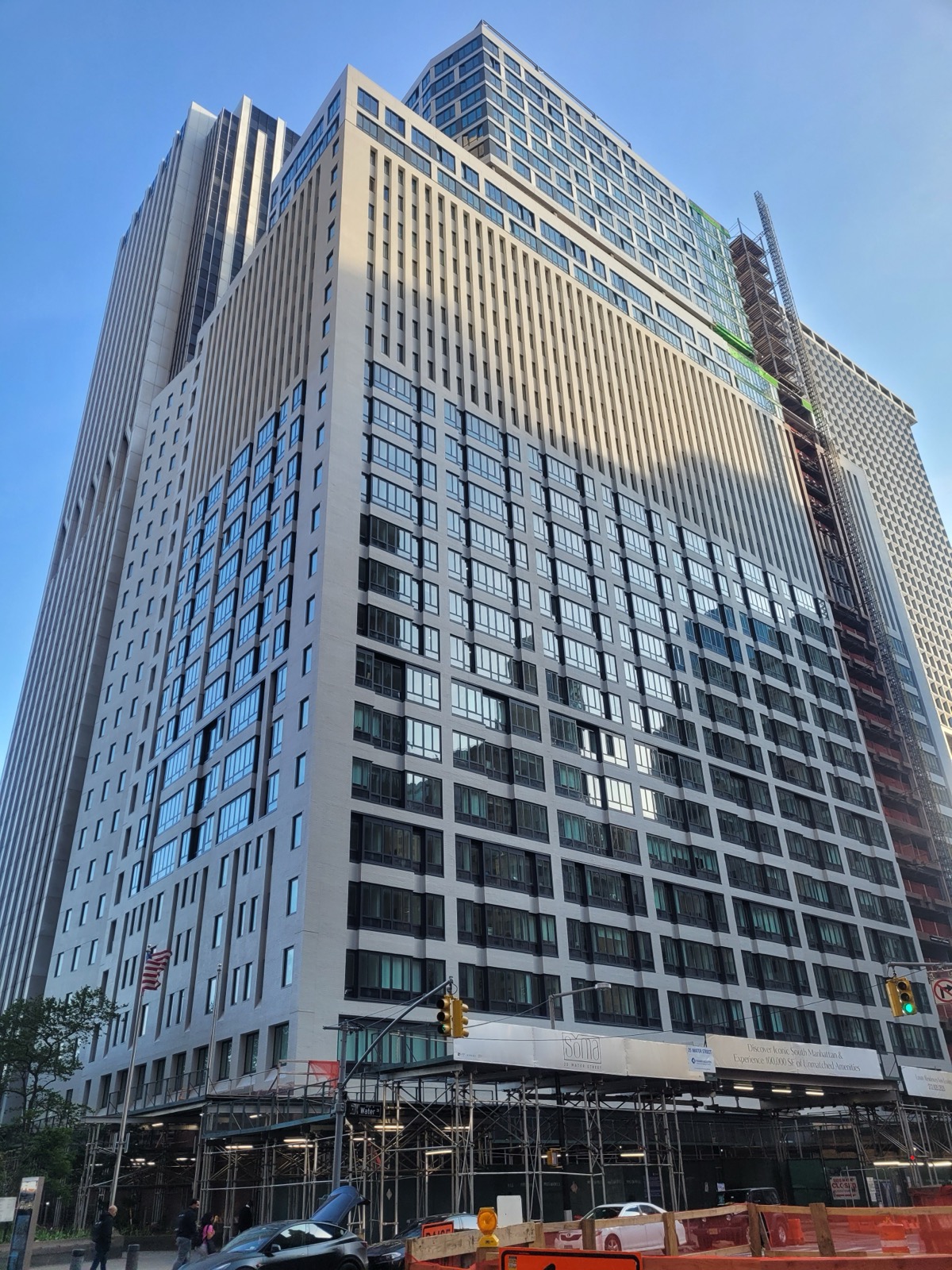
25 Water Street — JPMorgan’s old 1969 back office — sold for about $108 million in the crisis, $270 million in 2012, and $250.8 million by deed in lieu in December 2022, when a conversion group carved two light wells through its 40,000-square-foot floors, added ten stories, and made it the largest office-to-residential conversion in US history: 1,320 apartments, refinanced at $835 million. The tax program credited with enabling it was enacted sixteen months after the deal closed, with an eligibility window opening nine days after its loan — and the city’s own Comptroller priced that retroactive gift at $1.8 million per affordable unit.
Ben Fan, with Darryl WengDecember 21, 202516 min readWatch the reel
The office, by deed in lieu, Dec 2022
$250.8M
The refinancing as housing, Dec 2025
$835M
In December 2022 a conversion group took a half-empty 1969 office tower at 25 Water Street by deed in lieu of foreclosure, for the approximate price of its mortgage: $250.8 million.2,3 Three years and roughly $800 million of construction later, the same building — now SoMA, 1,320 apartments, the largest office-to-residential conversion in US history — refinanced for $835 million.7,11,12 The second figure is a loan, not a price, and this study says so wherever it appears. What sits between the two numbers is the trade the reel calls a cheat code — and a finding the reel has backwards: the programs credited with enabling this building were written after it, around it, and in one case retroactively onto it. Jump to the marks ↓
The reel this brief grew from gets the machine right and the causes wrong. The carved light wells, the ten added floors, the one-bedroom market at $4,000-to-$5,000 (Elliman: $4,500 median, $4,699 average), 55 Broad’s all-electric pitch, the private-credit lenders — all verify.7,8,25,30 Its two framing claims do not. “Mid-tier offices 30 to 40% vacant” is roughly double every published figure for any defined tier — downtown Class B and C availability runs 20.2%, the citywide mid-tier vacancy the Comptroller measured is 12.9%, and downtown’s overall vacancy hit a fourteen-quarter low the quarter the reel aired. The range is true only building by building, where the real story lives: 830 Third at 40%, 175 Water at 97%.16,18,23 And the causality is inverted: City of Yes passed in December 2024 and 467-m in April 2024 — years after all three of the reel’s example towers had been bought, financed and gutted under rules that already existed.15,16,20
That inversion is the study. The 4% housing machine this room examined in Ohio was a law that needs no deal-by-deal approval; 25 Water Street is a deal that needed no law — and then had one written onto it, sixteen months later, with an eligibility window that opens nine days after its loan closed.6,13,15
| The conversion at a glance | Number |
|---|---|
| The building | 4 New York Plaza, 1969 — 22 stories, ~1.1M square feet, 40,330-square-foot floor plates1,5 |
| The price history | ≈$108M (JPMorgan’s exit, 2009–10) → $270M (2012) → $250.8M by deed in lieu (Dec 2022)1,2,3,6 |
| The construction loan | $535.8M from MSD Partners and Apollo — the largest ever for a US conversion5,6 |
| The carve | Two light wells through the plates, ten floors added on top: 22 → 32 stories, ~$800M of work7,8 |
| The outcome | 1,320 apartments — the largest US office-to-residential conversion — leasing from Jan 20257,9 |
| The rents | Studios $3,436 at launch → $4,450–$4,870 by late 2025; one-bedrooms $6,6257,11 |
| The affordable quarter | 330 lottery units, $932 studios at 40% AMI to $3,286 three-bedrooms10 |
| The tax program | 467-m, first user — enacted Apr 2024, retroactive to conversions commenced after 31 Dec 20229,13,15 |
| What the program costs | $434M PV of benefits vs $67M of taxes paid — $1.8M per income-restricted unit, per the Comptroller16,17 |
| The zoning that actually enabled it | FiDi’s pre-1977 as-of-right conversion rules — City of Yes (Dec 2024) came too late to add units here8,16,20 |
| The exit from construction debt | $835M refinancing, December 2025 — 3.3× the 2022 purchase price12 |
| The company it keeps | 160 Water: $165M → 588 units → $280M refi · 55 Broad: $172.5M closed → 571 units → $500M RXR recap27,29,31,34 |
| The pipeline behind it | 84 Manhattan conversion projects, 25.7M square feet, as of April 202626 |
A box built for paper
The tower at 25 Water Street was born as 4 New York Plaza in 1969, one of the brown boxes thrown up along the East River in the decade Wall Street’s paperwork outgrew Wall Street. Its floor plates ran more than 40,000 square feet — trading floors, proof rooms, punch-card operations for the Daily News and, for decades, JPMorgan Chase.1,5 Buildings like it were the point of the Financial District’s twentieth century, and the problem of its twenty-first: too deep for daylight, too old for trophy tenants, too specific to the work that left.
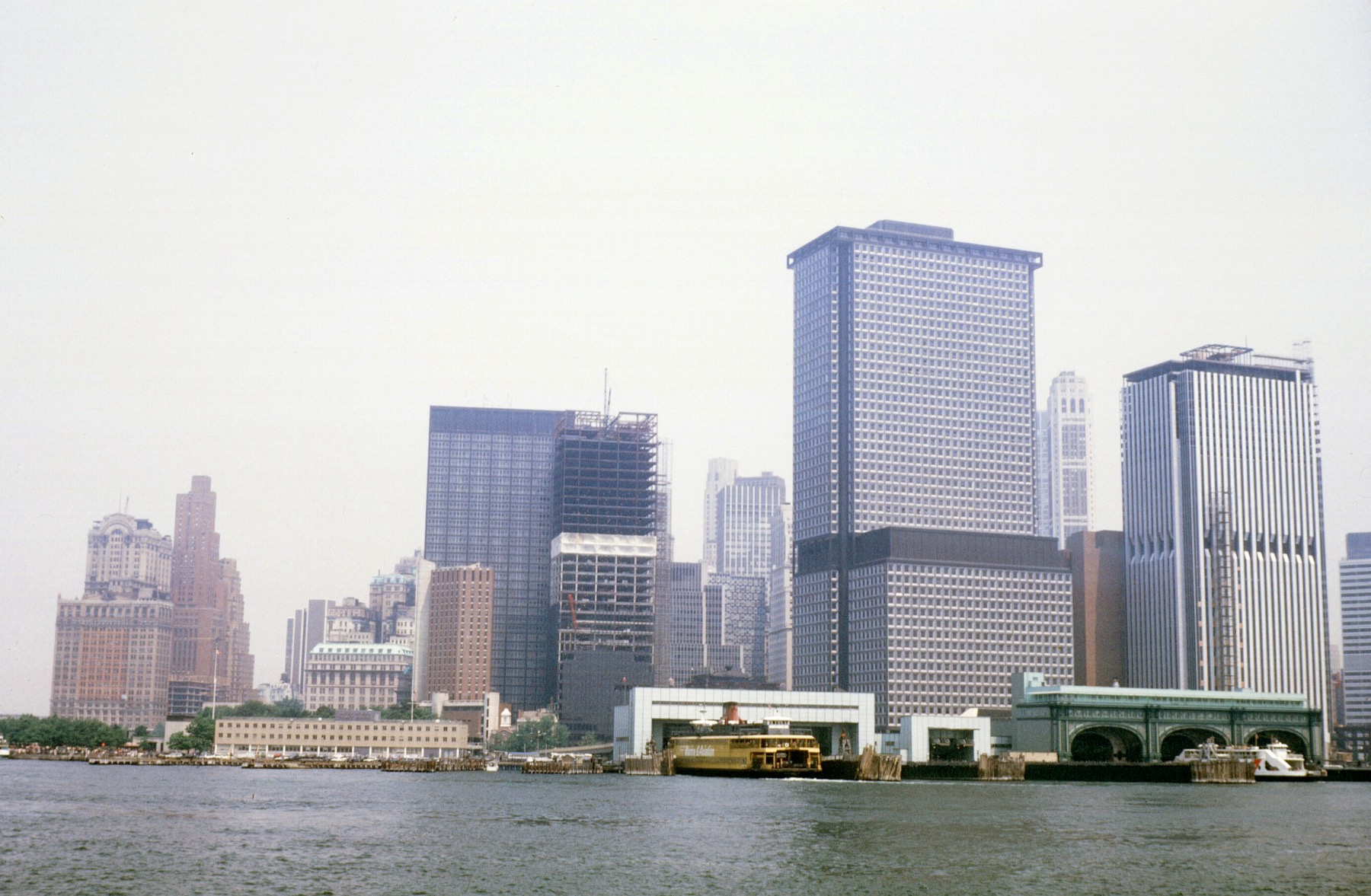
The decline was priced long before the pandemic. JPMorgan sold the building around the financial crisis — the record, from the same outlet, says both $108.9 million in December 2009 and $107 million in 2010, and this study carries both — and HSBC’s investment arm with Edge Fund Advisors paid $270 million for it in 2012.1,2,3,6 By 2022 JPMorgan was trying to sublease 500,000 of its 700,000 square feet, and the owner faced a ~$250 million DekaBank mortgage on a building whose next owner would say, plainly, that it “was not going to survive as an office building.”1,9 The reel’s “pennies” deserves its precision: the converters paid roughly the debt — $250.8 million, seven per cent below the 2012 price, well above JPMorgan’s crisis-era exit. Cheap is relative to use, not to history: as an office the price was the mortgage; as raw material for 1,320 apartments it was a basis.2,3,4
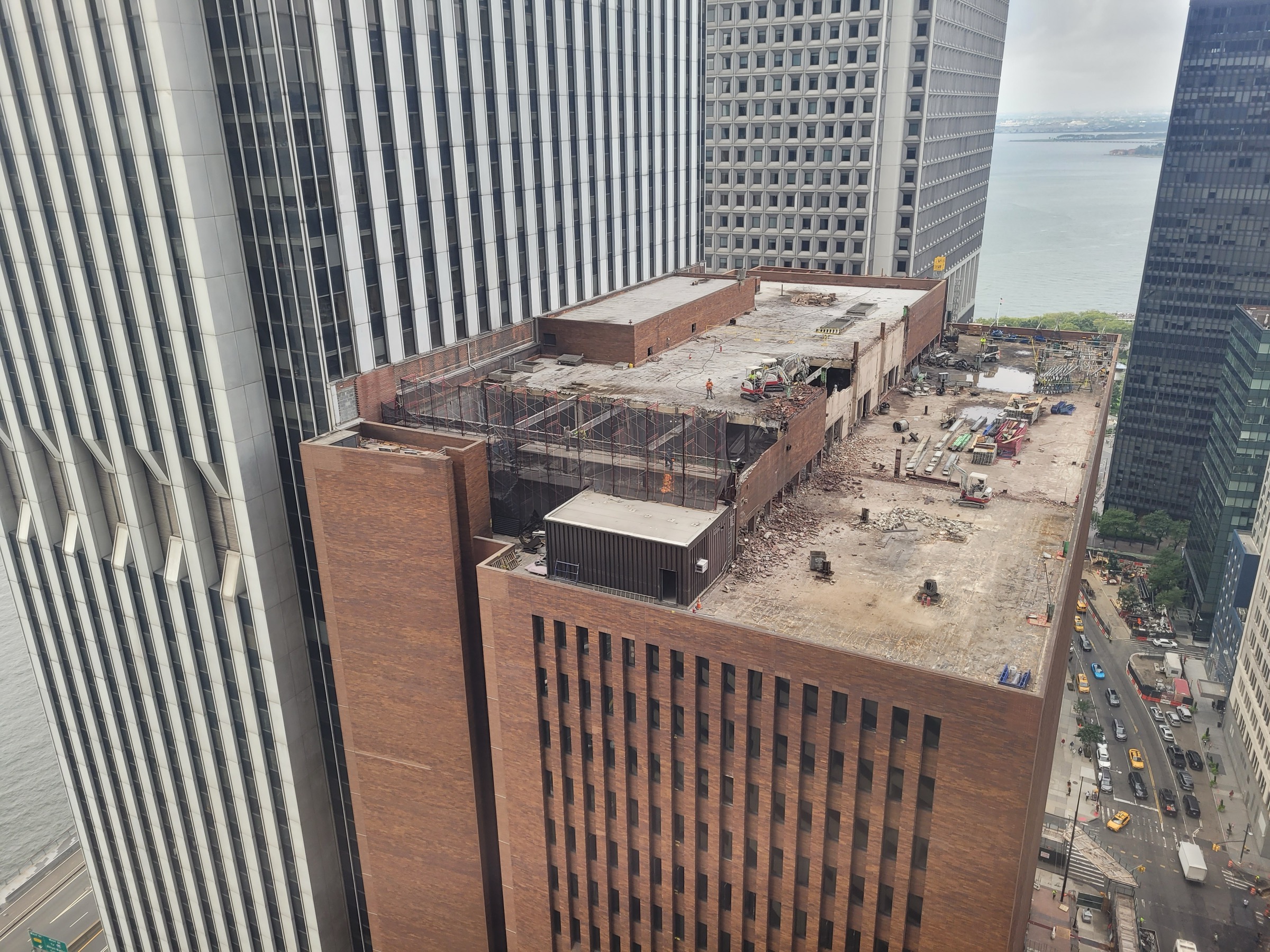
August 2023, from above
To save the building they cut it open.
The crown of 25 Water Street under demolition, August 2023 — the first act of a conversion that carved two light wells through the 40,000-square-foot plates and then added ten new floors where this roof stood.Photo: SnowFire, CC BY 4.0, via Wikimedia Commons
One tower, re-marked
Four numbers, one building, two uses. The tower's price as an office, twice; its price as raw material; and — hatched, because it is a loan and not a sale — what lenders advanced against it as housing.
What the tower traded at
$835M
Dec 2025 · Refinanced as 1,320 homes12
A loan, not a price — the only post-conversion number the record gives, drawn hatched for exactly that reason. Lenders advanced 3.3 times the 2022 purchase against the finished building.
- Dec 2009≈$108.9M
- 2012$270M
- Dec 2022$250.8M
- Dec 2025$835M
Three of the four marks are recorded trades; the fourth is debt, drawn hatched and labeled as such because a loan is evidence of value, not a statement of it. The 2009 mark carries the record’s own disagreement — $108.9M in December 2009 or $107M in 2010, from the same publication — and no multiple is printed across the set, because a ratio between a price and a loan would be arithmetic nobody published.1,6,12
| When | Mark | Value |
|---|---|---|
| Dec 2009 | JPMorgan sells the office | ≈$108.9M |
| 2012 | HSBC and Edge buy the office | $270M |
| Dec 2022 | Taken by deed in lieu | $250.8M |
| Dec 2025 | Refinanced as 1,320 homes — A loan, not a price — the only post-conversion number the record gives, drawn hatched for exactly that reason. Lenders advanced 3.3 times the 2022 purchase against the finished building. | $835M |
Dec 2025, Refinanced as 1,320 homes, $835M.
One tower, re-marked
The first mark is a bank shedding a building it no longer wanted to own — JPMorgan selling its own back office in the wake of 2008, at a price that looks, from here, like the bottom.1,6 It wasn’t read that way then. Deep-plate Water Street towers were believed to have an office future; the 2012 buyers underwrote one.
The last mark is hatched because it is a different kind of number: an $835 million refinancing, December 2025, on a building whose studios list at $4,450 to $4,870 with one or two units left per type.11,12 No one has sold SoMA, so no one has priced it. But lenders sized their advance at 3.3 times the 2022 deed — against rents, not against office rolls — and that is the whole trade stated in one line: the building’s price now answers to Elliman’s rent report, not to Cushman’s vacancy table.24,25
- Dec 2009≈$108.9M
- 2012$270M
- Dec 2022$250.8M
- Dec 2025$835M
Three of the four marks are recorded trades; the fourth is debt, drawn hatched and labeled as such because a loan is evidence of value, not a statement of it. The 2009 mark carries the record’s own disagreement — $108.9M in December 2009 or $107M in 2010, from the same publication — and no multiple is printed across the set, because a ratio between a price and a loan would be arithmetic nobody published.1,6,12
The law that chased the deal
What legalized this conversion was not new. Lower Manhattan’s zoning has allowed pre-1977 office buildings south of Murray Street to convert as of right since the 1990s revitalization plan, and the 421-g tax incentive (1995–2006) drove the first wave: 13 million square feet, about 12,900 apartments, before the program was allowed to lapse.16,21,22 A 1969 building needed no one’s permission in 2022. What it lacked was a tax incentive — 421-g had been dead sixteen years — and so the deal was underwritten without one: bought, financed and torn open on market rents alone.3,5,16
Then the law caught up, twice. In April 2024 the state enacted RPTL 467-m: a 90 per cent property-tax exemption for thirty years in Manhattan below 96th Street, five-year taper after, in exchange for 25 per cent affordable units (five per cent at 40 per cent of AMI, weighted average no higher than 80) with rent stabilization and a restriction period “extending in perpetuity.”13,14,15 Its eligibility window opens at conversions “commenced after December 31, 2022” — nine days after 25 Water’s loan closed, months before its demolition began — and HPD’s rules apply the benefits “retroactively.”13,15 SoMA became the statute’s first user; the New York Times had to append a correction just to locate the program’s authorship.8,9 That December, City of Yes extended conversion rights citywide to buildings built before 1991 — a real reform, passed 31–20, that arrived too late to shape this building at all. The architect’s verdict on the timing: “If City of Yes had existed, we would have been able to create more apartments here. A lot more apartments.”8,19,20
The cost of the law that chased the deal has its own auditor. The city Comptroller’s fiscal note took 25 Water Street as its case study: $434 million in present-value tax benefits against $67 million in present-value taxes to be paid — $538 million less than the same building fully market-rate — for 330 income-restricted units, “an opportunity cost per income-restricted unit in Lower Manhattan [of] $1.8 million.”16,17 Its plainest sentence is the study’s hinge: because the project’s feasibility “was established well before the passage of 467-m,” the building “plainly proves that the tax benefits exceed the rent discounts on income-restricted units.”16 The exemption did not summon the housing. It arrived after the housing was already financed, and paid anyway.
- As a market-rate building17$605MThe present value of the property taxes the finished building would pay over 37 years with no exemption — the counterfactual the fiscal note prices.
- The 467-m benefit17$434MThe present value of the exemption the retroactive program grants — the public’s purchase price for the affordable quarter of the building.
- Taxes actually to be paid17$67MWhat remains: roughly a ninth of the market-rate bill. The Comptroller’s verdict on the program in Lower Manhattan — “likely too generous.”
All three figures are the Comptroller’s, computed for this building, as reported when the fiscal note landed.16,17 Divided by the 330 income-restricted units, the middle number becomes the note’s headline: $1.8 million of foregone taxes per affordable apartment — for units the market, on the note’s own reading, would have built regardless.
The trade beside it
The reel’s supporting towers hold up as deals and sharpen as timing. Pearl House at 160 Water Street was bought by Vanbarton in 2014 for $165 million — “the fitting price of $160 million,” in its own partner’s later rounding; the record keeps both — converted beginning December 2021, 99 per cent occupied within a year of its 2023 opening, and refinanced for $280 million in late 2025; it predates both programs and is not even eligible for 467-m.16,27,28,34 55 Broad Street — the 1960s tower Goldman Sachs once filled — went from Rudin to Silverstein and Metro Loft at a $180 million contract in May 2022, closing at $172.5 million a year later, became the city’s first all-electric conversion at 571 units, qualified retroactively for 467-m alongside 25 Water, and drew a $500 million RXR recapitalization in April 2026.16,29,30,31 The reel’s “one-bed-plus-home-office” strategy is real but belongs to this building, not to 160 Water: Berman showed the New Yorker his windowless “home offices” and smiled that many “would wind up as bedrooms” — the ad-copy term is “convertible two-bedroom.”35 The financing pattern the reel describes — banks out, private credit in — is real as a wave, with debt funds like Derby Lane launching $1.8 billion for exactly this trade; the nuance is that these three deals were never bank-financed to begin with. MSD and Apollo, Brookfield’s debt arm, Ares preferred equity: alternative capital built this market, then scaled it.6,28,29,33
The honest edges of the trade belong in the same frame. The pipeline is real — 84 Manhattan conversion projects and 25.7 million square feet underway by April 2026, on the broker count — and it is also small against 500 million square feet of stock: Goldman’s estimate holds that office prices must fall roughly 50 per cent for conversions to pencil at scale, and one veteran’s figure is that 30 per cent of office buildings are “basically worth nothing” and will meet the wrecking ball, not the architect.26,32 And the technique itself carries a new asterisk: in July 2026, at Metro Loft’s conversion of the old Pfizer headquarters in Midtown, two columns buckled under newly added floors; nine buildings were evacuated while Berman called it “nothing more than a typical construction mishap.”32 Nor was it the converter-king’s first stumble: he lost his 20 Broad Street conversion to its lender — an Apollo insurance subsidiary — in October 2025, and his own longtime architect jokes that the product is “slums for the rich.”35 The overbuild that crowned 25 Water is the overbuild under investigation crosstown — same firm, same method, different outcome. The trade that turns dead offices into housing is engineering first, arbitrage second, and the order matters.
The sequence
1969
The box goes up on the Water Street corridor as 4 New York Plaza — a 22-story back-office machine with 40,330-square-foot floor plates, built for the paperwork of the securities industry. The Daily News and JPMorgan Chase become its defining tenants.1,5
Dec 2009
JPMorgan sells the building in the financial crisis’ shadow. The record carries two versions of the trade from the same outlet — about $108.9 million in December 2009, or $107 million in 2010 — and this study keeps both.1,6
≈$108M
2012
HSBC Alternative Investments and Edge Fund Advisors buy the office for $270 million. A decade later, one retelling would misdate it to 2015 — the record is 2012.2,3
$270M
2020–2022
The tenancy dissolves: JPMorgan, consolidating into its new headquarters, tries to sublease 500,000 of its 700,000 square feet. The building "was not going to survive as an office building," its next owner would say.1,9
22 Dec 2022
The conversion group — GFP Real Estate, Metro Loft, Rockwood Capital — takes the tower by deed in lieu of foreclosure, assuming DekaBank’s ~$250 million mortgage at a slight discount: $250.8 million on the deed. The same day, MSD Partners and Apollo close a $535.8 million acquisition-and-redevelopment loan, the largest ever for a US office-to-residential conversion.3,4,5,6
$250.8M · $535.8M loan
Mid-2023
The carve begins: two light wells cut through the 40,330-square-foot floor plates, the facade stripped and re-glazed, and — topped out 27 February 2024 — ten new floors added, 22 stories becoming 32. Total redevelopment: about $800 million.7,8
≈$800M works
Apr 2024
Sixteen months after the deal closed, the state enacts RPTL 467-m: up to 90% property-tax exemption for 30 years in Manhattan below 96th Street, for conversions with 25% affordable units — and an eligibility window opening at conversions "commenced after December 31, 2022." The deal that predates the law becomes its first beneficiary.13,14,15
5 Dec 2024
City of Yes for Housing Opportunity passes the Council 31–20, extending conversion rights citywide to buildings built before 1991. Too late to shape 25 Water: "If City of Yes had existed, we would have been able to create more apartments here. A lot more."8,19,20
Jan–Feb 2025
SoMA opens leasing at 1,320 units — the count having grown from 1,200 planned to 1,300 financed to 1,320 built — with studios from $3,436 and 100,000 square feet of amenities. First residents move in come February.7,9
Mar 2025
The affordable lottery opens on Housing Connect: 330 units, from $932 studios at 40% of AMI to $3,286 three-bedrooms — the quarter of the building that 467-m requires.10
Jul 2025
The Comptroller’s fiscal note makes 25 Water its case study: $434 million in present-value tax benefits against $67 million of taxes to be paid, $538 million less than a full market-rate building — "the opportunity cost per income-restricted unit in Lower Manhattan is $1.8 million." The program, it concludes, is "likely too generous" here.16,17
$434M benefit
2 Dec 2025
The exit from construction debt: an $835 million refinancing — 3.3 times the 2022 purchase price — on a building whose studios now list at $4,450 to $4,870, with one or two units left per type.11,12
$835M refi
Jul 2026
The technique’s stain arrives elsewhere: at Metro Loft’s Pfizer-headquarters conversion in Midtown, two columns buckle under newly added floors; nine buildings are evacuated. Berman calls it "nothing more than a typical construction mishap." The method that added ten floors here is the method under investigation there.32
What transfers
The first lesson is that a conversion is a price event before it is a design event. Nothing architectural happened to 25 Water Street between $270 million and $250.8 million; what happened was that the office thesis died and the equity above the mortgage died with it. The carve — the light wells, the overbuild, the $800 million — only became possible once the building had been re-priced down to raw material. Whenever a conversion headline appears, find the deed first: the architecture is downstream of a wipeout.
The second is about how incentive programs and pioneering deals actually relate. This room’s Ohio study found a program built to need no approvals; this one finds a deal that needed no program — and then had one drafted behind it, with a retroactivity window that reads like a tailor’s mark. The Comptroller’s conclusion generalizes: when a subsidy’s eligibility reaches backward to deals already financed, the subsidy is buying what the market had already decided to build. The first beneficiary of a new program is often the proof it wasn’t needed — at least not there.
The third is the vacancy lesson. “30 to 40 per cent vacant” describes no published tier of the Manhattan market — but it does describe particular buildings, and conversions are a building-by-building trade. Averages conceal the 97-per-cent-empty tower and the fully-let one next door; the market that matters to this trade is the deed-by-deed one, where a handful of unsalvageable offices clear at their mortgage while the headline vacancy rate falls partly because they leave the denominator. Read every conversion-wave statistic twice: once as supply, once as survivorship.
And the last is the housing arithmetic, held honestly in both hands. SoMA added 1,320 homes to a city desperate for them, 330 income-restricted — $932 studios in a neighborhood of $4,700 medians — and the public paid $434 million in foregone taxes for a project whose feasibility predated the payment. Both facts are true at once. The conversion trade is the rare machine that turns office distress into housing supply; the program that now rides it is, on the auditor’s own arithmetic, a $1.8-million-per-unit way to buy what was already being built. The buildings needed cutting open. Whether the tax code did is the question the record leaves on the table.
Common questions
- What exactly happened at 25 Water Street?
- A 1969, 22-story office building — formerly 4 New York Plaza, long home to JPMorgan Chase’s back office and the Daily News — was taken by a conversion group (GFP Real Estate, Metro Loft, Rockwood Capital) in December 2022 by deed in lieu of foreclosure for $250.8 million, roughly the balance of its mortgage. With a $535.8 million loan from MSD Partners and Apollo and about $800 million of construction, they carved two light wells through the 40,330-square-foot floor plates, added ten floors, and opened SoMA in January 2025: 1,320 apartments, the largest office-to-residential conversion in US history. In December 2025 it refinanced for $835 million.
- Did City of Yes and 467-m make this conversion possible?
- No — and that inversion is the study’s finding. Lower Manhattan has allowed pre-1977 buildings to convert as of right since the 1990s; 25 Water needed no new zoning, and City of Yes (adopted December 2024) arrived so late the architect says its density rules would have allowed “a lot more apartments” had they existed. The 467-m tax exemption was enacted in April 2024 — sixteen months after the deal closed — with an eligibility window for conversions commenced after 31 December 2022, applied retroactively. The deal that predates the law became its first beneficiary. The programs matter for the next wave: City of Yes extends conversion rights citywide to pre-1991 buildings, and 467-m is what makes affordable set-asides pencil.
- Was the tower really bought “for pennies”?
- It was bought for its debt. The $250.8 million deed-in-lieu price was about 7 per cent below the $270 million HSBC and Edge paid in 2012, and well above JPMorgan’s roughly $108 million crisis-era exit — so “pennies” overstates it against history. The real discount was against use: the sellers’ equity was wiped, the lender took a slight haircut, and the buyers acquired 1.1 million square feet of structure for about $190 per square foot in a borough where the finished apartments above it now rent studios at $4,450. Conversion buyers pay office-distress prices for residential raw material; that spread, not the absolute price, is the trade.
- What does the public pay, and what does it get?
- For 25 Water specifically, the city Comptroller computed the 37-year present value of its 467-m benefits at $434 million against $67 million in taxes to be paid — $538 million less than a fully market-rate building would have contributed — in exchange for 330 income-restricted units: about $1.8 million of foregone taxes per affordable apartment, for a project whose feasibility the note says “was established well before the passage of 467-m.” The units are real — $932 studios at 40 per cent of AMI, permanent affordability, rent stabilization — and the price paid for them is the retroactive subsidy of a deal that was already financed. The Comptroller’s verdict: 467-m in Lower Manhattan is “likely too generous.”
- Is the office-to-residential wave big enough to matter?
- It is real and it is bounded. By April 2026 Manhattan had 84 conversion projects underway totaling 25.7 million square feet — meaningful housing (the Comptroller tracks 17,400 units in the nearer pipeline) and one reason downtown office vacancy hit a fourteen-quarter low as the worst buildings left the denominator. But against roughly 500 million square feet of Manhattan office stock, conversions remove a few per cent; Goldman Sachs has estimated office prices must fall about 50 per cent for conversions to be viable at scale, and industry veterans put a third of office buildings in the tear-down, not convert, category. The trade cherry-picks the convertible — old bones, small-enough plates, dead tenancy, cooperative lenders — which is precisely why the buildings that clear all four gates command a machine this elaborate.
Sources
- The Real Deal — Gural, Metro Loft in contract for 25 Water Street — the June 2022 scoop: a ~$250M mortgage, buyers paying about the price of the debt, and JPMorgan trying to sublease 500,000 of its 700,000 square feet (2022-06-13)
- The Real Deal — GFP, Metro Loft seek to convert 25 Water Street to 1,200 rentals — the deed-in-lieu structure: assuming DekaBank’s $250 million loan at par while Edge Funds hands over the keys (2022-10-31)
- Commercial Observer (Celia Young) — GFP closes on 25 Water Street for $251M — the recorded $250.8 million, the DekaBank payoff at a slight discount, and the sellers’ brokers on the buyers’ “creativity and tenacity” (2022-12-28)
- PincusCo — Metro Loft, GFP, Rockwood pay $250.8M to Edge Funds — the deed record: buyer entity 25 Water Owner LLC, seller entity 4 Nyp Ventures LLC (2022-12-29)
- Newmark (press release) — Newmark arranges $535.8 million acquisition and redevelopment financing for the US’ largest-ever office-to-residential conversion — the 40,330-square-foot floor plates, and the three sponsors’ track records (2022-12-22)
- The Real Deal — GFP, Metro Loft close on $536M loan at 25 Water Street — Michael Dell’s MSD Partners and Apollo Commercial Real Estate Finance as the lenders (2022-12-22)
- 6sqft (Michelle Cohen) — NYC’s largest office-to-residential conversion opens leasing — the $800 million redevelopment, two light wells carved through the center, the 10-story overbuild, studios from $3,436, and a quarter of units affordable “a requirement of the 467-m tax incentive” (2025-01-30)
- The New York Times (via GFP Real Estate) — A former office tower goes big for residents — Berman’s “as close to an impossible conversion as you can get,” Cetra’s “if City of Yes had existed… a lot more apartments,” studios from $4,000, and the paper’s own correction: 467-m was the state legislature’s act, not the mayor’s (2025-04-25)
- Commercial Observer (design feature) — The Plan: 25 Water Street — 1,320 apartments, 100,000 square feet of amenities, Steinwurtzel on the first use of 467-m, and the program’s 35/30/25-year tiers (2025-02-27)
- New York YIMBY — Affordable housing lottery launches for 25 Water Street — 330 units on Housing Connect, from $932 studios at 40% of AMI to $3,286 three-bedrooms (2025-03-08)
- StreetEasy (SoMA building page) — The market’s answer, ten months in — 1,320 units, 32 stories, studios listed $4,450–$4,870, one available one-bedroom at $6,625, and one to two units left per type (undated)
- The Real Deal — GFP, Metro Loft land $835M refi on Water Street — the December 2025 financing package that marks the conversion’s exit from its construction debt (2025-12-02)
- NYC Department of Housing Preservation and Development (467-m program page) — The program’s own terms — eligible conversions “commenced after December 31, 2022,” benefits applied retroactively, 25% affordable with 5% at 40% of AMI and a weighted average no higher than 80% (undated)
- New York Real Property Tax Law §467-m (as enacted) — The statute — a 90% exemption for thirty years in Manhattan south of 96th Street, a five-year taper, rent stabilization for the affordable units, and a restriction period “extending in perpetuity” (2024)
- NYC HPD (final rules for RPTL 467-m) — The implementing rules, adopted 16 December 2024 — enacted “in Chapter 56 of the Laws of 2024,” with the public hearing of 6 November 2024 behind them (2024-12-16)
- NYC Comptroller (fiscal note) — Office-to-residential conversions in NYC: economics and fiscal estimates — 44 projects and 17,432 units tracked, the $5.6 billion tax expenditure, and the sentence at this study’s center: 25 Water Street’s feasibility “was established well before the passage of 467-m” (2025-07-17)
- The Broadsheet — An expensive way to create affordable housing — the Comptroller’s 25 Water arithmetic reported: $434 million of benefits against $67 million of taxes, $538 million below full market-rate, $1.8 million per income-restricted unit (2025-07-24)
- NYC Comptroller (Spotlight: New York City’s office market) — The mid-tier measured — Class B and C buildings are 46% of citywide office space, with vacancy that rose from 6.3% to 12.9%: high, and half the reel’s claim (2024-05)
- NYC Department of City Planning (City of Yes conversions guide) — The zoning change in the city’s own words — conversions extended to buildings built before 1991, “anywhere residential uses are allowed” (2024)
- Akerman (client alert) — New York City Council passes City of Yes for Housing Opportunity — adopted 5 December 2024, with the conversion provisions among eight reform planks (2024-12-18)
- NYU Furman Center (directory of NYC housing programs) — 421-g — the 1995–2006 Lower Manhattan conversion incentive: exemption plus abatement, rent stabilization for the duration, south of Murray Street (undated)
- NYC HPD (421-g program page) — The predecessor’s epitaph — “421-g is not available to projects that commenced conversion after 2006” (undated)
- Commercial Observer (Mark Hallum) — Downtown Manhattan office leasing statistics — Class B and C availability at 20.2%, the 14-quarter-low 22.2% vacancy, and 400,000 square feet removed for conversions in 2025 (2026-02-17)
- Cushman & Wakefield (Manhattan MarketBeat, Q4 2025) — The high-methodology read — Manhattan overall vacancy 21.1%, Downtown 22.2%, and the submarkets that actually reach the reel’s register: SoHo 30.2%, Financial West 28.2% (2026)
- Douglas Elliman / Miller Samuel (August 2025 rental report) — The rent the conversions lease into — Manhattan median $4,600, one-bedroom median $4,500 and average $4,699 (2025-08)
- Commercial Observer (Brian Pascus) — 485-x vs 467-m — and Bob Knakal’s April 2026 count: 84 Manhattan conversion projects underway, 25.7 million square feet. “That’s real activity.” (2026-06-15)
- Commercial Observer (Vanbarton interview) — Joey Chilelli on the conversion machine — Pearl House bought for “the fitting price of $160 million,” conversion begun December 2021, residents in 2023, and the pricing dislocation still open in Class B and C (2026-02-18)
- Commercial Observer — Brookfield refinances Vanbarton’s 160 Water Street — the $280 million that marks Pearl House stabilized (2025-10)
- The Real Deal — Silverstein, Metro Loft pick up Rudin’s 55 Broad Street for $180M — the May 2022 purchase that became the city’s first all-electric conversion (2022-05-18)
- New York YIMBY — 55 Broad Street’s renderings — “expected to be the first fully electric office-to-residential development to achieve LEED certification,” completing mid-2025 (2024-09-27)
- The Real Deal — RXR recapitalizing 55 Broad Street conversion — the $500 million round on a building bought for $180 million four years earlier (2026-04-03)
- Fortune (Alena Botros) — The Midtown conversion that buckled — two columns failing under Metro Loft’s added floors at the old Pfizer HQ, nine buildings evacuated, Berman’s “freak accident,” and Goldman’s estimate that prices must fall ~50% for conversions to work at scale (2026-07-08)
- Propmodo — Private credit steps in to fund America’s office conversion wave — banks cautious, debt funds filling the vacuum, and Derby Lane’s $1.8 billion launch (2025-10-15)
- The Real Deal — Vanbarton lands $280M loan for FiDi luxury building — the 2014 purchase at $165 million, the $272 million Brookfield construction loan replaced, and Pearl House 99 per cent occupied within a year (2025-10-02)
- The New Yorker (D.T. Max) — Can turning office towers into apartments save downtowns? — Berman’s windowless “home offices” that “would wind up as bedrooms,” his architect’s “slums for the rich,” and the model’s own ceiling: absorbing 20 per cent of the office space “would be optimistic” (2024-04-29)